Best and Worst States to Retire in 2025
Retirement Living takes an unbiased approach to our reviews. We may earn money when you click a partner link. Learn More
Best and Worst States to Retire in 2025
According to Retirement Living’s State of Retirement, nearly 58% of adults over 60 worry they won’t have enough to retire comfortably. With more Americans hitting retirement age than ever, that financial concern is entirely understandable.



Updated:
key insights:
- Wyoming ranks as the best state to retire in, requiring only $573,800 for a comfortable retirement, thanks to no state income tax and a strong economy.
↓ Jump to insight - Hawaii ranks as the worst state to retire in, requiring the highest retirement savings nationwide, $1,673,300, and offering limited healthcare access for seniors.
↓ Jump to insight - Florida, despite its popularity among retirees, ranks among the lowest in economic strength due to rising living costs and high senior poverty rates.
↓ Jump to insight
Open Access
Where you decide to spend your golden years can have a major impact on both your financial security and daily happiness. Two retirees with the same savings can face very different outcomes depending on state taxes, housing costs, healthcare access, and everyday expenses. The right location can stretch your income further and give you more peace of mind.
To help you navigate this decision, we’ve analyzed all 50 states based on how retirement-friendly they are. Building on our 2024 state retirement rankings, we’ve updated our methodology. We used a detailed 100-point scoring system that examines affordability, quality of life, and economic strength. This research draws on reliable data from sources including the U.S. Census Bureau, the CDC, the Tax Foundation, and other trusted public institutions.

Best States to Retire in 2025
Looking for tax-friendly policies, low crime, and a slower pace that doesn’t break the bank? These states offer a strong mix of affordability, stability, and quality of life.
Here’s how the top 5 states stack up:
1. Wyoming

Wyoming stands out as one of the most affordable states to retire in. Retirees need approximately $574,000 in savings to live comfortably here, thanks to no state income tax and one of the lowest property tax rates in the country at just 0.58%. That means retirees can stretch their savings further without worrying about surprise tax bills. Wyoming also has a senior poverty rate of just 7.4%, among the lowest in the nation.
Affordability isn’t the only draw. Wyoming ranks second in overall quality of life, thanks to a combination of low violent crime, easy access to parks, and access to healthcare facilities. Retirees who love the outdoors, prefer a slower pace, or want to stay active with part-time work, Wyoming offers both peace of mind and a fulfilling lifestyle.
2. West Virginia

West Virginia is one of the most affordable states to retire in the country. Seniors need just $303,199 to retire here–the lowest in the nation. Seniors also benefit from a low property tax rate of 0.54% and a modest state income tax rate of 5.12%.
While West Virginia faces some challenges, including a senior poverty rate of 12% and limited access to healthcare facilities, its financial advantages are hard to ignore. For cost-conscious retirees, West Virginia’s affordability often outweighs other concerns, making it an increasingly attractive option.
3. Florida

Florida continues to be a top pick for retirees, thanks to its warm year-round weather, no state income tax, and one of the largest senior populations in the country. Property taxes are relatively low at 0.79%, but rising living costs mean retirees need about $685,000 in savings to live comfortably.
Despite the higher price tag, the Sunshine State delivers strong value with easy access to healthcare facilities and a low violent crime rate. The state continues to attract retirees willing to pay premium prices for sunshine and senior-friendly communities.
4. Montana

Montana offers a high quality of life for retirees who value open spaces, outdoor living, and a community feel. Retirees need about $615,800 to live comfortably here, a reasonable amount considering the state’s 5.9% income tax and moderate property taxes at 0.75%. With a low senior poverty rate of just 9.5%, many older adults are doing well financially in the state.
Montana also shines when it comes to healthcare access, offering one of the highest ratios of facilities in the nation. For retirees looking to stay close to nature without sacrificing financial stability or medical care, Montana offers a compelling balance.
5. Delaware

Delaware is a good option for retirees looking for a stable economy and a strong senior community. It’s one of the few higher-tax states in this group that still manages to keep its economy attractive to retirees. Older adults need about $684,000 in savings to live comfortably, with a 6.6% income tax offset by low property taxes at 0.53%. A low senior poverty rate of just 7.9% and only 18.8% of seniors working past 65 suggest many can afford to fully retire.
Delaware offers solid quality of life, particularly for retirees who make up 21.3% of the population. The state excels in healthcare accessibility and has exceptional access to green spaces, with 97.6% of residents living within a 10-minute walk from a park.
Worst States to Retire in 2025
With high taxes, steep living costs, and limited support for retirees, some states make retirement more difficult than it needs to be.
Here are the 5 worst states to retire in:
1. Hawaii

Hawaii ranks last overall for retirement, a shocking result for a state often seen as paradise. While the year-round mild weather and natural beauty are undeniable, the cost of living is sky-high. Retiring in Hawaii requires an estimated $1.67 million in savings–the highest in the nation. The state’s 11% income tax only adds to the financial pressure, and for many, necessities can start to feel like luxury expenses.
However, it still delivers when it comes to quality of life. The state has a low violent crime rate, abundant green spaces, and a peaceful, scenic environment. For retirees with a generous budget, Hawaii can offer a truly tranquil place to enjoy their golden years.
2. New York

New York’s low ranking reflects the harsh reality of retiring in one of America’s most expensive states. Retirees need over $1,037,000 in savings to live comfortably, while the state’s 10.9% income tax and high property tax rate of 1.6% chip away at fixed incomes.
The senior poverty rate is also high at 14.3%, underscoring how difficult it can be to retire here. Safety is another concern, with both violent and property crime rates exceeding those in many other states. For retirees with the means, New York offers rich cultural experiences and diverse living options, but for most, the financial tradeoffs are hard to ignore.
3. Massachusetts

Massachusetts ranks as one of the least affordable states to retire, with nearly $1,280,000 needed for a comfortable retirement. High everyday costs, a 9% state income tax, and a 1.11% property tax rate add significant burdens for retirees on fixed incomes. Additionally, a senior poverty rate of 10.8% and the fact that nearly 24% of older adults are still working suggest that many continue working out of necessity rather than choice.
Still, Massachusetts offers a high quality of life, with excellent healthcare access. The state also has some of the most abundant green spaces in the country, ideal for retirees who enjoy walkable neighborhoods and time outdoors. Its mix of natural beauty, cultural richness, and seasonal charm is undeniably appealing, but it comes at a steep price.
4. New Jersey

New Jersey ranks low in affordability, needing about $964,000 in savings. The state imposes the highest property tax rate at 2.23% along with a steep 10.75% state income tax rate, making it one of the most expensive places to maintain a retirement lifestyle.
The Garden State does offer some redeeming qualities, particularly in its strong healthcare access. It has a decent walkability score of 59.1 and a low violent crime rate. But for many retirees, these advantages may not be enough to offset the high cost of living.
5. California

California ranks low in affordability, with seniors needing around $1,157,000 to retire, one of the highest in the country. The state also imposes the highest income tax in the nation at 13.3%, and while property taxes are relatively low at 0.71%, they offer little relief from the overall tax burden. The senior population is relatively small at 16.2%, and a 12% senior poverty rate, above the national average, suggests many retirees are feeling the strain.
Retiring in California also means access to diverse landscapes, a rich cultural scene, and countless lifestyle options. But for most retirees, those perks come with a price tag that’s simply out of reach, forcing some to relocate in search of affordability.
See Where Your State Ranks
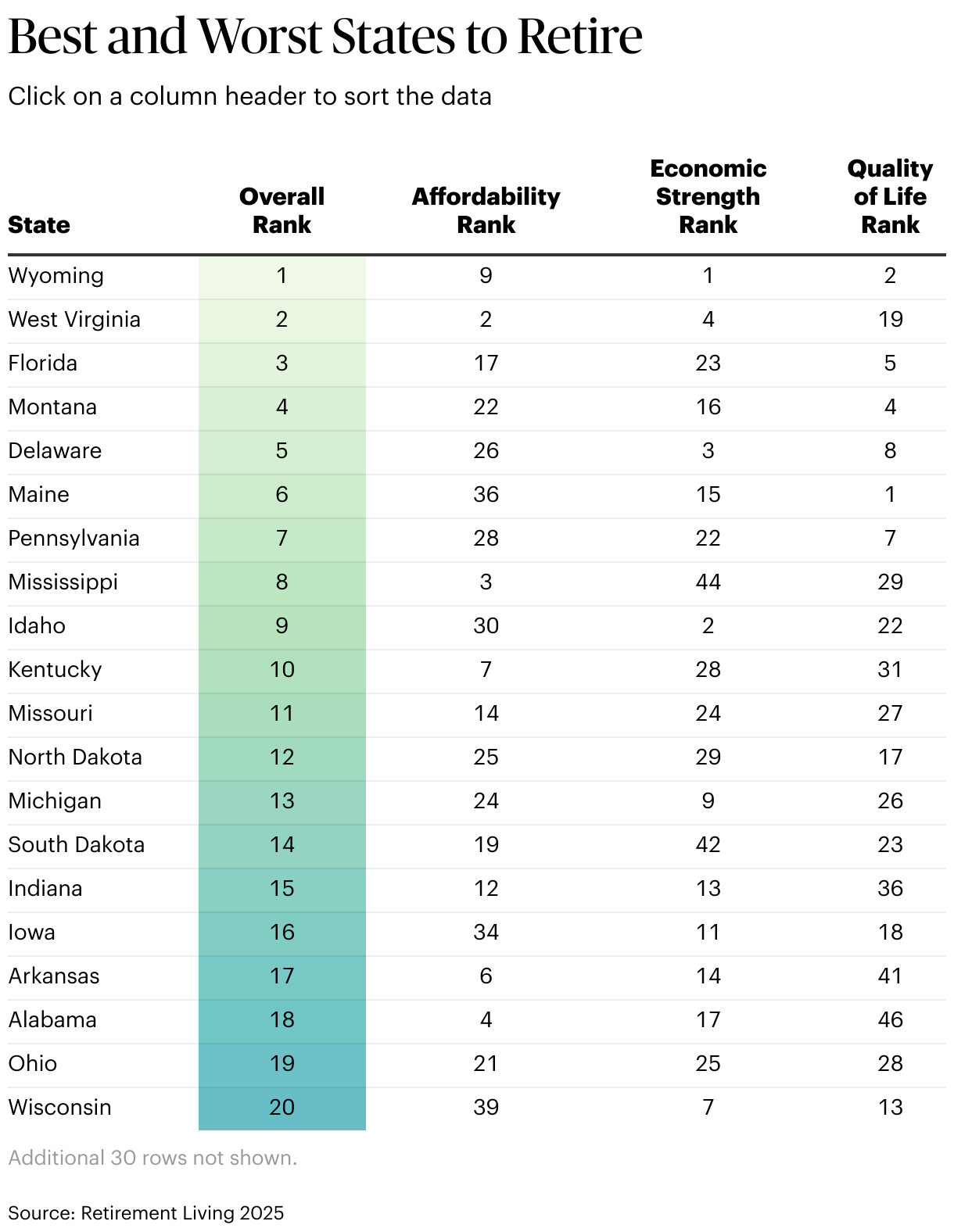
Here is a ranking of all 50 states based on how retirement-friendly they are, from most to least favorable:
Methodology
To determine the best and worst states to retire, the Retirement Living Research Team analyzed all 50 U.S. states using a 100-point scoring system across three key categories: quality of life, affordability, and economic strength. We assessed these dimensions through 15 specific metrics, each weighted based on its importance to retirement planning.
The rankings were built using reliable national data sources, including the U.S. Census Bureau, the CDC, the Tax Foundation, and other public datasets. The goal was to highlight states that offer the best overall value and experience for retirees.
Here’s how each category contributed to the final scores:
Quality of Life – Total Points: 60
- Well-Being Index (20 points)
- Percentage of Seniors (10 points)
- Number of Healthcare Facilities per 100,000 Seniors (9 points)
- Mild Summers (3 points)
- Mild Winters (3 points)
- Property Crime per 100,000 Residents (3 points)
- Violent Crime per 100,000 Residents (3 points)
- Walk Score (3 points)
- Park Score (3 points)
- Golf Courses per 1,000 seniors (3 points)
Affordability – Total Points: 30
- Savings Needed to Retire (20 points)
- State Income Tax (5 points)
- Property Tax (5 points)
Economic Strength – Total Points: 10
- Senior Poverty Rate (5 points)
- Percentage of Seniors Working Past 65 (5 points)
2024 vs 2025 Retirement State Rankings: What Changed
Our 2025 rankings reflect a fully redesigned methodology, moving away from the 2024 approach that equally weighted 13 metrics and incorporated direct retiree survey feedback. The chart below shows the full 2024 rankings for comparison and underscores how changes in methodology can significantly shift the way we evaluate the best states for retirement.

Reference Policy
We love it when people share our findings! If you do, please link back to our original article to credit our research.
Article Sources
- AARP. “New AARP Survey.” AARP. Evaluated Jun. 25, 2025.
- NeighborhoodScout. “About the Data: Crime Rates.” NeighborhoodScout. Evaluated June 13, 2025.
- Tax Foundation. “State Property Taxes.” Tax Foundation. Evaluated June 12, 2025.
- Bureau of Labor Statistics. “Consumer Expenditure Surveys Tables.” Bureau of Labor Statistics. Evaluated June 12, 2025.
- Sharecare. “CWBI State Rankings Report (2023).” Sharecare Well‑Being Index. Evaluated June 12, 2025.
- Weather Spark. “Weather Spark: The Weather Year Round Anywhere on Earth.” WeatherSpark.com. Evaluated June 12, 2025.
- Cost of Living Index. “Cost of Living Index.” COLI.org. Evaluated June 12, 2025.
- Centers for Disease Control and Prevention. “National Vital Statistics Reports, Volume 73, Number 7.” CDC. Evaluated June 12, 2025.
- Walk Score. “Walk Score: Walkability and Transit Scores.” WalkScore.com. Evaluated June 12, 2025.
- City Health Dashboard. “City Health Dashboard.” CityHealthDashboard.com. Evaluated June 12, 2025.
- United States Census Bureau. “County Business Patterns (CBP) Survey.” United States Census Bureau. Evaluated June 12, 2025.
- United States Census Bureau. “American Community Survey 5-Year Estimates (2022) — City Data Table.” data.census.gov. Evaluated June 12, 2025.
- United States Census Bureau. “Sex by Age by Employment Status for the Population 16 Years and Over (2023).” data.census.gov. Evaluated June 12, 2025.
- U.S. Census Bureau. “American Community Survey (ACS) Poverty Rate Data.” U.S. Census Bureau. Evaluated June 12, 2025.
Here’s how the Iran war could affect your retirement
Retirement Living takes an unbiased approach to our reviews. We may earn money when you click a partner link. Learn More
Here’s how the Iran war could affect your retirement
Market volatility and inflation are a bad combination


Updated:
key insights:
- Rising oil prices tied to the Iran war are pushing up everyday costs, hitting retirees on fixed incomes the hardest.
- Market volatility and slower economic growth are increasing the risk of losses for retirement savings.
- Social Security payments may rise in response to inflation—but likely not enough to offset higher living expenses.
As the conflict involving Iran ripples through global markets, economists warn that retirees may be among the most financially vulnerable groups in the United States. While the geopolitical stakes remain uncertain, the economic consequences are already taking shape—and they could have lasting implications for millions living on fixed incomes.
At the center of the economic fallout is energy. Oil prices have surged above $100 per barrel as supply routes face disruption and geopolitical risk intensifies.
That surge is feeding directly into inflation. Higher fuel costs increase transportation, manufacturing, and food prices, creating a broad rise in everyday expenses.
For retirees, that dynamic is especially painful. Unlike working households, most retirees rely on fixed income streams—such as Social Security or pensions—that don’t immediately adjust to rising costs. Even modest increases in gas, groceries, and utilities can significantly erode purchasing power over time.
Social Security may rise, but not enough
There is one potential upside: higher inflation could lead to larger cost-of-living adjustments (COLA) for Social Security recipients in the coming years. Analysts say sustained energy-driven inflation may push future benefit increases above earlier estimates.
However, experts caution that these adjustments often lag behind real-world price increases—and rarely cover the full extent of rising expenses.
In practical terms, retirees may see slightly larger monthly checks, but still find themselves falling behind as living costs climb faster.
Market volatility raises retirement risks
Beyond inflation, the war is also rattling financial markets. Stocks have already shown signs of stress, with major indexes declining amid fears of slower growth and higher costs.
That volatility poses a particular danger for retirees in or near the “fragile decade”—the years just before and after retirement—when withdrawals from investment accounts can lock in losses.
Economists warn that a prolonged conflict could increase the risk of “stagflation,” a combination of rising prices and slowing growth that historically weakens both stocks and bonds.
The war’s effects extend beyond markets and inflation. Businesses facing higher costs may reduce hiring or cut jobs, while consumer spending could weaken. Early data already shows slowing growth and rising cost pressures across key sectors.
For retirees, this broader slowdown can have indirect consequences—ranging from lower returns on investments to increased strain on public programs that support aging populations.
A disproportionate burden
Taken together, these forces suggest retirees will shoulder a disproportionate share of the economic burden. Rising costs, uncertain markets, and delayed income adjustments create a challenging environment—particularly for those without substantial savings.
Financial advisers emphasize that while global conflicts are unpredictable, the risks they pose to retirement security are not. Diversification, maintaining cash reserves, and avoiding panic-driven investment decisions remain key strategies in navigating turbulent times.
Still, as the Iran conflict continues to evolve, one reality is already clear: for retirees, the economic consequences are likely to be felt closer to home than the war itself.
One in five seniors seeking reverse mortgages face budget shortfalls, report finds
One in five seniors seeking reverse mortgages face budget shortfalls, report finds
Data suggest retirees turn to reverse mortgages when times are tough
Updated:

Key Insights
- About one in five seniors seeking reverse mortgages have budget deficits, according to new data from GreenPath Financial Wellness.
- Financial strain among older homeowners is worsening, with many unable to cover basic monthly expenses even before taking on new loans.
- Housing costs, inflation, and fixed incomes are driving demand for reverse mortgages as a last-resort financial tool.
Retirees often have most of their wealth tied up in their homes, and when times get tight, they sometimes tap into that equity. A new report from GreenPath Financial Wellness finds that a growing share of older Americans who explore reverse mortgages are already struggling to make ends meet, highlighting mounting financial pressure among retirees.
The nonprofit’s analysis found that roughly 20% of seniors exploring reverse mortgages have budget deficits, meaning their monthly expenses exceed their income. The findings suggest that many borrowers are not using the loans simply as a financial planning tool, but as a way to cope with existing financial hardship.
GreenPath’s data underscore a broader trend: financial strain among older households is intensifying. Many seniors live on fixed incomes that have failed to keep pace with rising costs for housing, health care, and everyday essentials. As a result, more homeowners are looking to tap into their home equity to bridge the gap.
How reverse mortgages are used matters
Reverse mortgages, which allow homeowners age 62 and older to convert home equity into cash without monthly loan payments, have long been marketed as a way to supplement retirement income. But experts caution that the product is often used as a last resort rather than a proactive strategy.
The report suggests that a significant portion of applicants are entering the process already financially vulnerable, raising concerns about long-term sustainability. Borrowers must still cover property taxes, insurance, and maintenance costs — expenses that can trigger foreclosure if unpaid.
Demand is rising
At the same time, demand for reverse mortgages appears to be rising again, driven in part by demographic shifts and economic pressures facing retirees. Millions of older Americans lack sufficient savings to weather unexpected expenses, pushing them to rely on home equity as a financial backstop.
The GreenPath findings highlight the delicate balance policymakers and financial counselors face: while reverse mortgages can provide needed cash flow, they may also expose already-strained seniors to additional risks if not carefully managed.
As the U.S. population ages and living costs remain elevated, the report points to a growing need for financial counseling and alternative solutions to help seniors maintain stability without jeopardizing their homes.
NCOA campaign aims to connect millions of seniors with unclaimed benefits
NCOA campaign aims to connect millions of seniors with unclaimed benefits
The seniors’ advocacy group is offering a tool to identify help
Updated:

Key Insights
- About nine million older Americans are eligible for critical benefits, but they aren’t receiving them.
- The National Council on Aging (NCOA) is promoting “Boost Your Budget Week” (April 13–17, 2026) to connect seniors with financial and health assistance programs.
- Advocates say these benefits — covering food, health care, and more — can be life-saving and add thousands of dollars annually to limited incomes.
The National Council on Aging (NCOA) has launched a campaign to focus attention on a persistent gap in the nation’s safety net: millions of older adults who qualify for assistance but never receive it.
The organization reports that nearly nine million older Americans are missing out on benefits that could help cover essential costs such as food, health care, and transportation.
The awareness campaign encourages seniors, caregivers, and community groups to use NCOA’s BenefitsCheckUp.org tool to identify and apply for programs they may qualify for.
“These benefits literally save lives,” said Josh Hodges, NCOA’s chief customer officer, noting that many eligible seniors either are unaware of the programs or mistakenly believe they don’t qualify.
High stakes
The stakes are high. NCOA points to research showing that adults aged 60 and older with very low incomes can have significantly shorter life expectancies than their higher-income peers.
More broadly, the organization estimates that over 17 million Americans age 65 and older are economically insecure, facing rising costs for housing, health care, and daily living expenses.
Programs highlighted during the campaign include the Supplemental Nutrition Assistance Program (SNAP), Medicaid, Medicare Savings Programs, and prescription drug subsidies — resources that can collectively save eligible seniors thousands of dollars each year.
The barriers
Despite their impact, enrollment barriers persist. Limited awareness, complex application processes, and misconceptions about eligibility often prevent seniors from accessing aid.
To address these challenges, NCOA works with a nationwide network of local organizations that provide benefits screening and enrollment assistance, while its online tool offers a free, confidential way for individuals to check eligibility in minutes.
Advocates say the campaign is not just about raising awareness but about improving long-term financial and health outcomes for older Americans living on fixed incomes.
Some scams target retirees more than others
Some scams target retirees more than others
A common thread is pressure on the victim to act quickly
Updated:

Photo by Getty Images on Unsplash
Key Insights
- Investment scams promise high returns — often involving cryptocurrency — but use fake accounts and statements to drain retirement savings.
- Government impostor scams mimic agencies like the IRS or Medicare, using threats or urgency to steal money or personal data.
- Romance scams build emotional relationships online before asking for money, frequently via gift cards or crypto.
Older Americans are among those who lose billions of dollars each year to increasingly sophisticated scams, but data suggest they may be the most vulnerable population group. Scammers target them because they are thought to be easy prey, and many have significant assets.
Seniors and retirees should be particularly aware of financial scams, even more dangerous now with criminals deploying artificial intelligence, impersonation tactics, and psychological manipulation to target retirement savings.
The scope of the problem is growing rapidly. In 2024 alone, adults 60 and older reported $2.4 billion in losses to the Federal Trade Commission, a 26% increase from the previous year, with many cases involving six-figure losses.
In addition to targeting seniors for their financial assets, fraudsters are also leveraging advanced tools such as deepfake audio and highly convincing phishing messages to make their schemes harder to detect.
Investment scams drain retirement funds
Among the most costly schemes are investment scams, which lure victims with promises of high returns and little risk. With many retirees worrying that they will outlive their money, criminals often pose as financial advisers and encourage seniors to move money into fraudulent accounts, sometimes tied to cryptocurrency ventures.
Victims may receive realistic-looking account statements showing steady gains, reinforcing the illusion of legitimacy, until the money is gone. This is a tactic that convicted scammer Bernie Madoff employed for decades, until he was exposed in the 2008 financial crisis.
Government impostors exploit fear
Another common tactic involves impersonating government agencies such as the IRS, Social Security Administration, or Medicare. Scammers may claim unpaid taxes, account problems, or benefit disruptions, often threatening arrest or loss of coverage to pressure immediate action.
These schemes frequently rely on spoofed phone numbers, fake emails or AI-generated voices to appear authentic.
Loneliness is another weakness scammers try to exploit, especially after the loss of a spouse. Romance scams target emotional vulnerability. Fraudsters build online relationships over weeks or months, often claiming to live far away or avoiding video calls. Once trust is established, they request money for emergencies, travel, or medical needs.
Payments are typically requested through hard-to-trace methods such as gift cards or cryptocurrency, making recovery nearly impossible.
Tech-support scams hijack devices
Another major category involves tech-support scams, which begin with alarming pop-up messages warning of computer problems. Victims are urged to call a number where scammers pose as technicians.
Once granted remote access, criminals install spyware or keyloggers to capture passwords, banking information, and other sensitive data.
Authorities warn that these scams are becoming more convincing as technology evolves. AI tools now enable fraudsters to mimic trusted voices, generate realistic documents, and scale their operations across email, phone, and social media.
The common thread across all scams is urgency — scammers push victims to act quickly, bypassing verification and critical thinking.
How to protect against scams
Senior advocates recommend several precautions: independently verify any unsolicited contact, avoid sending money via gift cards or cryptocurrency, and consult trusted family members or financial institutions before making large transactions.
Victims are also urged to report incidents to the FBI’s Internet Crime Complaint Center and the Federal Trade Commission, and to secure accounts immediately if fraud is suspected.
As scams grow more sophisticated, the best defense remains awareness — understanding how these schemes work can help seniors and their families recognize red flags before financial damage is done.
The average Social Security benefit at 70 — and what it really tells you
The average Social Security benefit at 70 — and what it really tells you
The ‘average’ benefit might not apply to you
Updated:

Key Insights
- The average 70-year-old retiree collects far more than early claimers — but the headline number hides a wide gender gap.
- Waiting until 70 can boost benefits by roughly 24% over full retirement age, yet many retirees still claim early.
- The real takeaway isn’t just “wait longer” — it’s understanding who actually benefits most from waiting and why.
Recent data from the Social Security Administration show how much larger Social Security checks become at age 70 — but also how uneven those gains are.
Men who wait until 70 collect about $3,334 per month on average, while women receive around $2,691.
That’s not a trivial gap. It reflects decades of differences in earnings, career length, and wage growth — all of which feed directly into how Social Security benefits are calculated.
Even more revealing: the underlying “baseline” benefit (before delayed credits) is much lower — around $2,516 per month — meaning the decision to delay plays a major role in boosting income.
Why 70 is the peak — and why it matters
Social Security is structured to reward patience. Benefits grow roughly 8% per year after full retirement age (up to 70) thanks to delayed retirement credits.
That’s why age 70 produces the highest average benefit of any claiming age. Compared with claiming at 62, the difference can easily exceed $800 per month in average payouts.
But here’s the catch: maximizing the monthly check doesn’t automatically mean maximizing your lifetime benefit.
‘Average’ can be misleading
Most coverage of Social Security focuses on the simple math: wait longer, get more. That’s true — but incomplete.
A more useful takeaway for people nearing retirement is this: The value of waiting depends heavily on your personal profile.
- Longevity matters more than income. If you live longer than average, delaying to 70 can pay off handsomely. If not, you may collect less overall.
- Women often benefit more from waiting — despite lower averages. Women live longer on average, which means they’re more likely to collect those larger checks for more years.
- High earners gain the most from delaying. Because benefits are tied to your highest 35 years of earnings, those with high incomes see larger absolute increases.
- Behavior matters as much as math. Research shows many retirees claim early even when it’s suboptimal, often due to fear of running out of money or a desire for immediate income.
The average numbers themselves can be misleading for planning. Even at age 70, a roughly $2,500–$3,300 monthly benefit may not fully cover expenses — especially with rising health care and housing costs. And while 2026’s average benefit sits just above $2,000 overall, many retirees rely on Social Security for the majority (or all) of their income.
That creates a critical planning gap: People often anchor on averages instead of calculating their own benefit and needs.
What near-retirees should do differently
If there’s one practical takeaway, it’s this:
Stop thinking in terms of “the best age” — and start thinking in terms of your break-even and lifestyle:
- Estimate your personal benefit at 62, full retirement age, and 70
- Compare that against expected expenses and life expectancy
- Factor in spousal benefits and survivor needs
- Consider whether delaying improves security, not just income
Because the real decision isn’t about hitting the highest monthly number — it’s about building the most reliable income stream for your specific retirement.
Delaying benefits is powerful, but only if it aligns with your health, income history, and risk tolerance. For many retirees, the biggest mistake isn’t claiming too early — it’s assuming the “average” applies to them.
How to stay socially active in retirement
How to stay socially active in retirement
Without going to work every day, it’s easy to become isolated
Updated:

Key Insights
- Stay connected through regular routines like weekly calls, group meetups, or community events.
- Explore new interests or revisit old hobbies that involve other people.
- Use technology as a bridge — not a barrier — to maintain relationships.
Many retirees find ending the daily grind of going to work to be exhilarating – at first. However, life transitions such as retirement, relocation, or the loss of friends and family can gradually shrink social circles.
Without intentional effort, isolation can set in, bringing not just loneliness, but real risks to mental and physical health. The good news is that meaningful connection is still very much within reach, and often easier to build than it seems.
Be proactive
Geriatric specialists say one of the most effective ways to stay socially engaged is to create structure around connection. Rather than waiting for social opportunities to arise, plan them.
A weekly coffee with a neighbor, a standing phone call with a family member, or a recurring club meeting can provide something to look forward to and help maintain a sense of rhythm. These small, consistent interactions often matter more than occasional large gatherings.
Community involvement is another powerful antidote to isolation. Local senior centers, libraries, religious organizations, and volunteer groups offer not just activities, but a sense of belonging.
Volunteering, in particular, adds an extra layer of purpose. Whether it’s mentoring, helping at a food bank, or participating in community projects, contributing to others fosters connection and reinforces self-worth.
Try something new
Hobbies also play a key role — especially those that bring people together. Group exercise classes, book clubs, gardening groups, or art workshops create natural opportunities for conversation and shared experience. Even if trying something new feels intimidating at first, it often leads to unexpected friendships.
Technology, while sometimes seen as a barrier, can actually be a powerful tool for staying connected. Video calls, social media, and messaging apps make it easier to maintain relationships across distance.
The key is to approach technology with curiosity rather than hesitation. Many communities offer basic tech classes specifically for older adults, making it easier to learn at a comfortable pace.
Download a rideshare app
Transportation can be a hidden obstacle to social activity, so it’s worth exploring options. Community shuttles, rideshare services, or coordinating rides with friends can make outings more accessible. Removing logistical barriers often opens the door to more consistent engagement.
It’s also important to recognize that staying socially active doesn’t always mean being busy. Meaningful connection can come from simple interactions — a chat with a neighbor, a conversation at the grocery store, or a shared moment at a park. Quality matters more than quantity.
Finally, it’s okay to take the first step. Reaching out can feel vulnerable, especially after periods of isolation, but many others are in the same position and equally open to connection. A simple invitation or conversation starter can be the beginning of something lasting.
Social connection is not just a luxury — it’s a cornerstone of healthy aging. With a bit of intention and openness, older adults can build and maintain vibrant, supportive social lives that enrich every stage of life.
Seniors group predicts a 2.8% Social Security benefit increase for 2027
Seniors group predicts a 2.8% Social Security benefit increase for 2027
The COLA, based on inflation, will be announced in October
Updated:

Photo by Volodymyr Hryshchenko on Unsplash
Key Insights
- Social Security’s 2027 cost-of-living adjustment (COLA) is projected at 2.8%, matching the 2026 increase.
- A new proposal would cap annual benefits at $50,000 per person, or $100,000 per couple.
- Advocacy groups warn the cap could effectively cut benefits for some retirees and faces strong opposition among seniors.
A modest increase in Social Security benefits could be on the horizon for retirees, but a controversial proposal to cap payments is stirring debate.
The 2027 cost-of-living adjustment won’t be announced until mid-October, but the Senior Citizens League (TSCL), a nonpartisan advocacy group, said its latest analysis of inflation data suggests the 2027 COLA will be 2.8%. That would match the 2026 increase and translate into an average monthly boost of about $56.69 for retired workers.
While any increase is typically welcomed by beneficiaries, TSCL says the projected adjustment underscores a larger concern: rising costs for essentials like housing and health care continue to outpace benefit growth, leaving many seniors financially strained.
$50,000 cap?
At the same time, policymakers and budget experts are exploring ways to shore up Social Security’s long-term finances. One proposal gaining attention — dubbed the “Six Figure Limit” — would cap annual benefits at $50,000 for individuals and $100,000 for couples.
The plan, put forward by the Committee for a Responsible Federal Budget, aims to address a projected funding shortfall that could otherwise lead to automatic benefit cuts of roughly 24% in the early 2030s if Congress takes no action.
Supporters argue the cap would primarily affect higher-income retirees and could close a significant portion of the program’s long-term deficit. Estimates suggest it could eliminate about three-fifths of the funding gap over the next 75 years.
The argument against it
But critics, including TSCL, say the proposal amounts to a benefit cut for some retirees and could have bigger consequences over time. The group’s research indicates strong resistance among older Americans: 95% oppose cuts to current retirees’ benefits, and two-thirds oppose cuts for future beneficiaries.
Advocates for seniors also argue that there are alternative ways to strengthen Social Security without reducing benefits. One commonly cited option is eliminating the cap on taxable earnings — currently set at $184,500 — so higher-income workers contribute more to the system.
TSCL Executive Director Shannon Benton emphasized that approach, saying policymakers should focus on “strengthening America’s pension system” rather than reducing benefits for those who have paid into it over their working lives.
The actual COLA is based on inflation data for July, August, and September.
Identity theft losses surge among older Americans
Identity theft losses surge among older Americans
Scammers target them because they tend to have savings and good credit
Updated:

Key Insights
- Older Americans lost $7.7 billion to scams in 2025, with identity theft losses rising about 70% year over year.
- Adults 60+ suffered $3.4 billion in identity-theft-related losses in 2023, and losses tend to be higher per victim than in younger groups.
- Nearly 84% of Americans believe seniors are highly vulnerable to online scams and identity theft.
Older Americans are losing billions of dollars each year to identity theft and related scams, as fraudsters increasingly target retirees and seniors with sophisticated schemes.
Recent data show that Americans 60 and older lost an estimated $7.7 billion to scams in 2025, with identity theft losses rising sharply — by as much as 70% year over year. Earlier figures indicate that seniors accounted for $3.4 billion in identity-theft-related losses in 2023, with higher average losses per victim than any other age group.
Investigators say the trend reflects a troubling dynamic: while older adults may experience fewer identity theft incidents overall, the financial damage is often far greater.
Bigger targets, bigger losses
Seniors are particularly attractive targets because they tend to have more savings and established credit. When fraud happens, the losses can be devastating.
Criminals often focus on high-value accounts such as retirement funds, bank accounts, and investment portfolios. In addition, older adults may be less familiar with rapidly evolving online scams, making them more vulnerable to deception.
Public perception mirrors the data. Surveys show that a large majority of Americans — about 84% — believe seniors are especially susceptible to online fraud and identity theft.
Common schemes
The most frequent forms of identity theft affecting older Americans include:
- Credit card fraud is the most common type
- Bank account takeovers, where criminals gain direct access to funds
- Medical identity theft, involving stolen Medicare or Social Security information
Fraudsters often rely on impersonation tactics, posing as representatives from government agencies, financial institutions, or tech companies. These scams frequently involve urgent demands — such as threats of account suspension or legal action — to pressure victims into revealing sensitive information or sending money.
How to stay protected
Consumer advocates say awareness and basic precautions can significantly reduce risk.
Among the most effective steps:
- Guard personal information: Never share Social Security, Medicare, or financial details in response to unsolicited calls, emails, or texts.
- Monitor financial activity: Regularly review bank and credit card statements for suspicious transactions.
- Use security tools: Enable two-factor authentication and consider placing a credit freeze to prevent unauthorized accounts.
- Watch for warning signs: Be skeptical of messages that create urgency or request unusual payment methods like gift cards or wire transfers.
Experts also encourage older adults to consult trusted family members or advisors before making major financial decisions, especially when responding to unexpected requests.
Authorities urge victims or those who suspect identity theft to report incidents promptly through federal resources such as IdentityTheft.gov or the FBI’s Internet Crime Complaint Center.
As identity theft continues to evolve, officials stress that vigilance remains the best defense, particularly for older Americans, who face some of the highest financial stakes.
The Woodstock Generation may not be that eager to retire
The Woodstock Generation may not be that eager to retire
The author cites examples of older adults’ continuing contributions
Updated:

Photo by Age Cymru on Unsplash
Key Insights
- Baby Boomers are living longer, healthier lives, creating a “longevity revolution” that challenges traditional ideas of retirement.
- Experts say society is underutilizing the experience and knowledge of older adults, treating them as a burden instead of a resource.
- A new book and organization aim to help older Americans find purpose, remain engaged, and continue contributing beyond traditional careers.
Baby Boomers, who grew up with better health care than their parents, are living longer, and that’s reshaping how Americans think about aging, retirement, and the role of older adults in society.
Vicki Thomas, author of the book From Woodstock to Wisdom, and one of the first members of the Baby Boom generation to turn 80, is raising a conversation that reaches far beyond retirement planning.
The U.S. Census Bureau projects that by 2030, all Baby Boomers will be at least 65 years old, totaling roughly 73 million people. A growing share of that group is expected to remain healthy and engaged for decades beyond traditional retirement age.
But while lifespans are increasing, the systems built around retirement have not kept pace, the author argues. Institutions designed for shorter lives are struggling to absorb what it describes as a surge of “energy, capacity, and accumulated knowledge” among older adults.
Changes in how aging is viewed
Thomas’ book advocates for a shift in how society views aging, from decline to continued contribution.
Thomas argues that sidelining older adults comes at a cost. Younger generations lose access to mentorship, communities miss out on leadership, and older individuals themselves may lose a sense of purpose — something research has linked to better health and longevity.
Her organization, My Future Purpose, offers programs such as discussion groups, workshops, and coaching aimed at helping older adults redefine their next chapter. The initiative promotes multiple “pathways to purpose,” including volunteering, entrepreneurship, advocacy, and pursuing long-held interests.
The broader message reflects a growing national conversation: longer lives are not just a medical achievement, but a social and economic shift.
