Best Rideshare Services for Seniors
Retirement Living takes an unbiased approach to our reviews. We may earn money when you click a partner link. Learn More
Best Rideshare Services for Seniors
Safe, convenient, and accessible transportation designed to support seniors’ mobility and independence



Updated:
Traveling and getting around town can be a hassle at any age, but many people find they are less willing to navigate traffic as they get older. For some, the places we need to go are just a short car ride away. If you’re traveling long distances, that short car ride is preceded by a cross-country flight. Whether you’re apprehensive about driving due to health concerns or simply don’t want to make the drive yourself, a rideshare company can be a convenient alternative.

GoGoGrandparent is a concierge service for older adults. One of the main offerings is a meal delivery service that helps older adults and people with disabilities order food and maintain a healthy diet through area restaurants without the need to cook. By partnering with services like DoorDash, it allows users to request deliveries via a simple phone call (no smartphone or app needed) making it easier for seniors to access meals.
- Great for hassle-free transportation and deliveries
- No app or smartphone required
- Safety features and caregiver monitoring available
About Rideshare Services
According to a Pew Research Study, only eight percent of adults ages 50-64 and four percent of adults ages 65 andor older have used a rideshare service or transportation program like Uber or Lyft. With user-friendly apps, widespread availability, competitive pricing, and even senior-focused options, rideshare companies can help older adults stay mobile and independent.
With that, rideshare and paratransit services must comply with the Americans with Disabilities Act and ADA-compliant vehicles, ensuring accessibility for riders with limited mobility, and many seniors rely on Medicaid or Medicare Advantage to help cover the cost of non-emergency medical transportation.
If you prefer not to use a smartphone app or require additional assistance with public transportation, there are rideshare services designed specifically with older adults in mind.
Popular Rideshare Services Reviews
GoGoGrandparent Review
Great for hassle-free transportation and deliveries
|
his service offered by GoGo, allows users to call a single phone number to request an Uber or Lyft ride, eliminating the need to create an account and use a smartphone app. Once you call the number you can:
- Press 1 to request a car to your home
- Press 2 to request a car to pick you up where your last drop off was
- Press 3, 4, or 5 to schedule a custom pickup location
- Press 6 to schedule a ride with an operator
Users can add custom locations book rides that are recurring for medical appointments or future travel dates, and opt to send real-time text message updates to caregivers or family members. GoGoGrandparent partners with rideshare companies to provide non-emergency medical transportation (NEMT), helping seniors get to appointments safely without needing to drive themselves.
GoGoGrandparent chargers a per-minute service fee in addition to the standard Uber or Lyft fare, with pricing subject to change.
Estimated airport cost with GoGoGrandparent: $20–$40*, depending on ride length and service fees
Uber Review
Great for on-demand rides and everyday transportation
|
Uber pricing varies by location, demand, and ride type, but fares typically include a base rate plus per-mile and per-minute charges that fluctuate throughout the day. If your destination is within 15-20 miles of your home or the airport, the fare is often relatively affordable compared to traditional taxis.
Uber is widely available across most U.S. cities and offer multiple ride options, including luxury vehicles and larger cars for groups of four or more passengers. Drivers undergo background checks and ongoing safety screenings, though requirements may vary by state and city.
The mobile app is generally user-friendly and allow riders to sign up using a phone number and link a payment method such as a credit card or digital wallet. Payment is processed automatically after the ride, and the app allows riders to split fares, add tips, and receive digital receipts.
Healthcare providers also use Uber Health to arrange safe, reliable rides for patients who need transportation to medical appointments.
Estimated airport cost with Uber: $15–$25*, depending on location and demand
Lyft Review
Great for affordable rides with flexible options
|
Lyft pricing is similar to Uber’s and varies by city, demand, and ride type, with per-mile and per-minute charges that fluctuate throughout the day.
Lyft is similar to Uber in that it is avaiable across multiple U.S. cities. They also have their drivers undergo similar background checks to Uber.
Lyft’s mobile app allows for contactless payment methods, along with splitting fares, tip drivers, and get a digital receipt from the ride.
Estimated airport cost with Lyft: $15–$25*, depending on location and demand
uberASSIST Review
Great for riders who need extra assistance and accessible support
|
uberASSIST was designed to support riders who need additional assistance, though availability has become limited in many markets. When available, uberASSIST vehicles can typically accommodate folding wheelchairs, walkers, and collapsible mobility devices. They don’t, however, have ramps or lifts.
Drivers receive basic training on assisting riders with mobility challenges, though services such as lifting or medical assistance are not guaranteed. For example, they can help transfer you to and from your wheelchair. Pricing is generally similar to standard Uber rides, though fees and availability may vary by location.
Estimated airport cost with uberASSIST: $20–$50*, depending on location and demand
Lift Hero Review
Great for door-to-door assistance and senior-friendly transportation
|
Lift Hero is a senior-focused transportation service available for in select areas, including parts of California.
Clients can schedule a ride through Lift Hero’s website, either in advance or on the spot, and may have the option to request a preferred driver when available.
Lift Hero emphasizes specialized drivers training, including basic safety and customer service, and many drivers have healthcare-related backgrounds. Drivers are typically required to have first aid and CPR certifications to provide additional peace of mind for riders, loved ones, and family members. Lift Hero is a paratransit provider of door-to-door service, meaning drivers help riders to and from the vehicle and can assist with bags from the grocery store; drivers can also wait during doctor’s appointments if requested.
Lift Hero’s pricing is typically hourly, with a minimum charge and additional time billed if the driver waits during medical or home care appointments; exact rates vary by region and service level.
Estimated airport cost with Lift Hero: $35 per hour*, depending on distance and service time
* based on a distance of 15-20 miles
Benefits of Using a Rideshare Service
As people age, changes in mobility, vision, and hearing can make driving more difficult and may eventually lead to giving up driving altogether. However, using a rideshare service can help maintain independence and freedom, even if you no longer drive.
In fact, budgeting for rideshare services instead of owning a car may be more convenient and cost-effective as you get older. Beyond travel, rideshares and ride-hailing apps eliminate the stress of parking and traffic for activities like dining out, attending concerts, or going to appointments from the senior centers.
According to a report from the insurance comparison site QuoteWizard, relying on rideshare services is becoming increasingly competitive with the costs of car ownership. The report estimates that, by 2027, relying entirely on rideshares could be more affordable than maintaining a personal vehicle. Although owning a car may still be less expenseive in some cases, the annual cost of rideshare use is steadily approaching that of car ownership.
| Average Annual Cost of a Car* | Average Annual Cost of a Rideshare Service** |
|---|---|
| Car Payment: ~$1,130 per year (5-year loan with 15% down) | Daily Rideshare Trip in Seattle: ~$25.30 |
| Cost of Gas: ~$2,235 per year (13¢ per mile average in the U.S.) | Daily Rideshare Trip in Denver: ~$24.90 |
| Cost of Auto Insurance: ~$1,694 per year (full-coverage policy) | |
| Cost of Maintenance/Repair: ~$1,656 per year (11.04¢ per mile per 15,000 miles) | |
| Cost of Depreciation: ~$4,334 per year | |
| Registration, License, & Taxes: ~$813 per year | |
| Total = ~$11,862 | Total (Seattle) = ~$9,235 Total (Denver) = ~$9,080 |
* Averages based on 15,000 miles driven per year in a midsize SUV (AAA and Insure.com)
** Source: QuoteWizard report
Rideshare costs could decrease further in the future if companies successfully and safely implement driverless vehicles.
Frequently Asked Questions (FAQs) About Rideshare Services
Rideshares are on-demand transportation services that let users use a smartphone app to book a ride. Businesses like Uber and Lyft provide a practical alternative for driving, public transportation, or taxis by matching passengers with local drivers. Standard car rides, wheelchair-accessible or luxurious options, and even non-emergency medical transportation through partnerships with healthcare providers are all examples of rideshares.
For seniors, the best rideshare app depends on comfort with technology and mobility needs. Uber and Lyft are widely available and easy to use for most everyday trips, but they require a smartphone and app setup. For those who prefer phone‑based booking or extra assistance, GoGoGrandparent is often a better choice, as it lets users schedule Uber or Lyft rides by phone without needing the apps. For riders needing more personalized care, like help getting to the door or assistance with bags, specialized services like Lift Hero (in select areas) can be ideal. The “best” option is one that matches a senior’s tech comfort, location, and level of support needed.
uberASSIST is typically referred to as the senior version of Uber. This service is intended for riders who require additional help, such as those who use walkers, folding wheelchairs, or other mobility aids. The cars are outfitted to offer a more accessible and comfortable experience than a typical Uber ride, and drivers are trained to assist passengers in getting in and out of the vehicle safely.
GoGoGrandparent can be safe for seniors who need help booking rides without using a smartphone, as it works with licensed Uber and Lyft drivers and offers 24/7 phone support and real‑time ride monitoring to help seniors get to their destinations. GoGo operators can assist with scheduling, watch for cancellations, and update families on trips, which adds a layer of support beyond a standard app‑based service.
However, reliability and customer experiences vary (some users report issues with pricing, membership handling, and ride availability) so it’s important to compare costs and read service terms carefully before signing up.
Yes, most rideshare services offer convenient pick‑up times and flexible locations. Apps like Uber, Lyft, and GoGoGrandparent let you request a ride quickly from almost anywhere with just a few taps or a phone call, and drivers typically arrive within minutes. For scheduled trips (such as airport rides or appointments), many services let you book in advance so you can choose the time and location that works best for you.
The top rideshare options for seniors who need extra assistance include services that go beyond standard app‑based rides. Uber’s UberASSIST offers drivers trained to help with mobility needs and folding wheelchairs, while GoGoGrandparent lets seniors book Uber or Lyft rides by phone without using a smartphone. In select areas, services like Lift Hero provide specially trained drivers who offer door‑to‑door support and assistance with bags or groceries. These options combine convenient ride‑hailing with extra help for seniors who need it most.
Bottom Line: Rideshare Services Are Convenient and Easy to Use
If you are unable to drive or find yourself not wanting to deal with traffic and parking, you have transportation options. Whether you’re traveling for the holidays, going on vacation, or running everyday errands, rideshare services can help you remain mobile and independent. Along with rideshare services, several nonprofit organizations provide local transportation programs for senior care and people with disabilities who cannot easily access traditional rideshare services.
Aging in Place or Assisted Living Facility: Where do Retirees see Themselves Living?
Retirement Living takes an unbiased approach to our reviews. We may earn money when you click a partner link. Learn More
Aging in Place or Assisted Living Facility: Where do Retirees see Themselves Living?
Surveying how adults 50+ plan to age in place versus moving to assisted living and the factors influencing their choices.



Updated:
At a glance:
- Just over 80 percent of respondents say they plan on living at home as they age.
- 75 percent of people said failing health is the leading push factor that would cause them to move into an assisted living facility, up about 25 percent from 10 years ago. The second biggest push factor is the loss of the ability to drive at 30 percent.
- Most people want to stay in their home or community because it’s near places they frequent (grocery stores, doctor’s offices, libraries, etc.), with over 80 percent saying it’s important or extremely important.
Our goal with this study is to get a glimpse into where people plan on living as they age, in particular, do they want to age in place, that is, stay in their own home and community, or do they want to live in an assisted living facility. To do so, we asked over 2,300 adults ages 50 and older questions about where they plan on living as they get older and what they’ll do to make it as easy as possible.
We dug into the response data and found that while most people want to remain in their own home and community for as long as possible and are willing to use technology and home remodeling to do so, there are factors that would push them to move into an assisted living facility.
Whatever stage in life you find yourself in, be sure to check out our aging in place resources and assisted living and home health care guides. Guides are broken down by city and state to help narrow down your search.
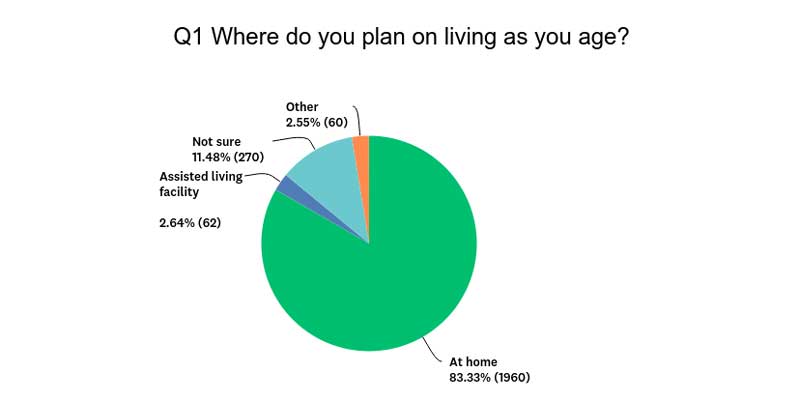
1. 83 percent of people plan on living at home as they age and are willing to remodel and use technology to do so
Analyzing the survey data for the question about where people plan on living as they age showed just over 83 percent of people plan on living at home followed by around 11 percent saying they’re not sure. A little more than two and a half percent of respondents (62 people) said they plan on living in an assisted living facility. It’s worth noting that assisted living facilities are less restrictive than nursing homes. Many assisted living facilities offer care on an “as-needed” basis but allow you to come and go as you please, while nursing homes focus on full-time medical-based care and come with less freedom.
1a. Most people want to stay in their home and community because it’s familiar. We asked how important six factors were when it comes to staying in your current home and community: being near work, being near transit, how easy it is to walk to nearby places, being near church or social organizations and being near areas you frequent (grocery store, doctor’s office, library, etc.). While the data shows most categories we asked about are important, being near work was not very important, showing most people don’t plan on working as they get older or don’t need to adjust their living situation based on a job.
A little more than 80 percent of people said being near places they frequent like grocery stores and doctors offices were important to important, followed by being near friends and family (68 percent).
Based on these results it seems the number of assisted living facilities in a community or close to a community where one lives might make the idea of transitioning into an assisted living community a little more attractive to people.
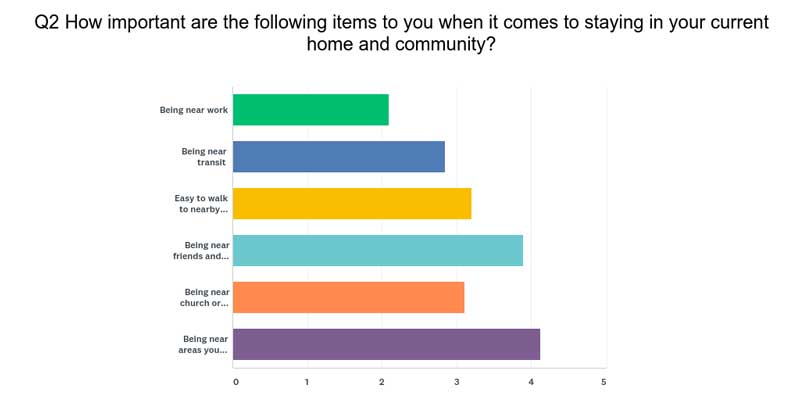
* 1 – Not At All Important, 2 – Not Very Important, 3 – Somewhat Important, 4 – Important, 5- Extremely Important
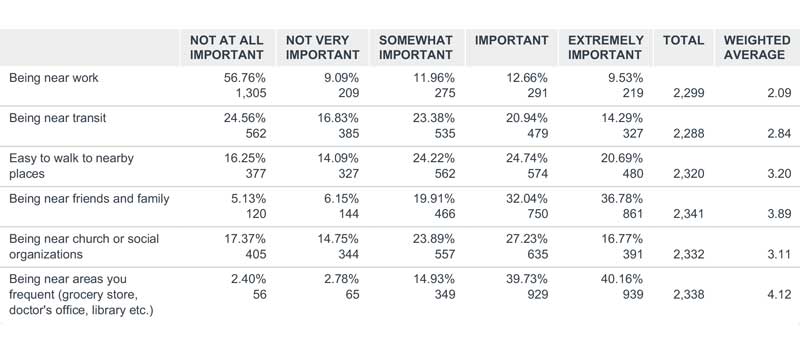
Source: Retirement Living
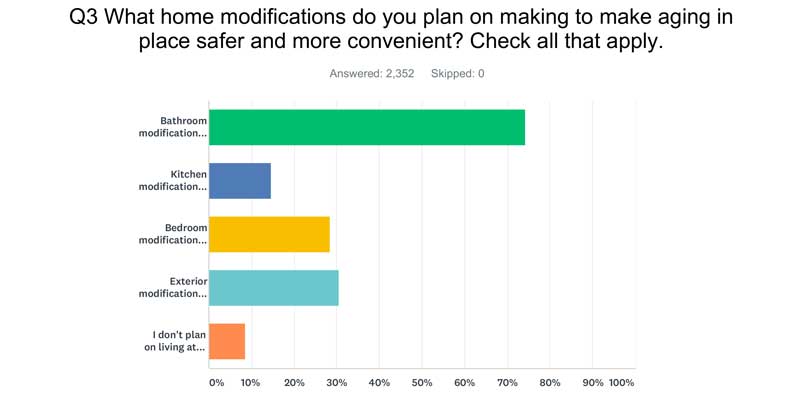
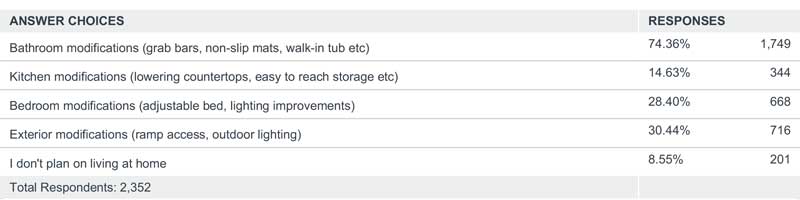
1b. Most people recognize the need for a little help when it comes to making aging in place safer and more convenient. When asked about what home modifications they plan on making to accommodate aging in place, nearly 75 percent of people plan on making some sort of modification to their bathroom. This could mean small changes like adding grab bars and non-slip mats or larger changes like installing a walk-in bathtub.
Around 30 percent of respondents also plan on making modifications to their bedroom and the exterior of their home, adding things like an adjustable bed, ramp access and improved interior and exterior lighting.
It’s interesting to note around 200 of our 2,352 respondents don’t plan on making any home modifications as they age.
1c. Finally, we see that people are starting to consider the use of technology to make aging in place easier and more convenient. Overall the response data shows the majority of people still aren’t sure about using technology to help with aging in place with all but one category averaging in the “I don’t know” range. However, the trend leans slightly towards the “likely” and “very likely” categories as opposed to the opposite end of the scale.
Of the six technologies we asked about: medical alert systems, grocery/food delivery services, ride-share apps (Uber, Lyft), activity monitoring systems, online pharmacies and stair lifts, most people either weren’t sure or were likely to use technology to help with aging in place. This shows an upward trend compared to 10 years ago when people weren’t sure and leaned towards not being likely to use technology. The chart below shows a snapshot of the upward trend.
| Technology | Weren’t Sure | Likely/Very Likely | Total |
|---|---|---|---|
| Medical Alert Systems | 31.01% | 39.12% | 70.13% |
| Grocery/food Delivery Services | 22.51% | 40.73% | 63.24% |
| Ride-share Apps | 21.63% | 31.21% | 52.84% |
| Activity Monitoring Systems | 27.56% | 30.91% | 58.47% |
| Online Pharmacies | 14.59% | 53.45% | 68.04% |
| Stairlift | 21.26% | 10.98% | 32.24% |
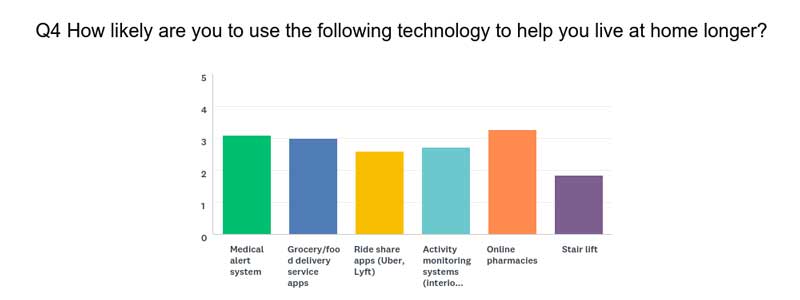
*1 – Not Likely, 2 – Somewhat Likely, 3 – I Don’t Know, 4 – Likely, 5 – Very Likely
Source: Retirement Living
2. Home health care edges out assisted living facilities when it comes to not being able to live alone
Survey data shows that having part- or full-time in-home care is preferable over moving into an assisted living facility if you could no longer take care of yourself. When asked what they would do if they could no longer live on their own, 52 percent of respondents said they would stay in their home and have a part- or full-time caregiver. Thirty percent said they would move into an assisted living facility, followed by wanting to move in with a family member (just over 16 percent) and moving into a nursing home (a little more than one and a half percent).
Survey data shows that having part- or full-time in-home care is preferable over moving into an assisted living facility if you could no longer take care of yourself. When asked what they would do if they could no longer live on their own, 52 percent of respondents said they would stay in their home and have a part- or full-time caregiver. Thirty percent said they would move into an assisted living facility, followed by wanting to move in with a family member (just over 16 percent) and moving into a nursing home (a little more than one and a half percent).
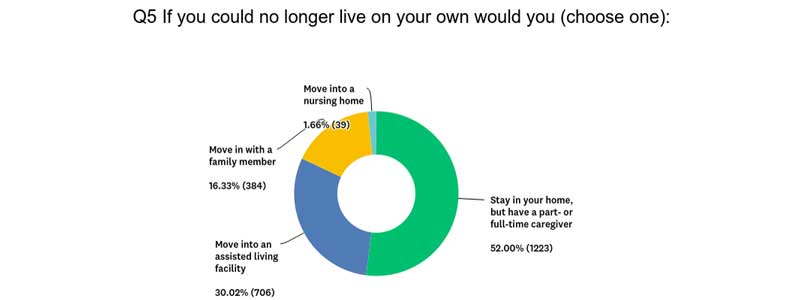
We compared these numbers with a 2016 Pew Research Center study. Below is a side-by-side comparison of the two sets of data.
| Statement | Retirement Living Study (2018) | Pew Research Study (2016) |
|---|---|---|
| Stay in home with a caregiver | 52% | 61% |
| Move into assisted living facility | 30% | 17% |
| Move in with family/friends | 16% | 8% |
| Move into nursing home | 1.6% | 4% |
3. Failing health is the biggest push factor that would cause people to move into an assisted living facility
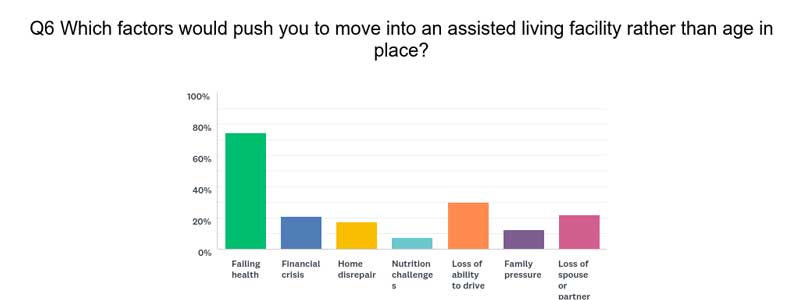
When asked which factors would push them to move into an assisted living facility rather than age in place, nearly 75 percent of respondents said failing health would be the leading factor. This is still the same leading push factor from 10 years ago but up about 25 percent.
The data shows the factors that have the most push are those that cause the individual to lose some form of independence. Following failing health, the loss of the ability to drive (almost 30 percent) and a financial crisis (just over 20 percent) are top factors that would cause someone to move into an assisted living facility.
It’s important to note that loneliness may be a strong push factor for some, with 514 respondents saying the loss of a spouse or partner would cause them to move into an assisted living facility.
Key Findings
It’s important for most people to remain in their current home and community as they age. This is because people like being near friends and family and areas they frequent like grocery stores, doctor’s offices, libraries, etc. The more assisted living facilities within a community may make the idea of moving a little more attractive.
People plan on making home modifications to remain in their home as they age – mainly the bathroom. Installing things like grab bars, non-slip surfaces and walk-in tubs provide peace-of-mind for adults who are aging in place. Many people also said they plan on making bedroom modifications like adding an adjustable bed and exterior modifications like installing a ramp and better lighting to make aging in place easier.
The use of technology to make aging in place easier seems to be playing more of a factor than it did 10 years ago. While most people are still unsure about how much they’ll use things like medical alert systems, meal/food delivery services and ride-share apps, the trend is leaning more towards the “likely” to “very likely” categories as opposed to “possibly” and “not at all” from 10 years ago.
When asked if they could no longer live on their own, most people prefer to live in their current home and use home health care, either part- or full-time. However, they are more inclined to move into an assisted living facility now than in 2016 (up about 13 percent).
Failing health continues to be the biggest push factor that would cause someone to move into an assisted living facility, followed by the loss of the ability to drive, a financial crisis and the loss of a spouse or partner.
Methodology
Retirement Living wanted to know where people plan on living as they age, how they’ll deal with challenges that come with aging in place and their views on living in an assisted living facility.
To do this, Retirement Living surveyed over 2,300 people (n = 2,352) ranging in age from 50 to over 81 years old. Here’s a breakdown of respondents by age:
- Ages 50-55 – 204 people
- Ages 56-61 – 329 people
- Ages 62-68 – 741 people
- Ages 69-75 – 641 people
- Ages 76-81 – 263 people
- Ages 81+ – 174 people
The survey was created using multiple choice questions and questions using the Likert-scale format.
