
Retirement Living takes an unbiased approach to our reviews. We may earn money when you click a partner link. Learn More
Best Portable Oxygen Concentrators
Breathe easier with portable oxygen concentrators that are safe, reliable, and simple to use.



Updated:
We selected the six best portable oxygen concentrators after evaluating and researching ten popular manufacturers. Our evaluation included customer and independent reviews, pricing, features, warranties, and extended battery life. The companies that stood out include Inogen, CAIRE Inc., Philips Respironics, ResMed, and Invacare.
4.6
Inogen makes compact, lightweight portable oxygen concentrators designed for active lifestyles and outdoor use. Each POC comes with a lifetime warranty. Inogen POCs range in price from $2,295 to $3,465.
- Great Warranty
- ACHC accredited
- Rare lifetime warranty

ApriaDirect is a trusted online provider of CPAP and home healthcare supplies. It offers top brands like ResMed and Philips Respironics, expert guidance, and fast delivery. Backed by Apria Healthcare, ApriaDirect makes it easy to find essential equipment for sleep apnea, oxygen therapy, mobility, and more—at competitive prices with auto-reorder options.
- Great for automatically reordering supplies
- Free shipping and exclusive deals available
- Wide range of top brands to choose from
Known for its healthcare and medical equipment, Philips makes portable oxygen concentrators and other respiratory-related medical equipment under the name Philips Respironics. Its portable oxygen concentrators come in two models with anywhere from 5 to 11 pulse flow settings. Philips POCS cost between $2,495 to $3,295.
- Most Versatile
- Large number of pulse flow settings
- Continuous and pulse-dose

4.4
CAIRE, Inc. is an Accreditation Commission for Health Care (ACHC) qualified and accredited company. It is the largest manufacturer of oxygen therapy systems on the market, bringing high-level technology to those suffering from COPD, asthma and other respiratory ailments. Its POCs range in price from $1,500 to $3,200.
- Great Selection
- 4 oxygen concentrators available
- ACHC accredited
ResMed is known for its oxygen therapy products and makes and sells the Mobi™ portable oxygen concentrator. The Mobi™ comes with an intuitive display, pulse-wave technology and one of the longest lasting batteries on the market. Pricing for the Mobi™ is around $2,295.
- Great Battery Life
- Up to 13 hours of battery life
- Pulse-Wave technology
Invacare is known for its medical products including its portable oxygen concentrator: The Platinum Mobil. Weighing in at under five pounds, the Platinum Mobile has a battery life of up to five hours and recharges in as little as two hours and twenty minutes. The Platinum Mobile is priced at $2,195.
- Great Pulse Technology
- Sensi-Pulse Technology
- Water & heat resistant
4.5
The Zen-O portable oxygen concentrator is designed for use both inside and outside the home. Many patients can use this POC 24 hours a day, eliminating the expense of an in-home stationary oxygen concentrator. Zen-O adjusts to the patient’s oxygen needs automatically, whether they are relaxing or taking a vigorous walk.
- Great Automatic Adjustments
- Rate Responsive Therapy
- Long Battery Life
Oxygen Concentrator Store
4.8
The Oxygen Concentrator Store is an authorized reseller of oxygen concentrators from the major manufacturers, and offers a free guide on how to shop for and live with a portable oxygen concentrator.
- Great Reseller
- 10 Manufacturers
- Product Reviews
Portable Oxygen Depot
4.5
Portable Oxygen Depot is an authorized reseller of oxygen concentrators, CPAP machines, CPAP mask, and CPAP cleaners from the major manufacturers. Shop for a device that makes your life better.
- Great Purchase Options
- New, Used And Refurbished Inventory
- Top manufacturers available

Pure Medical
5
Pure Medical seeks to provide customers with a lightweight and portable oxygen concentrator to ensure customers can live an active and healthy life while breathing comfortably.
- Great Customer Service
- Extremely lightweight
- Buy-back Guarantee
In this guide, we will discuss the types of portable oxygen concentrators, also known as an oxygen machine, share tips for choosing one to fit your needs, and we’ll share our detailed evaluations of the top companies. Read our helpful frequently asked questions about portable oxygen concentrators later in this guide as well.
Top Portable Oxygen Concentrator Tips:
- Determine whether buying or renting a portable oxygen concentrator best fits your budget and lifestyle.
- Test an POC you’re considering with a reliable pulse oximeter to confirm it meets your oxygen needs during daily activities.
- Consider purchasing extra batteries when possible to extend your time away from home without interruption.
What to Know About Portable Oxygen Concentrators
Portable Oxygen Concentrators: Continuous or Intermittent Flow?
Lesson:
Buy only the features you need to keep costs and cell battery use down.
Portable oxygen concentrators (POCs) are available as continuous flow (CF) or intermittent flow/pulse flow (IF) devices. Intermittent flow devices are commonly called pulse flow concentrators.
- Pulse flow devices deliver oxygen in timed pulses, adjusting the rate to match your inhalation pattern. Pulse flow POCs provide oxygen only while inhaling, conserving oxygen, and extending battery life.
- Continuous flow POCs deliver a steady amount of oxygen measure in liters per minute.
According to the COPD Foundation, most patients’ supplemental oxygen needs are met with pulse flow POCs. Your physician will prescribe the appropriate flow rate based on your medical condition.
 Source: Virginia Medical Repair
Managing the Cost of a Portable Oxygen Concentrator
Lesson:
Save money with rental options and check Medicare or private insurance coverage.
Portable oxygen concentrators can be expensive, making purchasing a challenge for some users. Renting a POC through Medicare Part B as durable medical equipment (DME) can reduce costs. Consult your doctor for recommended rental providers.
Medicare generally covers rental for the first 36 months at 20% of the cost, plus any remaining Part B deductible. After 36 months, your supplier must maintain and service the POC for up to five years at no additional cost if oxygen therapy is still needed. After five years, you may continue with the same supplier or switch, restarting the 36-month rental cycle.
Read more: Portable Oxygen Concentrator Statistics
Portable Oxygen Concentrator Benefits
Lesson
Let your medical needs, lifestyle, and budget determine which POC is best for you.
Portable oxygen concentrators are lightweight and portable, allowing users to carry them while walking, shopping, traveling, or attending appointments. Home-use POCs typically come on wheels or carts and weigh under 20 pounds. Wearable concentrators weigh under five pounds and can be carried in a small carry bag or backpack. Wearable POCs run on AC, DC, and rechargeable batteries with a power adapter charger for flexible use at home or on the go. The main drawback is that wearable POCs are more expensive than larger, wheeled units.
Our Search for the Best Portable Oxygen Concentrators
- We reviewed a broad list of 10 companies that manufacture portable oxygen concentrators
- Our evaluation considered expert-guided criteria including consumer and independent ratings, price, features, warranties, and battery life
- We highlighted the portable oxygen concentrator companies that stood out as the most reliable and feature-rich for your consideration
Portable Oxygen Concentrator Company Reviews
When a physician prescribes long-term oxygen therapy, it can be overwhelming to know where to begin. Low oxygen saturation levels often result from conditions that prevents the lungs from absorbing sufficient oxygen, including:
- Asthma
- Chronic bronchitis
- Chronic obstructive pulmonary disease (COPD)
- Cystic fibrosis
- Heart failure
- Pneumonia
- Sleep apnea
- Other lung diseases
Managing a diagnosis and lifestyle changes is challenging enough without sorting through countless POC companies, so we did the research for you. We conducted an in-depth analysis of 10 of the most common used POC companies. From there, we narrowed the list using criteria such as features, price, warranties, and battery life. The result is our curated list of the six best portable oxygen concentrator companies.
Inogen Review
Great Warranty
|
In 2001, Inogen CFO Alison Bauerlein’s grandmother was diagnosed with COPD and required oxygen therapy. Existing oxygen equipment allowed her to breathe but was cumbersome, requiring her to manage a heavy oxygen tank. Bauerlein, then a University of California student, sought to restore freedom and independence to her grandmother. Along with students Brenton Taylor and Byron Myers, she created a prize-winning business plan that led to Inogen, a company focused on improving lives with portable oxygen concentrators.
Inogen offers compact, lightweight, wearable POCs designed for active lifestyles and backed by a rare lifetime warranty. Each wearable POC can be purchased individually and come with a three-year warranty. Purchasing an Inogen One G3 or G4 system as part of Freedom Package provides a lifetime warranty and additional batteries.
Inogen is ACHC-accredited for oxygen therapy and maintains an “A+” rating with the Better Business Bureau (BBB). Inogen’s portable oxygen concentrators have received design awards in the Medical Design and Excellence categories.
| Features | Inogen Rove 6™ | Inogen Rove 4™ |
|---|---|---|
| Technology | Portable (pulse dose) | Portable (pulse dose) |
| Pulse Flow Setting | 1–6 pulse dose | 1–4 pulse dose |
| Weight | 4.8 lbs | 2.9 lbs |
| AC Power Supply | Yes | Yes |
| DC Power Supply | Yes | Yes |
| Battery Power | 12 hours 45 minutes | 5 hours |
| Price | $2,795 | $2,695 |
Features and Prices
For more information, read our comprehensive Inogen review.
Apria Healthcare Portable Oxygen Concentrators Review
Great for automatically reordering supplies
|
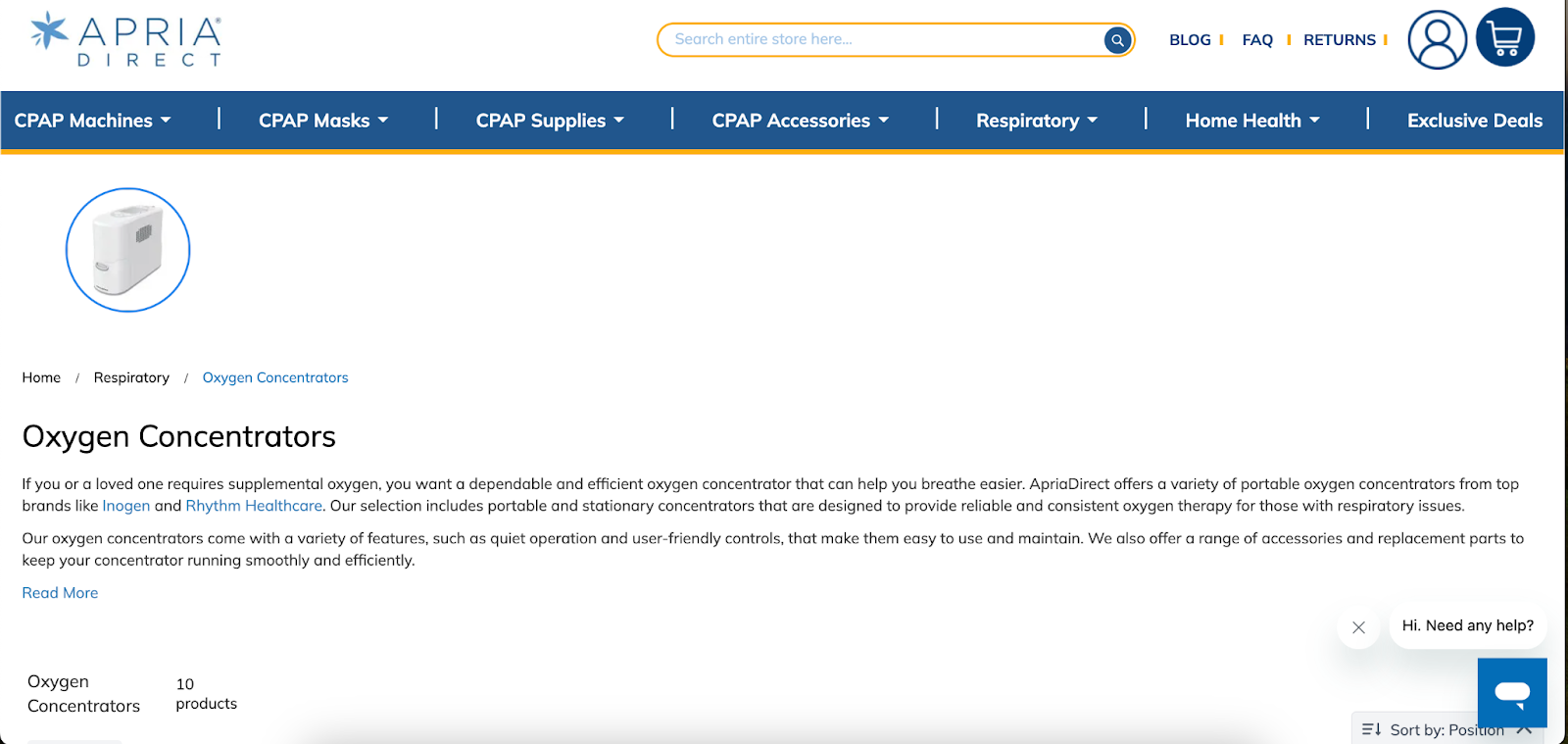
ApriaDirect provides a broad selection of POCs to help individuals with respiratory conditions stay independent at home and on the go. Featuring leading brands like Inogen and Rhythm Healthcare, these devices offer reliable oxygen therapy for improved quality of life.
Portable POCs are lightweight, quiet, and easy to use, ideal for travel and daily routines. ApriaDirect helps you select the right POC, from compact units for mobility to high-capacity devices for extended use.
Choosing ApriaDirect ensures top-quality portable and home oxygen concentrators with expert guidance and reliable customer support. Their team guides you through the selection process to ensure the device fits both your medical needs and budget.
ApriaDirect offers competitive pricing, fast shipping, and a smooth online shopping experience. Supported by Apria Healthcare, ApriaDirect delivers convenience, quality, and customer service to help you breathe easier wherever you are.
CAIRE, Inc. Review
Great Selection
|
CAIRE Inc. is ACHC-accredited, meeting rigorous standards that reflect superior performance and patient care. Over the past ten years, CAIRE has grown into the largest manufacturer of oxygen therapy systems. The supply oxygen systems to high-altitude clinics on Mount Everest, military units, and space research labs. CAIRE delivers advanced technology and innovative solutions to seniors with COPD, asthma, and other respiratory conditions. CAIRE Inc. offers four oxygen concentrators including three portable models, ensuring support wherever you need it. Every CAIRE portable oxygen concentrator a limited warranty and optional accessories.
Beyond its portable options, CAIRE produces the Companion 5, a wheeled continuous-flow model priced at $800. Weighing 36 pounds and without battery options, the Companion 5 is designed strictly for in-home use.
| Features | FreeStyle® Comfort® | Eclipse 5® |
|---|---|---|
| Technology | Lightweight portable (pulse dose only) | Transportable (pulse dose + continuous flow) |
| Pulse Flow Setting | 1–5 pulse flow (up to ~1050 mL/min) | 1–9 pulse flow |
| Weight | 5 lbs | 18.4 lbs |
| AC Power Supply | Yes | Yes |
| DC Power Supply | Yes | Yes |
| Battery Power | 8–16 hours | 5 hours |
| Price | $2,395 | $3,550 |
For more information, read our comprehensive CAIRE Inc. review.
Philips Respironics Review
Most Versatile
|
Philips manufactures a wide range of healthcare equipment, from MRI and imaging devices to personal health solutions like Philips Lifeline, sleep apnea devices, and portable oxygen concentrators. Philips aims to combine innovation with cost-effective solutions. With sales and service in over 100 countries and $20.1 billion in annual revenue, Philips offers both stationary concentrators and portable oxygen concentrators.
The Philips Respironics SimplyGo line includes the only POC that both continuous flow and pulse-dose oxygen in a single 10-pound device. With 5 to 11 pulse dose settings depending on the model, the SimplyGo keeps you active while meeting your oxygen requirements. Philips also produces the SimplyFlo, the smallest and lightest stationary oxygen concentrator available. Weighing under nine pounds, the SimplyFlo is ideal for overnight oxygen therapy.
Philips is not BBB-accredited but maintains an “A+” rating.
| Features | SimplyGo | SimplyGo Mini |
|---|---|---|
| Technology | Continuous + pulse flow POC | Pulse‑dose only POC |
| Pulse Flow Setting | 1–6 settings | 1–5 settings |
| Weight | 10 lbs | 5 lbs |
| AC Power Supply | Yes | Yes |
| DC Power Supply | Yes | Yes |
| Battery Power | 3 hours | 4.5 hours |
| Price | $2,595 | $2,100 |
For more information, read our comprehensive Philips Respironics review.
Frequently Asked Questions about Portable Oxygen Concentrators
The air we breathe is typically 80% nitrogen and 20% oxygen. A portable oxygen concentrator draws in ambient air, concentrates and purifies it, delivering 90 to 95% oxygen and five to 10% nitrogen.
Stationary oxygen concentrators provide continuous flow oxygen and usually include a large tank. Stationary concentrators allow daily activities at home using tubing that can extend up to 50 feet. They are particularly useful during sleep, delivering oxygen at rates of one to five liters per minute. Modern stationary concentrators are quieter, smaller, and no longer require the older 50-pound tank. However, SOCs require an electrical outlet and limited mobility to the home.
Portable oxygen concentrator typically weigh around five pounds and can be as light as three pounds. POCs run on batteries and can be worn or carried by the user. These features make POCs convenient and easy to manage outside the house.
Yes. Supplemental oxygen is considered a medical treatment. Your doctor will prescribe the appropriate flow rate and daily usage for your oxygen therapy.
Most insurance providers cover portable oxygen concentrators as durable medical equipment with a physician’s prescription. Always verify coverage details with your insurance provider.
Yes. Since 2009, the Department of Transportation (DOT) requires airlines allow passengers with a disability to use an FAA-approved portable oxygen concentrator on flights. Currently, 23 FAA-approved POCs exist, including the wearable models highligted in this guide.
Make sure you understand the company’s return policy and any restocking fees. Verify how the company provides service and repairs for the POCs. Ask if they offer a loaner device during maintenance or repairs. Finally, read the warranty carefully to avoid surprises if issues arise with your POC.
Concluding Thoughts on Portable Oxygen Concentrators
Bottom Line:
Consult your healthcare provider before purchasing a POC to determine the features you need for safe and independent oxygen use.
No matter what company you choose, select a POC based on your oxygen needs and lifestyle requirements. There is no single “best” POC; each has pros and cons, but CAIRE Inc., Inogen, and Philips provide reliable, high-quality options.