
The Safest and Riskiest States for Seniors


Updated:
Open Access
America is aging rapidly, with the 65-and-over population growing five times faster than the total population. Seniors are also one of the country’s most vulnerable populations, facing greater risks from crime, climate, health emergencies, and more. While these issues present dangers to seniors everywhere, just how much risk they present varies from place to place.

Key Insights
Pennsylvania is the country’s safest state for seniors, largely due to low crime rates and limited climate risk.
↓ Jump to insight
Nevada is the riskiest state in the U.S. for seniors, with some of the country’s hottest temperatures in summer and the highest rate of elder abuse.
↓ Jump to insight
Only nine U.S. states currently have an enhanced state hazard mitigation plan in place.
↓ Jump to insight
Maryland ranks as the worst state for senior health care access.
↓ Jump to insight
Every region is represented in the 10 safest states for seniors in the country; the Midwest and South each lead with three.
↓ Jump to insight
Choosing where to spend your retirement is about more than affordability. It’s also about finding a place to live that is safe and secure and offers ample access to quality health care. With tens of millions of Americans now considering how and where to spend their golden years, we created this guide to help identify which states are the safest for retirees and highlight the risks to seniors in each one.
The Five Safest States for Seniors
Our senior care report provides a clear look at how each state supports its aging population. Ranks are calculated using 17 weighted factors, measuring healthcare quality, access, community support, and overall senior living conditions. Whether you’re planning a cross-country move or staying in your current home, the key is matching your personal priorities with what each state offers best.
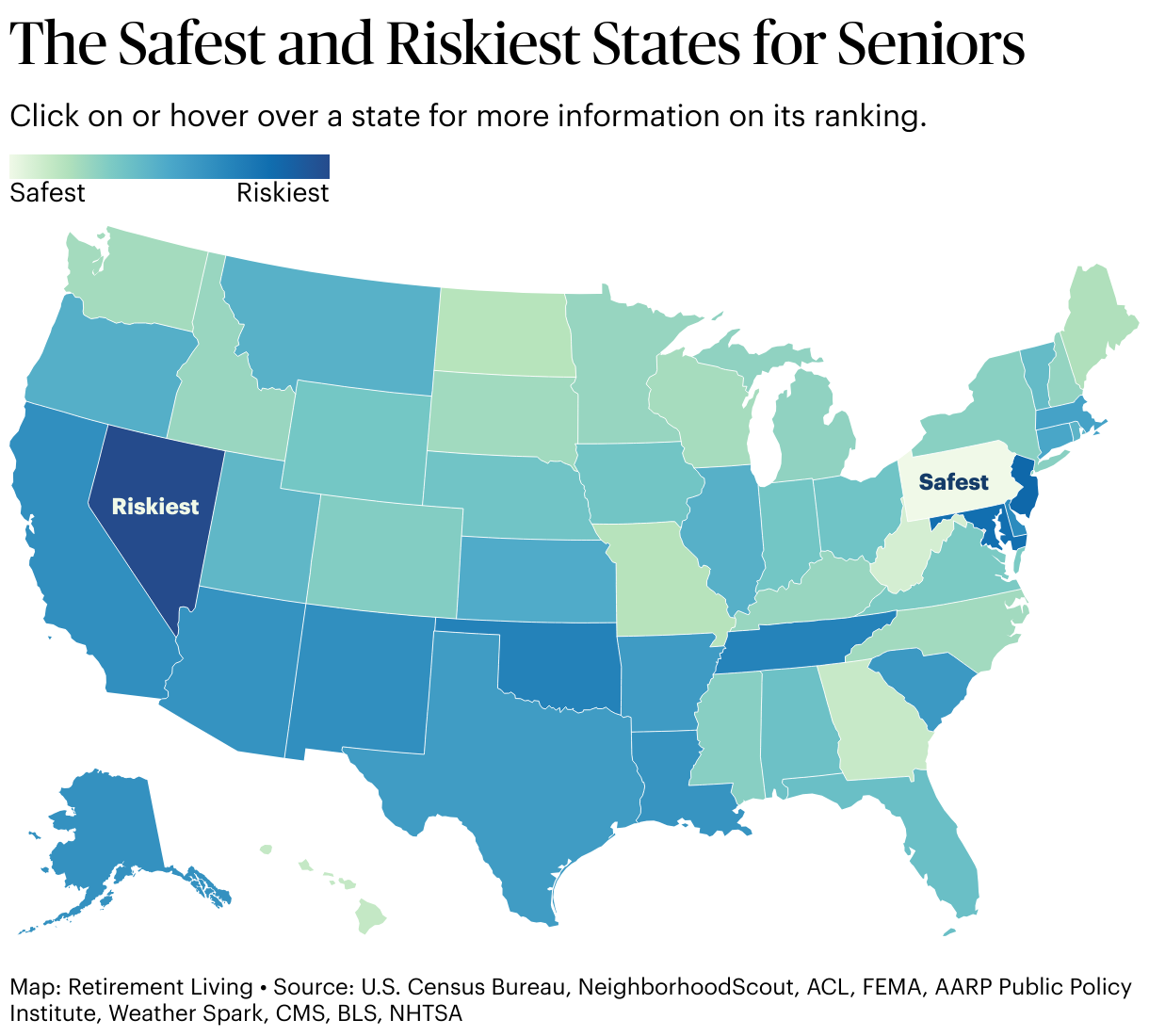
1. Pennsylvania
The safest state for seniors in our 2025 study is Pennsylvania, which earned top 20 safety scores in all but one major category. Pennsylvania performed especially well in two categories in particular: crime and climate.
Elder abuse is relatively uncommon in Pennsylvania, which sees just 7.5 reported incidents per 100,000 seniors in the state. The Keystone State ranks fourth overall in climate safety, thanks to moderate temperatures throughout the year. Pennsylvania’s enhanced state hazard mitigation plan ensures that if extreme climate events impact state residents, a Federal Emergency Management Agency-approved plan is in place to minimize the damage. That should provide plenty of peace of mind for senior citizens looking for a secure, comfortable place to retire.
In addition to being a safe place to spend your golden years, Pennsylvania is relatively close to several major metropolitan areas, like New York City. That means seniors can enjoy the peace and serenity the state has to offer while having easy access to big city excitement when the mood strikes.
2. West Virginia
West Virginia claims second place on our list of the safest states for seniors this year with high scores in all but the traffic category, where it ranks 27th. Seniors have relatively little violent crime to worry about in the Mountain State, which has the ninth-lowest violent crime rate in the country, at just 12.4 reported incidents per 1,000 seniors. Property crime is also notably low in West Virginia, with a reported incident rate of 55.6 per 1,000 seniors, the fourth-lowest rate in the nation.
Despite West Virginia’s mostly rural setting, health care access is one of its main strengths. The state ranks within the top 10 for high-quality home health, with more than a quarter (25.5%) of agencies rated 4 stars or above.
West Virginia may be “wild and wonderful,” but our data shows that it’s also safe and comfortable for retirees. The fresh mountain air and beautiful vistas are a big bonus.
3. Georgia
Georgia ranks third overall for the safest states for seniors and is one of two Southern states in the top three. The Peach State excels when it comes to climate safety, ranking fifth overall in the category. Its exceptionally mild winters are the main draw, with an average winter low of a crisp-but-comfortable 41 degrees Fahrenheit. That helps reduce the risk of exposure-related illnesses compared with places that experience consistent freezing temperatures. Georgia also earns points for its relatively low climate risk score from FEMA and for having an enhanced state hazard mitigation plan in place.
While Georgia’s performance in the health care access category is somewhat uneven, it has a few big green flags. The state ranks 11th in lowest average Medicare payments for hospital outpatient services per capita and eighth in the percentage of Medicare recipients enrolled in Medicare Advantage plans.
With mountains in the northern part of the state and gorgeous beaches along its coastline, Georgia is a dynamic state with plenty to offer seniors looking for a little variety in retirement. Our research indicates it’s also a low-risk place for them to make a home.
4. Hawaii
Hawaii would be an attractive retirement destination even if it didn’t earn strong scores for senior safety. In fact, the Aloha State scores high in every major safety category except climate, where it finishes in the middle of all states.
Crime isn’t something retired residents of Hawaii need to worry about much. The state has the fifth-lowest rates of violent crimes (8.9 reported incidents per 1,000 seniors) and elder abuse (3.3 reported incidents per 100,000 seniors) in the country. Seniors have even less to worry about when it comes to cold weather in Hawaii, which has an average winter low temperature of 66, well within the comfort range.
There are a whole lot of reasons for seniors to say “aloha” (goodbye) to the continental U.S. and “aloha” (hello) to Hawaii for retirement. Incredible nature, pristine beaches and a laid-back island lifestyle don’t need data to back them up. The data does, however, confirm the relative safety of moving to Hawaii for one’s golden years.
5. North Dakota
North Dakota closes out our list of the top five safest states for seniors in 2025. In the health care access category, it ranks first in average time spent in the hospital emergency room before going home, at one hour and 50 minutes per visit, the lowest in the country.
While North Dakota ranks second in the nation for overall climate safety and has one of the lowest climate risk scores, retirees should be prepared for its frigid winters. The state’s average low winter temperature is just 7, the coldest in the U.S., even colder than Alaska’s. However, if a natural disaster does occur, North Dakota’s hazard mitigation plan ensures a FEMA-approved response is in place.
North Dakota may not be at the top of most people’s lists when they begin looking for a state to retire in. However, when you combine the relative safety seniors experience while living there with its abundance of natural beauty, perhaps it should be — especially for those who embrace the winter.
What Are The Riskiest States for Seniors?
On the other end of the spectrum are the states that are the least safe for seniors. The following states emerged as the overall riskiest for senior living based on the same criteria used to determine the safest. Each of these states earned an overall senior safety score below the U.S. average, including low scores across multiple evaluation categories.
1. Nevada
Based on our research, Nevada is the riskiest state in the U.S. for seniors to call home. Crime is a major concern in Nevada; it has the fifth-highest rate of property crime, with about 145 incidents per 1,000 seniors. Elder abuse is especially worrisome, with 247.6 reported incidents per 100,000 seniors — the worst in the country. These two crime rates, plus an above-average violent crime rate, make Nevada rank dead last in the crime category.
Climate is also a serious concern for seniors in Nevada. The average summer high temperature of 92 is the third highest of any state, posing a significant risk of heat stroke and other exposure-related illnesses. Winters can also be a problem, with an average low temperature of 28.
Nevada is home to plenty of fun and is conveniently close to many attractions. It’s just not a state that offers much safety and security to residents in their retirement years. For seniors, Nevada is likely a much better place to visit than to call home.
2. New Jersey
New Jersey scores poorly particularly in climate safety and crime, making it the second-riskiest state for seniors. Because the state is vulnerable to hurricanes and other tropical storms during the summer and significant snowfall during the winter, seniors face climate-related risks all year long. This is supported by New Jersey’s climate risk score of 90.2 out of 100, which is the second-highest score of any state in the country.
Rates of violent and property crime are actually below the U.S. averages. However, New Jersey has the second-highest rate of elder abuse of any state, at 239.1 reported incidents per 100,000 seniors.
Despite its reputation, many parts of New Jersey are beautiful, with lush countryside and lots of lovely beaches. The state’s proximity to New York City and Philadelphia can make it an enticing option for seniors who want easy access to city life. That said, seniors who also seek security in retirement have many better options than New Jersey.
3. Maryland
Maryland is the third-riskiest state in the country for seniors, according to our research. It scores in the bottom 15 in every category except traffic safety. The Free State has one of the 10 highest climate risk scores in the U.S., meaning seniors face a strong probability of being affected by severe events. With no enhanced state hazard mitigation plan in place, there’s not as much assurance that seniors will get timely relief and support when disasters happen.
However, the biggest concern for seniors in Maryland is access to health care, with the state ranking last in the country in that category. Maryland has a below-average ratio of home health care workers to seniors, at 36.1 aides for every 1,000 seniors. The state also has the longest ER times in the U.S., at an astounding average of four hours and 11 minutes per visit.
Maryland offers quick access to cities like Washington, D.C., Baltimore and Philadelphia, and is home to a strong local culture and diverse landscapes. Still, it has several red flags for seniors hoping to retire somewhere they can feel secure.
4. Oklahoma
Oklahoma has many points of concern for senior living. While the Sooner State finished in the top half of states for health care access, it ranks poorly in every other category, particularly crime. Oklahoma residents face some of the country’s highest rates of violent and property crimes, as well as the fifth-highest rate of elder abuse of any state, at 88.2 reported events per 100,000 seniors.
Traffic safety is also a significant problem in Oklahoma. It has the fourth-worst traffic safety score, with high rates of fatal crashes and traffic-related deaths involving seniors. Given that public transportation options are limited in this mostly rural state, driving in Oklahoma is both a necessity and a risk for retirees.
5. Tennessee
Closing out our list of the five riskiest states for seniors is Tennessee. Crime is a major factor in the Volunteer State’s below-average score for senior safety. Seniors there are subject to the country’s fourth-highest rate of elder abuse, as well as the eighth-highest rate of property crime. And with a rate of 35.9 reported incidents per 1,000 seniors, Tennessee has the third-highest violent crime rate in the U.S.
Like in Oklahoma, traffic safety is a major concern for Tennessee’s senior residents. The state ranks among the 10 worst in the country for senior-involved fatal crashes and senior traffic fatalities.
Tennessee is loaded with natural sites and theme parks to explore, as well as exciting, culturally important cities to take in. Unfortunately, it doesn’t provide much in the way of safe and secure living for seniors.
How Does Your State Rank for Senior Safety?
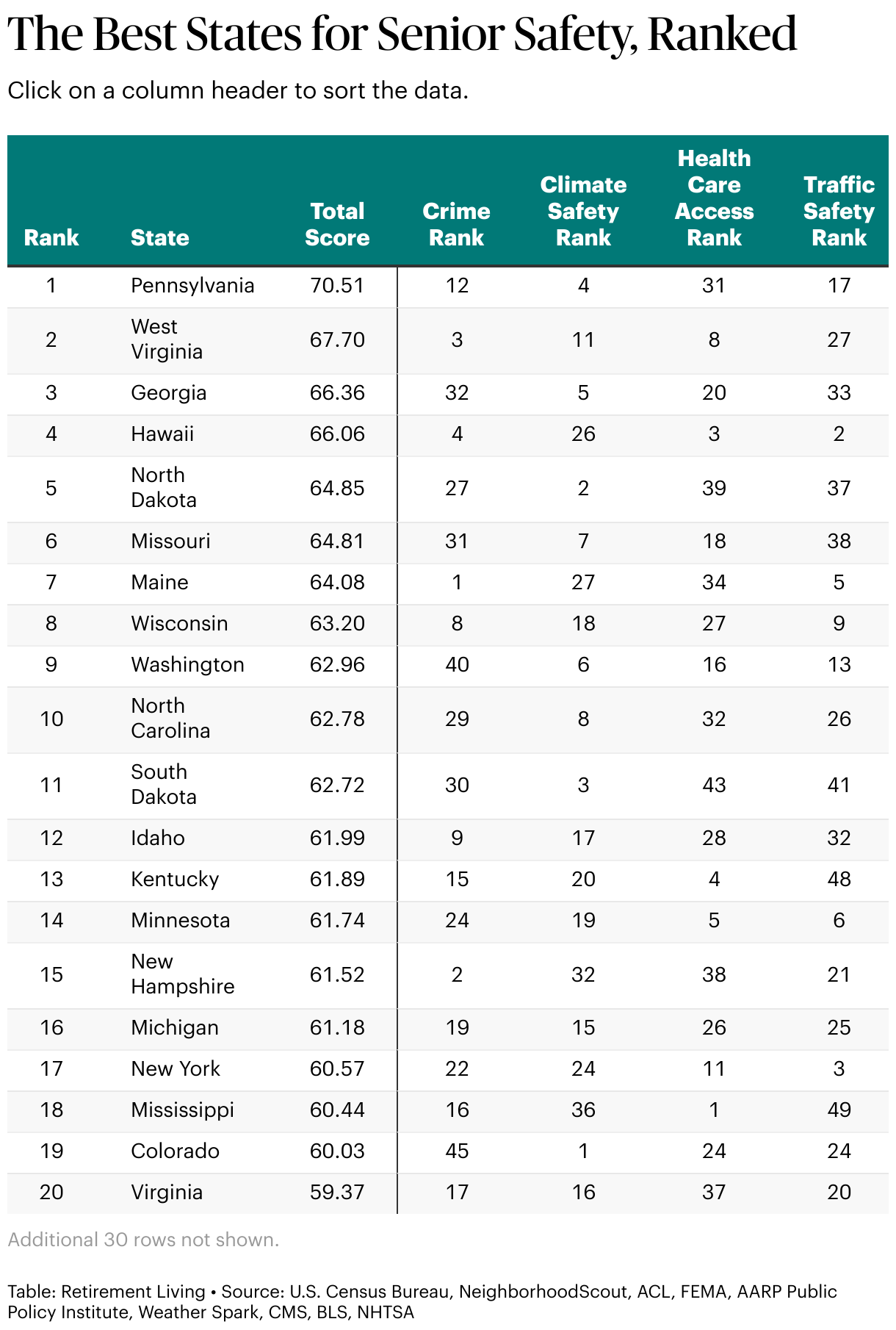
Every state has some degree of risk for older adults, with some states less safe than others. The table below lists the overall risk score and category rankings for each state in the U.S. You can use it to see the biggest risks for seniors in your state — or in any others you may be considering for retirement.
Ways to Protect Your Health and Safety in Retirement
The relative threat of crime, climate disasters, low health care access, and deadly traffic may vary throughout the country, but there is no place in the U.S. where seniors are completely free of danger. No matter where you choose to spend your retirement, there are some things you can do to set up guardrails and reduce risks to your health and safety, including:
- Install safety features in your home. Equipment like grab bars in bathrooms and additional handrails on staircases and walkways helps prevent falls and is relatively inexpensive.
- Wear a medical alert device. Bracelets and other medical alert wearables can help ensure you get assistance as quickly as possible if you fall or suffer an accident and can’t reach the phone, when every minute can make a difference.
- Improve your home’s lighting. Installing brighter lights and ensuring all of your home’s pathways and areas of activity are sufficiently lit can reduce the chance of a misstep or running into furniture while moving around.
- Invest in a home security system. An alarm system and other home security tools make your home more difficult to break into and a less appealing target for thieves. Many home security companies offer monitoring services that can get help to your home when you can’t make the call yourself.
- Have a home generator installed. Extreme heat and freezing temperatures pose significant risks for seniors in their homes. A backup generator can ensure that your HVAC system continues to work during power outages and keeps your home at a safe and comfortable temperature.
Methodology
The Retirement Living Research Team identified the safest and riskiest states for seniors by comparing all 50 U.S. states across four weighted categories worth a total of 100 points.
- Crime (35 points): The crime score includes violent and property crime rates per 1,000 seniors (10 points each) and reports of elder abuse per 100,000 seniors (15 points). Data is from NeighborhoodScout (2023) and the Administration for Community Living (2024).
- Climate safety (30 points): The climate safety score factors in a climate risk index score from FEMA (10 points), whether the state has a FEMA-approved enhanced state hazard mitigation plan (10 points) and how far the average summer high and winter low temperatures deviate from the comfortable range of 65 to 75 degrees (5 points each). Data is from FEMA (2025), the AARP Public Policy Institute (2023) and Weather Spark (2024).
- Health care access (30 points): The health care access score includes the average time patients spent in the emergency department before leaving from the visit (10 points), the average Medicare payment per capita for hospital outpatient department services (5 points), the percentage of Medicare beneficiaries enrolled in Medicare Advantage plans (5 points), the percentage of home health agencies rated 4 stars or higher (5 points) and the number of home health and personal care aides per 1,000 seniors (5 points). Data is from the Centers for Medicare & Medicaid Services (2025 and 2022) and the U.S. Bureau of Labor Statistics (2024).
- Traffic safety (5 points): The traffic safety score includes the number of fatal crashes involving seniors (age 65 and over) per 100,000 seniors and the number of senior traffic fatalities per 100,000 seniors (2.5 points each). Data is from the National Highway Traffic Safety Administration (2023).
For each metric, the state that performed the best received the maximum possible score, with all other states scored relative to that benchmark. We added the category scores to calculate each state’s overall score, which is out of 100.
Reference Policy
We love it when people share our findings! If you do, please link back to our original article to credit our research.
Article Sources
Retirement Living writers primarily rely on government data, industry experts and original research from other reputable publications to inform their work. Specific sources for this article include:
- U.S. Census Bureau, “Explore Census Data.” Accessed Oct. 22, 2025.
- NeighborhoodScout, “NeighborhoodScout.” Accessed Oct. 22, 2025.
- Administration for Community Living, “Data Explorer.” Accessed Oct. 22, 2025.
- AARP, “Safety and Quality.” Accessed Oct. 22, 2025.
- Federal Emergency Management Agency, “Map National Risk Index.” Accessed Oct. 22, 2025.
- Weather Spark, “The Weather Year Round Anywhere on Earth.” Accessed Oct. 22, 2025.
- Centers for Medicare & Medicaid Services, “Timely and Effective Care – State.” Accessed Oct. 22, 2025.
- Centers for Medicare & Medicaid Services, “Medicare Geographic Variation – by National, State & County.” Accessed Oct. 22, 2025.
- Centers for Medicare & Medicaid Services, “Monthly Enrollment by State 2025 03.” Accessed Oct. 22, 2025.
- Centers for Medicare & Medicaid Services, “Home Health Care – State by State Data.” Accessed Oct. 22, 2025.
- U.S. Bureau of Labor Statistics, “OEWS Research Estimates by State and Industry.” Accessed Oct. 22, 2025.
- National Highway Traffic Safety Administration, “Fatality Analysis Reporting System (FARS).” Accessed Oct. 22, 2025.
- Federal Emergency Management Agency, “Enhanced State Mitigation Planning: Basics for New Enhanced States.” Accessed Oct. 22, 2025.
- U.S. Census Bureau, “2020 Census: 1 in 6 People in the United States Were 65 and Over.” Accessed Oct. 22, 2025.