
Retirement Living takes an unbiased approach to our reviews. We may earn money when you click a partner link. Learn More
Best and Worst States to Retire in 2025
According to Retirement Living’s State of Retirement, nearly 58% of adults over 60 worry they won’t have enough to retire comfortably. With more Americans hitting retirement age than ever, that financial concern is entirely understandable.



Updated:
key insights:
- Wyoming ranks as the best state to retire in, requiring only $573,800 for a comfortable retirement, thanks to no state income tax and a strong economy.
↓ Jump to insight - Hawaii ranks as the worst state to retire in, requiring the highest retirement savings nationwide, $1,673,300, and offering limited healthcare access for seniors.
↓ Jump to insight - Florida, despite its popularity among retirees, ranks among the lowest in economic strength due to rising living costs and high senior poverty rates.
↓ Jump to insight
Open Access
Where you decide to spend your golden years can have a major impact on both your financial security and daily happiness. Two retirees with the same savings can face very different outcomes depending on state taxes, housing costs, healthcare access, and everyday expenses. The right location can stretch your income further and give you more peace of mind.
To help you navigate this decision, we’ve analyzed all 50 states based on how retirement-friendly they are. Building on our 2024 state retirement rankings, we’ve updated our methodology. We used a detailed 100-point scoring system that examines affordability, quality of life, and economic strength. This research draws on reliable data from sources including the U.S. Census Bureau, the CDC, the Tax Foundation, and other trusted public institutions.

Best States to Retire in 2025
Looking for tax-friendly policies, low crime, and a slower pace that doesn’t break the bank? These states offer a strong mix of affordability, stability, and quality of life.
Here’s how the top 5 states stack up:
1. Wyoming

Wyoming stands out as one of the most affordable states to retire in. Retirees need approximately $574,000 in savings to live comfortably here, thanks to no state income tax and one of the lowest property tax rates in the country at just 0.58%. That means retirees can stretch their savings further without worrying about surprise tax bills. Wyoming also has a senior poverty rate of just 7.4%, among the lowest in the nation.
Affordability isn’t the only draw. Wyoming ranks second in overall quality of life, thanks to a combination of low violent crime, easy access to parks, and access to healthcare facilities. Retirees who love the outdoors, prefer a slower pace, or want to stay active with part-time work, Wyoming offers both peace of mind and a fulfilling lifestyle.
2. West Virginia

West Virginia is one of the most affordable states to retire in the country. Seniors need just $303,199 to retire here–the lowest in the nation. Seniors also benefit from a low property tax rate of 0.54% and a modest state income tax rate of 5.12%.
While West Virginia faces some challenges, including a senior poverty rate of 12% and limited access to healthcare facilities, its financial advantages are hard to ignore. For cost-conscious retirees, West Virginia’s affordability often outweighs other concerns, making it an increasingly attractive option.
3. Florida

Florida continues to be a top pick for retirees, thanks to its warm year-round weather, no state income tax, and one of the largest senior populations in the country. Property taxes are relatively low at 0.79%, but rising living costs mean retirees need about $685,000 in savings to live comfortably.
Despite the higher price tag, the Sunshine State delivers strong value with easy access to healthcare facilities and a low violent crime rate. The state continues to attract retirees willing to pay premium prices for sunshine and senior-friendly communities.
4. Montana

Montana offers a high quality of life for retirees who value open spaces, outdoor living, and a community feel. Retirees need about $615,800 to live comfortably here, a reasonable amount considering the state’s 5.9% income tax and moderate property taxes at 0.75%. With a low senior poverty rate of just 9.5%, many older adults are doing well financially in the state.
Montana also shines when it comes to healthcare access, offering one of the highest ratios of facilities in the nation. For retirees looking to stay close to nature without sacrificing financial stability or medical care, Montana offers a compelling balance.
5. Delaware

Delaware is a good option for retirees looking for a stable economy and a strong senior community. It’s one of the few higher-tax states in this group that still manages to keep its economy attractive to retirees. Older adults need about $684,000 in savings to live comfortably, with a 6.6% income tax offset by low property taxes at 0.53%. A low senior poverty rate of just 7.9% and only 18.8% of seniors working past 65 suggest many can afford to fully retire.
Delaware offers solid quality of life, particularly for retirees who make up 21.3% of the population. The state excels in healthcare accessibility and has exceptional access to green spaces, with 97.6% of residents living within a 10-minute walk from a park.
Worst States to Retire in 2025
With high taxes, steep living costs, and limited support for retirees, some states make retirement more difficult than it needs to be.
Here are the 5 worst states to retire in:
1. Hawaii

Hawaii ranks last overall for retirement, a shocking result for a state often seen as paradise. While the year-round mild weather and natural beauty are undeniable, the cost of living is sky-high. Retiring in Hawaii requires an estimated $1.67 million in savings–the highest in the nation. The state’s 11% income tax only adds to the financial pressure, and for many, necessities can start to feel like luxury expenses.
However, it still delivers when it comes to quality of life. The state has a low violent crime rate, abundant green spaces, and a peaceful, scenic environment. For retirees with a generous budget, Hawaii can offer a truly tranquil place to enjoy their golden years.
2. New York

New York’s low ranking reflects the harsh reality of retiring in one of America’s most expensive states. Retirees need over $1,037,000 in savings to live comfortably, while the state’s 10.9% income tax and high property tax rate of 1.6% chip away at fixed incomes.
The senior poverty rate is also high at 14.3%, underscoring how difficult it can be to retire here. Safety is another concern, with both violent and property crime rates exceeding those in many other states. For retirees with the means, New York offers rich cultural experiences and diverse living options, but for most, the financial tradeoffs are hard to ignore.
3. Massachusetts

Massachusetts ranks as one of the least affordable states to retire, with nearly $1,280,000 needed for a comfortable retirement. High everyday costs, a 9% state income tax, and a 1.11% property tax rate add significant burdens for retirees on fixed incomes. Additionally, a senior poverty rate of 10.8% and the fact that nearly 24% of older adults are still working suggest that many continue working out of necessity rather than choice.
Still, Massachusetts offers a high quality of life, with excellent healthcare access. The state also has some of the most abundant green spaces in the country, ideal for retirees who enjoy walkable neighborhoods and time outdoors. Its mix of natural beauty, cultural richness, and seasonal charm is undeniably appealing, but it comes at a steep price.
4. New Jersey

New Jersey ranks low in affordability, needing about $964,000 in savings. The state imposes the highest property tax rate at 2.23% along with a steep 10.75% state income tax rate, making it one of the most expensive places to maintain a retirement lifestyle.
The Garden State does offer some redeeming qualities, particularly in its strong healthcare access. It has a decent walkability score of 59.1 and a low violent crime rate. But for many retirees, these advantages may not be enough to offset the high cost of living.
5. California

California ranks low in affordability, with seniors needing around $1,157,000 to retire, one of the highest in the country. The state also imposes the highest income tax in the nation at 13.3%, and while property taxes are relatively low at 0.71%, they offer little relief from the overall tax burden. The senior population is relatively small at 16.2%, and a 12% senior poverty rate, above the national average, suggests many retirees are feeling the strain.
Retiring in California also means access to diverse landscapes, a rich cultural scene, and countless lifestyle options. But for most retirees, those perks come with a price tag that’s simply out of reach, forcing some to relocate in search of affordability.
See Where Your State Ranks
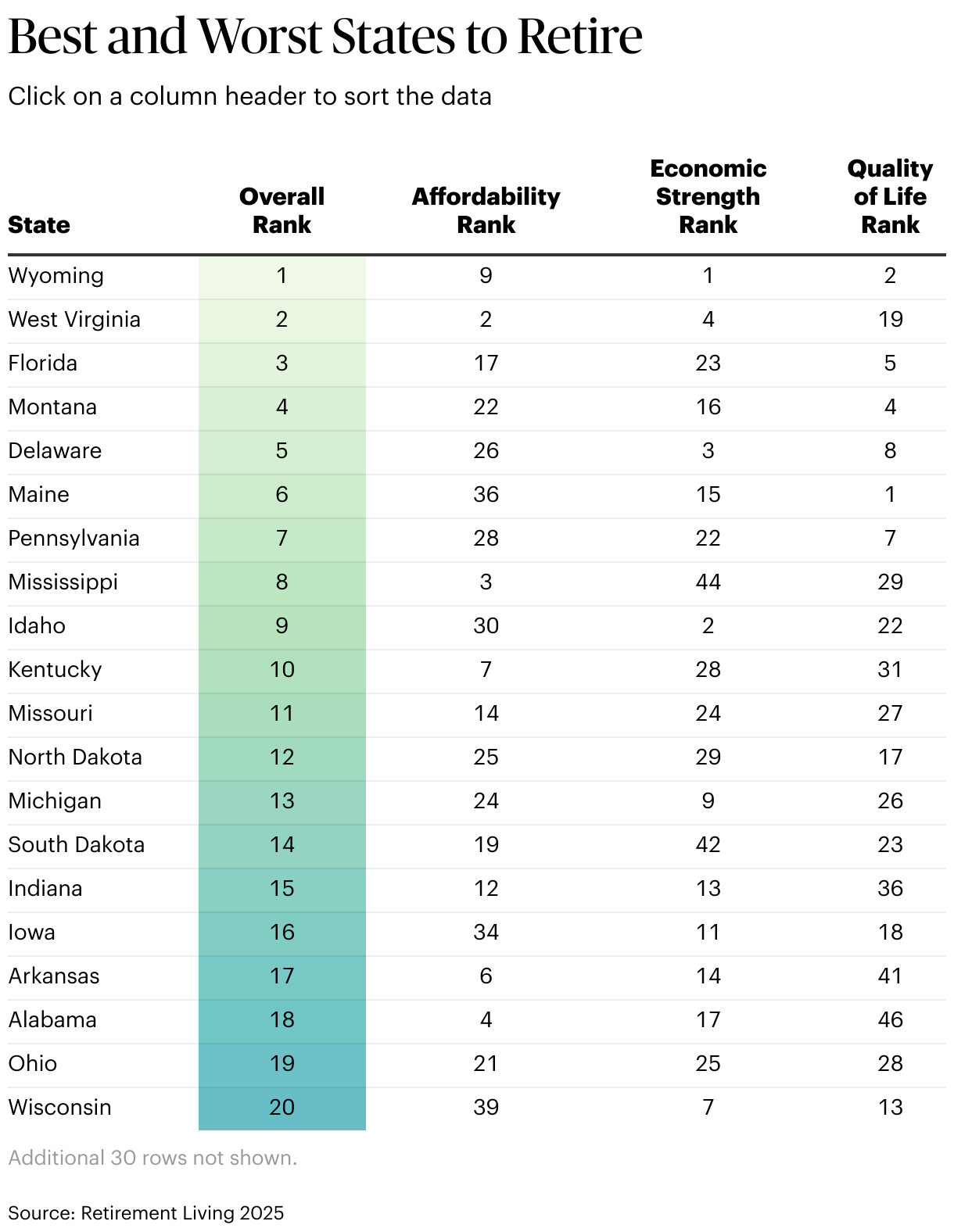
Here is a ranking of all 50 states based on how retirement-friendly they are, from most to least favorable:
Methodology
To determine the best and worst states to retire, the Retirement Living Research Team analyzed all 50 U.S. states using a 100-point scoring system across three key categories: quality of life, affordability, and economic strength. We assessed these dimensions through 15 specific metrics, each weighted based on its importance to retirement planning.
The rankings were built using reliable national data sources, including the U.S. Census Bureau, the CDC, the Tax Foundation, and other public datasets. The goal was to highlight states that offer the best overall value and experience for retirees.
Here’s how each category contributed to the final scores:
Quality of Life – Total Points: 60
- Well-Being Index (20 points)
- Percentage of Seniors (10 points)
- Number of Healthcare Facilities per 100,000 Seniors (9 points)
- Mild Summers (3 points)
- Mild Winters (3 points)
- Property Crime per 100,000 Residents (3 points)
- Violent Crime per 100,000 Residents (3 points)
- Walk Score (3 points)
- Park Score (3 points)
- Golf Courses per 1,000 seniors (3 points)
Affordability – Total Points: 30
- Savings Needed to Retire (20 points)
- State Income Tax (5 points)
- Property Tax (5 points)
Economic Strength – Total Points: 10
- Senior Poverty Rate (5 points)
- Percentage of Seniors Working Past 65 (5 points)
2024 vs 2025 Retirement State Rankings: What Changed
Our 2025 rankings reflect a fully redesigned methodology, moving away from the 2024 approach that equally weighted 13 metrics and incorporated direct retiree survey feedback. The chart below shows the full 2024 rankings for comparison and underscores how changes in methodology can significantly shift the way we evaluate the best states for retirement.

Reference Policy
We love it when people share our findings! If you do, please link back to our original article to credit our research.
Article Sources
- AARP. “New AARP Survey.” AARP. Evaluated Jun. 25, 2025.
- NeighborhoodScout. “About the Data: Crime Rates.” NeighborhoodScout. Evaluated June 13, 2025.
- Tax Foundation. “State Property Taxes.” Tax Foundation. Evaluated June 12, 2025.
- Bureau of Labor Statistics. “Consumer Expenditure Surveys Tables.” Bureau of Labor Statistics. Evaluated June 12, 2025.
- Sharecare. “CWBI State Rankings Report (2023).” Sharecare Well‑Being Index. Evaluated June 12, 2025.
- Weather Spark. “Weather Spark: The Weather Year Round Anywhere on Earth.” WeatherSpark.com. Evaluated June 12, 2025.
- Cost of Living Index. “Cost of Living Index.” COLI.org. Evaluated June 12, 2025.
- Centers for Disease Control and Prevention. “National Vital Statistics Reports, Volume 73, Number 7.” CDC. Evaluated June 12, 2025.
- Walk Score. “Walk Score: Walkability and Transit Scores.” WalkScore.com. Evaluated June 12, 2025.
- City Health Dashboard. “City Health Dashboard.” CityHealthDashboard.com. Evaluated June 12, 2025.
- United States Census Bureau. “County Business Patterns (CBP) Survey.” United States Census Bureau. Evaluated June 12, 2025.
- United States Census Bureau. “American Community Survey 5-Year Estimates (2022) — City Data Table.” data.census.gov. Evaluated June 12, 2025.
- United States Census Bureau. “Sex by Age by Employment Status for the Population 16 Years and Over (2023).” data.census.gov. Evaluated June 12, 2025.
- U.S. Census Bureau. “American Community Survey (ACS) Poverty Rate Data.” U.S. Census Bureau. Evaluated June 12, 2025.