
Retirement Living takes an unbiased approach to our reviews. We may earn money when you click a partner link. Learn More
Platinum vs. Gold Investment: Which Is Better?
A comprehensive comparison to guide investors in choosing between platinum and gold for their portfolios.



Updated:
AT A GLANCE:
- Gold offers stability, liquidity, and long-term wealth preservation, ideal for conservative investors.
- Platinum provides higher growth potential but carries more volatility due to industrial demand.
- Both metals have unique benefits, with gold excelling in long-term stability and platinum providing opportunities for those willing to take on more risk.
- For a diversified portfolio, gold remains the go-to choice, while platinum may complement your holdings if you’re open to higher volatility.
Gold and platinum are both highly valued precious metals, but they have different roles in investment portfolios. Gold is widely recognized for its stability, long-standing value, and consistent demand across global markets.
Platinum is rarer and more volatile, with growing demand driven by its use in industries like automotive and green technology.
Deciding which metal is the better investment depends on your goals, risk appetite, and investment strategy. While gold offers a stable, trusted store of wealth, platinum’s limited supply and industrial applications provide unique opportunities for those seeking potential growth.
We explore the key differences in this blog to help you determine the right fit for your portfolio.
Gold vs. Platinum Compared
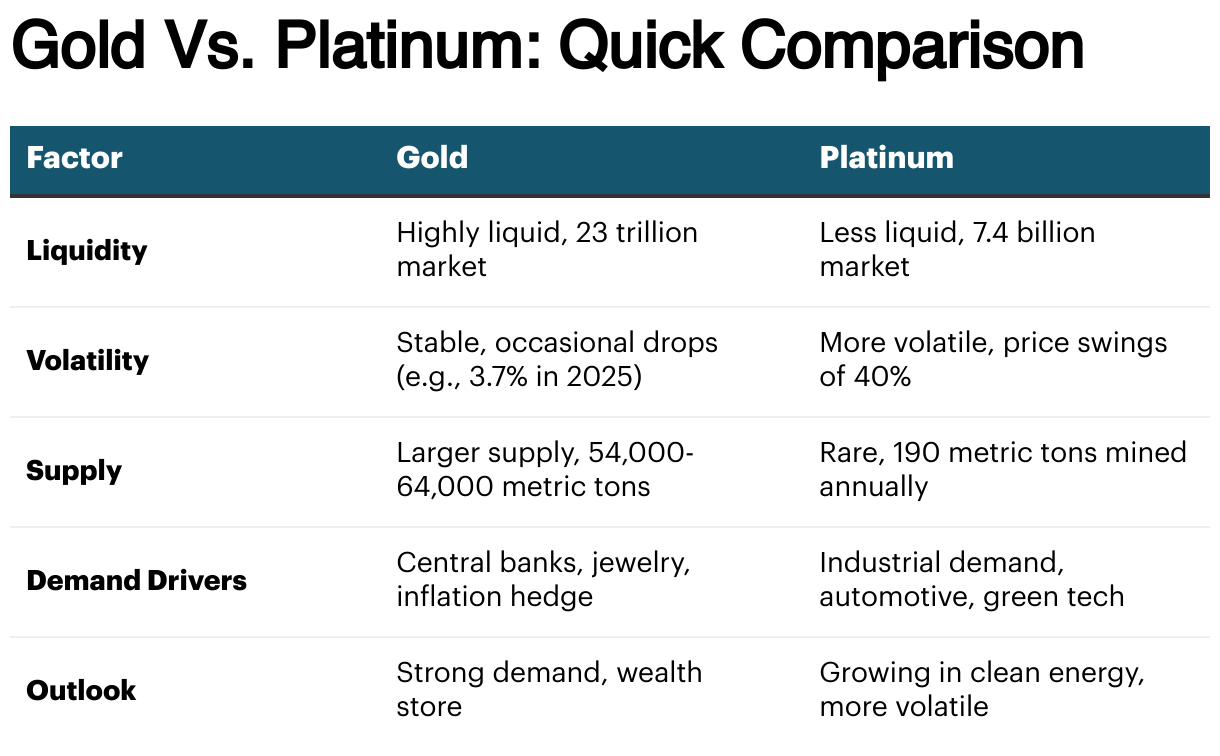
When comparing platinum and gold, several key factors distinguish these two metals. Understanding these differences can help you make informed decisions when diversifying your portfolio or hedging against economic uncertainty.
Investment and Liquidity
Gold stands out for its investment potential due to its high liquidity and ease of access. The global gold market is vast, valued at about $23 trillion, making it one of the most liquid assets. Gold can be easily bought, sold, and traded in various forms, such as gold coins, bullion, gold-backed ETFs, and gold IRAs. This broad availability means investors can enter and exit positions quickly with greater flexibility.
Gold IRA companies like American Hartford Gold, Patriot Gold Group, and Goldco offer easy access to gold in retirement accounts, making it simple for investors to add gold to their portfolios.
Platinum, while still valuable, has a smaller market size, with an estimated value of $7.4 billion, making it less liquid. The limited number of investment options through platinum ETFs, IRAs and mining stocks means it’s not as easily traded. Its price is often influenced by industrial demand, which can make it more volatile compared to gold. During economic crises or changes in industrial uses, platinum’s price can fluctuate significantly, becoming a riskier investment in terms of liquidity.
Price Volatility and Historical Performance
Gold has always been a reliable investment, showing steady growth over the years. In 2025, the price of gold surged to $3,433 per ounce, mainly due to rising inflation, increasing demand, and global uncertainty. While gold tends to hold its value well, it’s still subject to some price drops.
For example, in April 2025, the price fell 3.7% in one day, one of its biggest drops in recent years. However, it’s important to note that gold has stayed above $1,000 per ounce since the 2008 financial crisis, which highlights its long-term stability.
Platinum, on the other hand, is much more volatile. In 2025, the price of platinum reached $1,483 per ounce, but by mid-year, it had dropped to $895 per ounce. Platinum’s value is highly influenced by industrial demand, especially from the automotive and technology sectors.
As these industries change, platinum prices can swing drastically. While this can lead to higher potential returns, it also means platinum carries more risk compared to gold.
The table below presents the statistics based on data up to 16th August 2025.

Rarity and Supply Dynamics
Platinum is much rarer than gold, with only about 190 metric tons mined each year, compared to 3,000 metric tons of gold. This scarcity is one of the reasons platinum’s price can be more volatile, as its supply is highly concentrated in just a few countries, like South Africa and Russia. Supply disruptions in these regions, due to political instability or mining challenges, can lead to significant price swings, making platinum a riskier investment in terms of availability.
Gold has a larger and more stable supply. It is mined in many regions across the world, and its reserves in the earth’s crust are substantial, with an estimated 54,000 to 64,000 metric tons remaining. This broader supply base allows gold to maintain more consistent pricing and availability, making it a more predictable and stable investment compared to platinum. While gold is also a finite resource, its steady supply contributes to its long-term value and reliability.
Demand Drivers & Long-Term Outlook
Gold remains a top choice for investors, as it serves as a safe-haven asset during periods of economic downturns, inflation, and market volatility. Demand stems from central bank purchases, investment inflows, and jewelry consumption. With ongoing inflation concerns and central banks continuing to diversify their reserves, gold’s role as a store of value ensures its long-term stability.
Platinum sees significant demand from industrial applications, particularly in automotive catalytic converters and green energy technologies. However, its price tends to be more volatile, influenced by economic cycles and technological advancements. Platinum’s limited supply and growing role in sustainable energy present strong potential for growth in the future.
Investment Options: How to Invest in Platinum and Gold
There are several ways you can invest in gold or platinum:
- Physical Gold and Platinum can be purchased in the form of coins, bars, jewelry or physical bullion for direct ownership. While this allows you to hold tangible assets, storage and insurance costs should be considered.
- Gold and Platinum ETFs allow investors to gain exposure to the price of the metals without needing to hold physical assets. These exchange-traded funds track the value of gold or platinum and can be bought or sold easily on the market.
- Gold and Platinum Mining Stocks give you indirect exposure to the metals by investing in mining companies. However, these stocks can be more volatile since they are also influenced by company performance, not just the metal’s price.
- Platinum and Gold IRAs provide tax advantages for investors looking to include precious metals in their retirement portfolios. These self-directed IRAs allow for the inclusion of physical gold and platinum, which is stored in IRS-approved custodians.
Platinum vs. Gold: Which Is Better for Your Portfolio?
When considering platinum vs. gold for your portfolio, it’s important to evaluate historical trends and market cycles. Gold has been a stable investment for many. It’s especially favored by those seeking to diversify their portfolio with low risk, making it ideal for conservative investors and retirement savings.
Platinum offers a higher potential for returns, especially during periods of industrial and economic growth in sectors like automotive manufacturing and green technologies. But it’s more volatile and dependent on industrial demand, which can create price swings. If you’re open to higher risk tolerance and seeking growth in specific market cycles, platinum could be a worthwhile addition to your portfolio.
For retirement, gold investment is generally a safer, more stable option due to its proven track record in preserving wealth. It offers a hedge against stock market fluctuations and economic uncertainty.
That said, consulting with a financial advisor is always recommended to make sure your investment decisions align with your goals, risk tolerance, and overall portfolio diversification strategy.
FAQs
It depends on your investment goals. Gold is a more stable and reliable asset, offering lower volatility, while platinum can offer higher returns but with increased risk due to its reliance on industrial applications.
In 2020, both gold and platinum saw a rise of about 25% in price. However, platinum has experienced higher volatility, with price swings reaching 40% in certain years, compared to gold’s more consistent 6-8% annual growth over the past decade. While platinum offers higher short-term potential, gold provides steadier, long-term investment returns.
Gold generally has a more liquid and stable resale value due to its widespread demand and recognition as a safe-haven asset. Platinum can be more volatile and less liquid, depending on market conditions and demand fluctuations.
Platinum investment carries more risk due to its price volatility, which is influenced by industrial demand and economic cycles. Gold tends to be more stable, making it less susceptible to market swings and better suited for risk-averse investors.
We’d love to hear your experiences with platinum or gold investments! If you’ve recently invested in platinum or gold, feel free to email us at [email protected]. Your personal details will remain completely confidential.