


Open Access
Obstructive sleep apnea (OSA) affects about 32% of adults in the United States. Researchers project that 76.6 million adults ages 30 to 69 will have OSA by 2050, keeping demand for treatment high.
Continuous positive airway pressure, or CPAP, remains the primary treatment. About 33 million American adults use a CPAP machine for ongoing therapy.
Key Insights
Obstructive sleep apnea affects roughly 32% of U.S. adults, with 76.6 million cases projected by 2050, driving continued demand for CPAP therapy.
↓ Jump to insight
Most standard CPAP machines operate between 30 and 100 watts per hour, depending on humidifier use and pressure settings.
↓ Jump to insight
Overnight energy consumption typically ranges from 240 to 800 watt-hours, translating to about $2 to $4 per month in electricity costs at 2025 rates.
↓ Jump to insight
A CPAP connected to a 120-volt outlet generally draws 0.25 to 0.75 amps, but CPAPbattery use at 12 volts increases current to 2 to 8 amps.
↓ Jump to insight
A 1,000Wh power station can provide roughly one to two nights of CPAP use, depending on humidification settings.
↓ Jump to insight
How Much Power Does a CPAP Machine Use Per Hour?
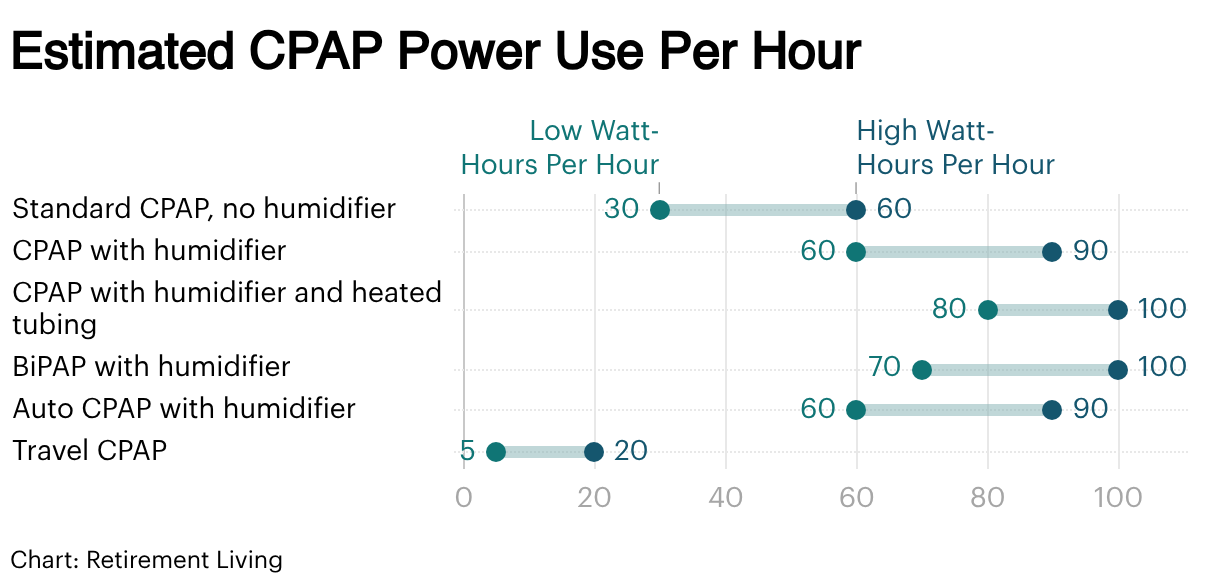
A standard CPAP machine without a humidifier uses 30 to 60 watts. Adding a heated humidifier increases usage to 60 to 100 watts. Heated tubing keeps power draw near the upper end.
BiPAP and auto-adjusting CPAP machines follow similar ranges. Without a humidifier, most use 40 to 70 watts. With humidification, they typically fall between 60 and 100 watts, depending on pressure settings.
Travel CPAP machines draw 5 to 20 watts because they do not include heated components. By comparison, portable oxygen concentrators often draw between 100 and 300 watts, depending on flow rate and model.
Power Ratings for Popular CPAP Models
Most mainstream CPAP machines use similar power supplies:
- The ResMed AirSense 10 uses a 90-watt power supply.
- The AirSense 11 uses a 65 to 90-watt adapter, depending on configuration.
- Philips DreamStation CPAP models typically use an 80-watt power supply when paired with a humidifier.
These numbers reflect maximum capacity, not constant usage. Actual overnight draw is usually lower, especially without heated humidification.
How Much Power Does a CPAP Use in 8 Hours?
Calculate your CPAP’s overnight energy use with this formula:
Wattage × number of hours used = watt-hours
If your machine draws 30 watts for eight hours during a full night’s sleep, it uses 240 watt-hours. If it draws 100 watts for eight hours, it uses 800 watt-hours. Your exact number depends on pressure settings and whether you use heated humidification.
These calculations also help when traveling with portable oxygen concentrators, since both medical devices require advance battery planning.
Now convert that power usage into cost. The average U.S. residential electricity rate in 2025 was about $0.178 per kilowatt-hour. One kilowatt-hour equals 1,000 watt-hours.
If your CPAP uses 400 watt-hours per night, that equals 0.4 kilowatt-hours. At $0.178 per kilowatt-hour, you pay about $0.07 per night, or roughly $2.13 per month.
If your machine uses 800 watt-hours per night, that equals 0.8 kilowatt-hours. That costs about $0.14 per night, or about $4.27 per month. In practical terms, a CPAP uses less electricity than many everyday appliances.

What Affects CPAP Power Consumption?
Here are some factors that determine how much electricity your CPAP machine uses each night.

How Many Amps Does a CPAP Machine Use?
When you plug a CPAP into a standard 120-volt wall outlet or AC outlet, it typically draws between 0.25 and 0.75 amps.
When you run the same device from a 12-volt DC power source, it draws between 2 and 8 amps. Lower voltage requires higher current to deliver the same power.
This difference matters when you size a battery backup system. Battery capacity is measured in amp-hours at a specific voltage, so higher current draw reduces runtime. Use your device’s DC amp rating to estimate how long a lithium-ion battery will last.
What Size Power Station or Battery Do You Need for a CPAP?
Here’s how to determine the right battery or reliable power station size for your CPAP.
How to Estimate CPAP Runtime on a Battery
CPAP Runtime = Battery watt-hours / Nightly CPAP watt-hours
If your CPAP uses 400 watt-hours per night, a 500 watt-hour power station runs it for about one night. A 1,000 watt-hour unit runs it for about two nights.
If your CPAP uses 800 watt-hours per night with heated humidification, a 500 watt-hour unit will not last a full night. A 1,000 watt-hour unit will cover about one night.
Use your highest expected nightly usage when selecting battery size and estimating battery life.
Will a 400-Watt Inverter Run a CPAP?
A 400-watt inverter can run most CPAP machines because these devices typically draw well under 100 watts, even with heated humidification enabled. That leaves significant capacity within a 400-watt continuous rating.
However, wattage alone does not determine compatibility. You should use a pure sine wave inverter, since CPAP machines rely on stable power output to operate correctly.
Before selecting an inverter, check the maximum wattage listed on your CPAP power adapter and review the device’s power requirements. Confirm that your backup power system provides enough continuous output to avoid overload.
Best CPAP Backup Power Options
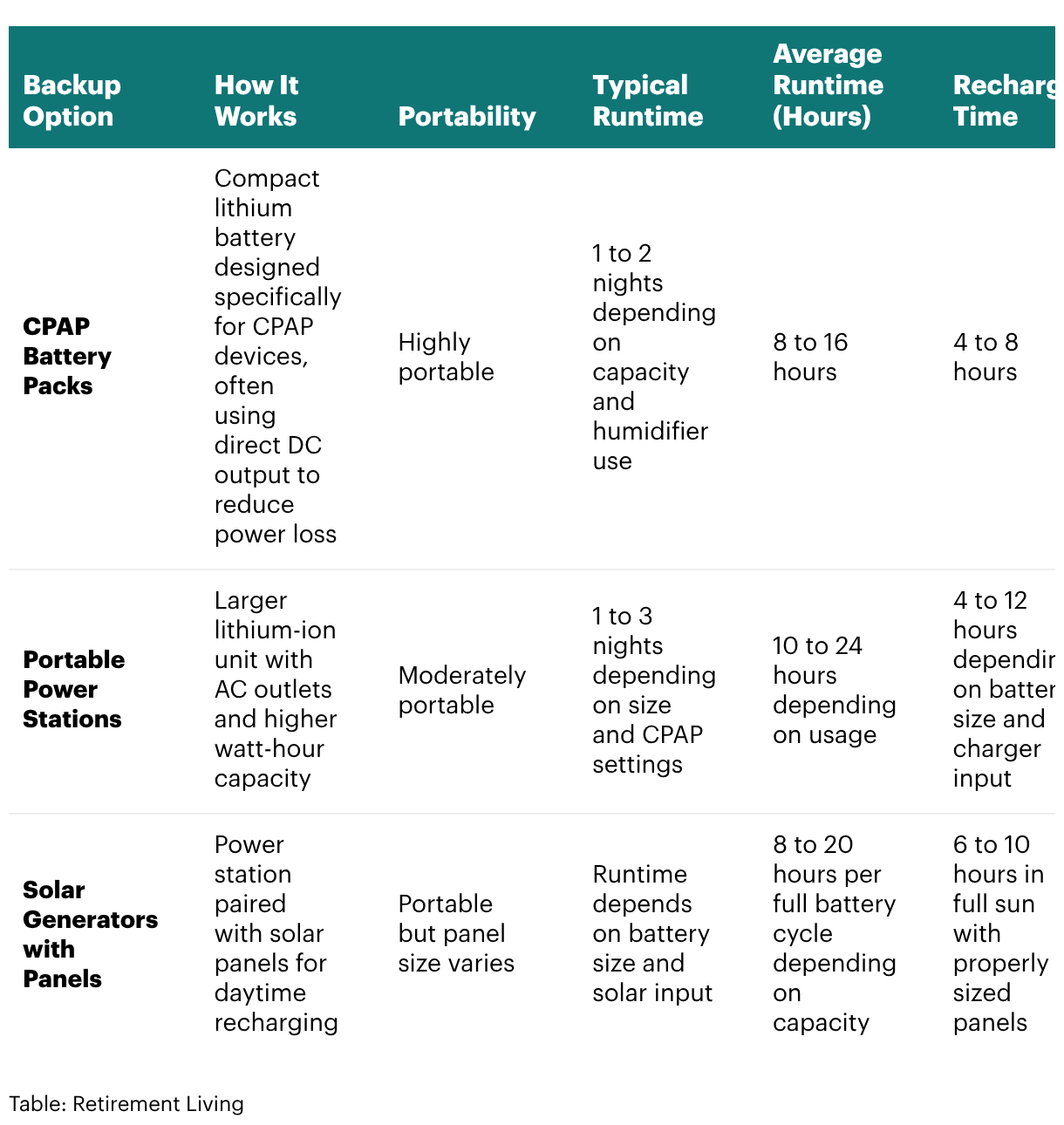
Here are the main backup battery power options to run your CPAP during power outages, travel, or off-grid use, and how to choose the right power solution for your needs.
Does Medicare Cover CPAP Machines?
Medicare Part B covers CPAP therapy for OSA when your doctor documents medical necessity. You must complete a sleep study and receive a formal diagnosis before coverage begins. Medicare typically approves an initial 12-week trial period to confirm that the therapy improves your condition.
CPAP machines qualify as durable medical equipment under Part B. After you meet the 2025 Part B annual deductible of $257, Medicare pays 80% of the approved amount. You pay the remaining 20% unless you carry supplemental insurance that covers that portion.
Medicare treats CPAP equipment as a capped rental. You rent the machine for 13 continuous months through a Medicare-approved supplier. After the 13-month rental period, you own the CPAP device.
Medicare also covers related supplies, including CPAP masks, tubing, and filters, based on a replacement schedule tied to medical guidelines. Coverage does not extend to electricity costs, portable power stations, or portable battery backup systems. It applies only to medically necessary equipment and approved accessories.
Bottom Line
Obstructive sleep apnea remains one of the most common chronic health conditions in the United States. Around 83.7 million adults live with OSA, with men accounting for 59% of cases and women 41%.
Nearly 90% of adults consider sleep apnea a serious medical condition, and a similar share say treatment would be important if diagnosed. Willingness to try CPAP therapy stands at 59%, while many others prefer lifestyle changes or oral appliances. Only a small minority say they would take no action.
By 2050, prevalence of OSA is expected to reach 46.2%, resulting in 76.6 million projected cases among adults ages 30 to 69. Female prevalence is projected to rise 65.4% over the next three decades, outpacing growth among men.
These trends signal sustained demand for CPAP therapy and related equipment. As sleep apnea becomes more common, reliable access to treatment and backup power planning will remain essential for long-term health management.
Fair Use Statement
If you have practical insight or personal experience related to using portable oxygen concentrators, you can share it with us at [email protected]. Any personal information shared will remain confidential.
Sources
- EIA Electric Power Monthly – U.S. Average Residential Electricity Price Data (Evaluated 20 February 2026)
Link here - Respiratory Medicine, ScienceDirect – Unmasking obstructive sleep apnea: Estimated prevalence and impact in the United States (Evaluated 20 February 2026)
Link here - PubMed – Projecting the 30-year burden of obstructive sleep apnoea in the USA: a prospective modelling study (Evaluated 20 February 2026)
Link here - National Sleep Foundation – Understanding Sleep Apnea (Evaluated 20 February 2026)
Link here - JAMA – Positive Airway Pressure, Mortality, and Cardiovascular Risk in Older Adults With Sleep Apnea (Evaluated 20 February 2026)
Link here - ICJS – Investigating Obstructive Sleep Apnea (OSA) in African and Latin Americans from Chicago (Evaluated 20 February 2026)
Link here - Dr. Liran Oren, UC College of Medicine – Discussion on VortexPAP (Evaluated 20 February 2026)
Link here