
Retirement Living takes an unbiased approach to our reviews. We may earn money when you click a partner link. Learn More
Are Stair Lifts Tax Deductible?
Stair lifts are usually tax-deductible when recommended by a doctor and itemized higher than 7.5% of your Adjusted Gross Income (AGI), as long as you submit all proper documentation to the Internal Revenue Service (IRS).


Updated:
At a glance:
- Stair lifts usually fall under IRS Publication 502’s list of deductible medical expenses, allowing you to deduct either part of or the entire cost when you file your taxes.
- To qualify for the tax deduction, you’ll need a doctor’s letter of medical necessity (LMN) and provide all related medical expense receipts. Then, you can list it as an itemized medical expense on Schedule A (Form 1040).
- If your stair lift doesn’t qualify for medical deductions, look for financial assistance through Medicare Advantage (Part C), Medicaid, Veterans Administration (VA) benefits, or local nonprofits.
When seniors with mobility challenges want to age in place but can’t access traditional healthcare coverage for stair lift installations, tax deductions can be a vital way to recoup costs. Even if you pay the full price for one of these much-needed home modifications, guides like IRS Publication 502 allow you to either lower the amount of tax you owe or increase your tax refund—depending on your situation. Read on to learn how you can get a reliable tax deduction for your new stair lift.
What Are IRS Medical Expense Tax Benefits?
For U.S. seniors and families with senior spouses or dependents, the IRS allows itemized deductions for out-of-pocket medical equipment and disability-related home improvements, such as stair lifts.
However, even with present mobility issues, the stair lift still needs to meet certain eligibility requirements. While they’re not categorized as Durable medical equipment (DME), they are considered medically necessary equipment with the proper documentation.
Before you submit your Schedule A (Form 1040), you can see if your installation is eligible on the IRS website. Some examples of deductible medical expenses include:
- Durable medical equipment (DME), including wheelchairs and in-home hospital beds.
- Other medically necessary equipment (often includes stair lifts)
- Health insurance premiums
- Prescription drugs
- Blood sugar monitoring kits
- Glasses, hearing aids, and some dental expenses
- Communication aids
Are Stair Lifts Tax Deductible Under IRS Publication 502?
Stair lifts are typically tax-deductible under IRS Publication 502 as a medically necessary capital expense (home improvement), but approval is on a case-by-case basis. For example, you may be eligible if:
- The primary purpose of the stair lift is medical care for you or a senior spouse/dependent.
- You have a doctor’s recommendation showing that the mobility equipment is medically necessary.
- The total medical expense for the stair lift exceeds 7.5% of your Adjusted Gross Income (AGI).
How Much Can I Deduct For a Stair Lift?
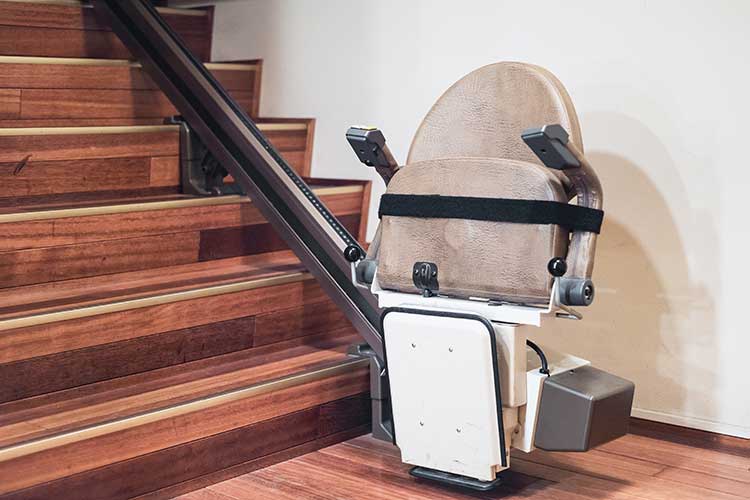
For traditional stair lifts that function using a track fixed securely to the treads, IRS rules often allow full deductions. That’s because you can deduct the full cost of any medical expense that doesn’t substantially increase the home’s value, which traditional stair lifts don’t.
On the other hand, vertical platform lifts (VPLs) and more advanced home elevators are considered to add value to the home, meaning you’ll need to do some math to find the correct deduction. Simply subtract the increase in your home’s value from the total cost of the home elevator to determine the qualified amount. Depending on how much your home value increases, a deduction may or may not be worth it.
How To Properly Submit a Stair Lift Tax Deduction
While we always recommend working with a tax professional to get the best stair lift deduction with minimal headaches, you’re also allowed to submit the forms yourself. Here is a simple, step-by-step guide for taxpayers:
- Gather documentation by compiling receipts and invoices related to your stair lift; installation charges, any necessary home-modification work, and ongoing maintenance or service contracts. You’ll also want written proof of medical necessity given by your health care provider.
- Itemize medical expenses on Schedule A (Form 1040) instead of a standard deduction to report reimbursed medical expenses. Stair lifts are generally treated as capital medical expenses (home improvements).
- Apply the 7.5% AGI threshold to calculated medical expenses for you and your qualified loved ones. Essentially, you can only deduct amounts that exceed 7.5% of your Adjusted Gross Income (AGI). Example: with a $50,000 AGI, only expenses over $3,750 are deductible.
- Complete Schedule A and submit your tax return as usual. If the stair lift was capitalized, follow the instructions for medical home improvements.
- Keep thorough records, like invoices, proof of payment, your doctor’s recommendation, warranties, and any insurance correspondence—just in case you need to resubmit or face an IRS audit.
Other Financial Assistance Methods For Stair Lifts
If your stair lift isn’t tax-deductible, or if you need more immediate financial assistance, there are some healthcare plans and local programs that can help. Unfortunately, Original Medicare (Parts A and B) isn’t included on this list, but other available options are:
Medicare Advantage (Part C)
Some Medicare Advantage plans provide supplemental benefits that cover home accessibility upgrades, like stair lifts, as long as they help seniors age in place. However, because coverage varies by region and plan, access to these benefits will depend on your specific policy.
Medicaid
Medicaid is a joint state-federal program that can help seniors cover home mobility equipment. While each state offers different programs, almost all provide access to unique Home and Community-Based Services (HCBS) waivers that pay for the cost of stair lifts. Start by researching eligibility and specific programs in your area.
Veterans Benefits
Senior veterans and their loved ones can also achieve full or partial coverage through Veterans Benefits, including Veterans Directed Home and Community-Based Services (VD-HCBS), Specially Adapted Housing (SAH) grants, and more. These programs are designed to help seniors who are disabled—especially if the disability is the direct result of service—age in place.
Local Nonprofits
Even if you don’t qualify for certain health insurance, there are local nonprofit organizations that can help. Both Habitat for Humanity’s Aging in Place and Rebuilding Together can help seniors access new and used stair lifts at little to no cost. Visit a nearby Area Agency on Aging (AAA) for more information.
Health Savings Accounts (HSAs)
HSAs are savings accounts that allow seniors to make tax-free withdrawals for approved medical expenses. Stair lifts may also qualify for certain reimbursements, but you should check with your HSA administrator to confirm eligibility.
Bottom Line
Stair lifts can be a crucial medical necessity for seniors looking to age in place, and they’re often tax-deductible under IRS Publication 502. This allows seniors and qualified loved ones to either pay less in taxes or earn more on their tax returns, depending on their income source.
Not sure if you’re eligible? Reach out to a tax professional today to learn how you can get money back for certain medical expenses this upcoming tax season.
Frequently Asked Questions About Stair Lift Tax Deductions
Home improvements like stair lifts are tax-deductible when:
– Your doctor recommends it as a medical necessity
– The total cost exceeds 7.5% of your Adjusted Gross Income (AGI)
– The installation doesn’t increase your home value
Before you file your taxes, you’ll need a written letter of medical necessity (LMN) from your doctor, receipts for equipment and installation, and any maintenance bills. You will then submit this information in a Schedule A (Form 1040) as part of your income tax returns.
Stair lifts typically cost between $2,500 and $14,000 out-of-pocket, meaning that if you make less than $30,000 a year, you should qualify for a tax deduction. However, seniors with higher incomes are less likely to qualify, as the lift may not exceed 7.5% of AGI.
Yes, used stair lifts are tax-deductible, provided they meet the same eligibility requirements. However, they’re less likely to fall under the AGI threshold due to lower upfront costs.
If your stair lift isn’t tax-deductible, you may have options for financial assistance. As long as the installation is medically necessary, healthcare options like Medicare Advantage, Medicaid, and some Veterans Benefits can help. If you can’t get a letter from the doctor, local nonprofits can also help.
Yes, you can usually use your HSA funds to reimburse for medically necessary equipment, such as stair lifts, but you should check with your HSA administrator to confirm eligibility.
Help us improve our cost data! Email your latest stair lift quote to [email protected]. Rest assured, your personal details will remain completely confidential.