
Retirement Living takes an unbiased approach to our reviews. We may earn money when you click a partner link. Learn More
The Latest in Stair Lift Technology
The future of stairlifts continues to improve in terms of usability, space efficiency, and intuitiveness, making independent living more feasible than ever before.


Updated:
At a glance:
- Modern stair lifts mount to stair treads, not walls, reducing damage and allowing flexible, customized fits.
- Options like swivel and perch seats improve ease of use for those with limited mobility or narrow staircases.
- New models include obstacle sensors, gentle starts/stops, backup batteries, and pressure-sensitive controls.
Technological advancements in stair lifts are developing rapidly as the demand for safer, more intelligent, and customized mobility solutions increases. To enhance user experience and safety, stair lift innovations are focusing on advanced sensors, AI-powered controls, and integration with smart home systems. More adaptable features that meet a greater range of mobility needs, sleeker designs, increased energy efficiency, and quieter motors are all to be expected.
Let’s explore the latest stair lift technology you should look for as you search for the best stair lift for your home.
Stair Lift Rails
In the past, stair lifts were secured to both the stairs and wall studs, resulting in intrusive installations and potential damage to the wall if they were removed.
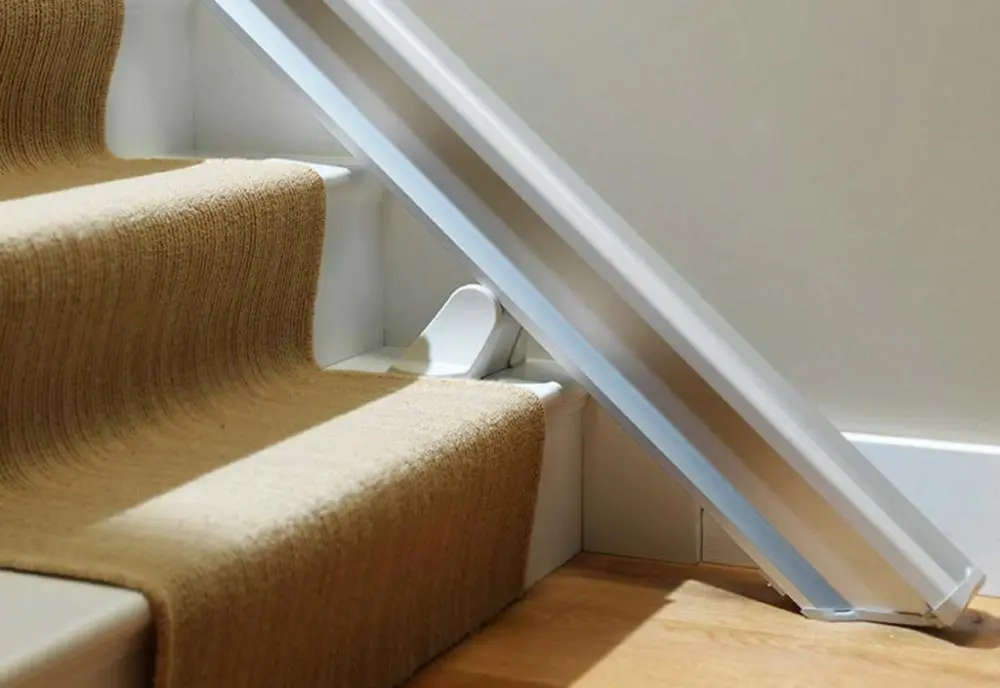
Today, nearly all stair lift models are attached to stronger rails and supports that are secured only to the treads of your stairs. This modern installation method is cleaner, faster, and avoids damage to walls. Though rare, some models may still require a wall support bracket.
Additionally, custom-fitted rails are now the norm. Previously, custom stair lifts required rails to be individually designed and cut to match your staircase. Now, modular rail systems allow for easier adjustments and faster on-site fitting. This is especially helpful for curved staircases, as rail pieces can be fitted together on-site to match the staircase’s shape.
Finally, hinged rails make installation possible in tighter spaces, such as doorways or on narrow staircases. When not in use, the space-saving stair lift travels to the top, allowing the hinged rail to fold up and clear the bottom of the stairs. Both manual and powered hinged rail options are available, with the power version raising or lowering with the push of a button.
Automatic hinged rail activates when the lift is in motion and includes safety features like lights and buzzers to alert nearby users. A buzzer will also sound if the hinge remains down, preventing potential tripping hazards.
Source: Stannah
Stair Lift Seats
Stair lifts assist those with limited mobility, many of whom may find bending down or twisting painful. All lifts come with adjustable armrests that provide added comfort and support, making it easier for homeowners or family members to safely sit and stand during their ride.
Swivel seats: Swivel seats let users exit onto the landing without twisting on the stairs. Some models swivel manually, while others swivel automatically for added convenience. Most power swivel seats come with a locking feature.
Perch seats: Perch seats, newer in today’s designs, resemble barstools. They require minimal bending and transport users in a nearly upright position. They’re ideal for narrow stairways, and can often fit where traditional stair lifts couldn’t.
Types of Stair Lifts
There are numerous types of stair lifts to suit various home and mobility challenges. The most common types are:
- Straight Stair Lifts: These are made for staircases that lack landings or curves. Due to their straightforward, linear rail system, they are usually more affordable and easier to install.
- Curved Stair Lifts: Specifically designed to accommodate staircases with spiral, turn, or landing designs, curved stair lifts feature precisely shaped modular rails shaped to navigate the staircase safely and smoothly.
- Outdoor Stair Lifts: Outdoor stair lifts are made with weather-resistant, high-quality materials and protective coatings that can withstand rain, snow, and other weather conditions.
Each type offers unique benefits and can be tailored to the specific needs and layout of your home.
Stair Lift Safety
Several new or improved safety features and functionality are common in modern stair lifts. These include:
- Start and stop: Modern stair lifts are designed to be user-friendly, starting and stopping smoothly, which reduces the jolt common in older models–a key benefit for those with aching joints.
- Sensors: Smart sensors in the chair’s footrest detect objects and stop the lift automatically. This feature is especially helpful in homes with pets or small children.
- Backup battery: Modern stair lifts use DC power and include backup batteries that activate during power outages. The battery automatically charges when your chair lift is not in use and holds enough power for around six to eight trips.
- Speed limiter: Stair lifts typically travel at 0.16 to 0.34 mph and include speed governors to ensure safe, consistent motion.
- Pressure-sensitive operation: Many modern stair lift models come with a pressure-sensitive control, similar to a joystick. The user must hold the control for the stair lift to move, and once the control is released, the stair lift stops automatically. Most models also include emergency stop buttons for added safety.
Stair Lift Controls and Power
A few notable improvements to how stair lifts are controlled and how they operate include:
- Remote controls: Remote controls address concerns about the lift being on the opposite floor. Previously, stair lifts relied on wired call buttons installed at both landings, resulting in a more complicated stair lift installation process. Modern stair lifts come with remote controls that are held in a wall-mounted cradle.
- DC power: Older models relied on trailing power cables, which created tripping hazards. Modern DC-powered motors are strong enough to move adults and are self-contained inside the chair, eliminating the need for trailing wires. They are also designed with energy efficiency in mind.
- Weight capacity: Thanks to improved stair lift rails, power, and overall structure, modern heavy duty stairlift models can carry a maximum weight of around 250 to 350 pounds.
The Bottom Line
Today’s stair lifts offer a smoother, safer ride, are far less permanent and damaging to walls, and can fit in locations where older models couldn’t.
Most manufacturers have showrooms where you or your loved one can test different models and features in person. If you last looked into stair lifts a few years ago, today’s advancements offer several new reasons to consider investing.
For tips to stay safe and mobile in your home, check out our Stair Lift Troubleshooting Guide.