
Retirement Living takes an unbiased approach to our reviews. We may earn money when you click a partner link. Learn More
Historical Gold Prices
Learn how gold prices changed over the last 100 years, what drives those changes, and what the data means for your retirement decisions today.


Updated:
At a glance:
- Gold prices have surged over 16,000% in the last century, acting as a safe-haven asset during economic crises and currency fluctuations.
- Central bank buying, inflation, and a weakening U.S. dollar have driven recent gold price spikes, including a 38% increase in 2025.
- For retirement planning, gold works best as part of a diversified portfolio rather than a standalone investment.
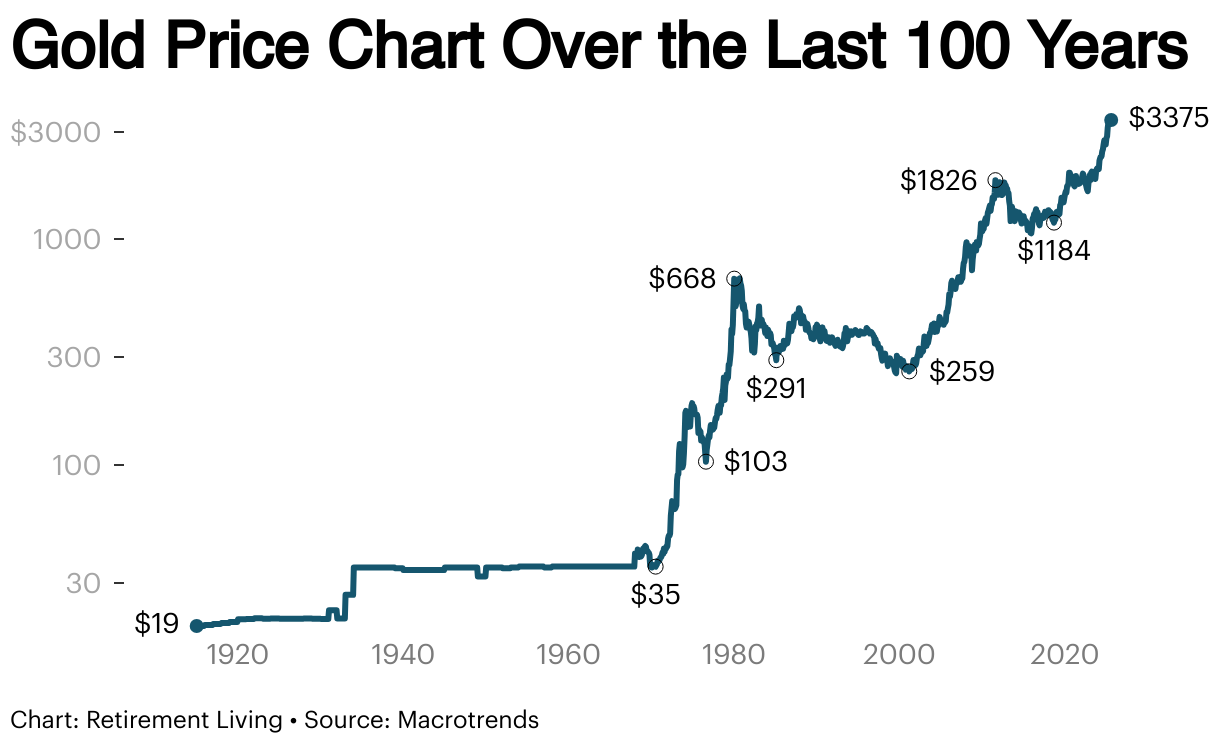
Gold prices have risen by more than 16,000% over the past century. The metal has held its value through wars, recessions, volatility, inflation, and currency shifts. Throughout history, gold has played a role as a safe-haven investment when stock markets and the U.S. dollar face uncertainty.
Current Gold Price
As of August 2025, gold trades at $3,343.78 per troy ounce. This figure reflects the real-time spot price of gold in U.S. dollars.
In 1925, gold traded at $20.67 per troy ounce. Compared with today, this marks a large long-term increase over the last 100 years. The growth shows how gold has held its role as a store of value during times of economic uncertainty.
Other precious metals have also grown significantly. Silver has increased by 5,422% since 1925, platinum by 464% since 1969, and palladium by 1,956% since 1977.
Gold prices, like those of other metals, change daily with global supply and demand, currency exchange rates, and economic policy decisions from the Federal Reserve and central banks.
Understanding Gold Prices and Historical Data
Metal prices are based on the spot price, which is the cost for immediate delivery in the global market. A troy ounce, about 31.1 grams, is the standard unit used for all precious metals.
Prices are quoted in U.S. dollars, so changes in the dollar or other major currencies like the euro can raise or lower gold’s value worldwide.
Real-time data shows daily price movements, while historical data tracks long-term trends so you can compare the current price with decades of past performance.
Gold Price History Over Time
Looking at gold prices across this timeframe shows how economic events shaped its value. Let’s take a look at the long-term price trends, how gold reacted during financial crises, and the impact of the U.S. dollar and global policies on gold spot price movements.
Gold Prices During Recessions and Crises
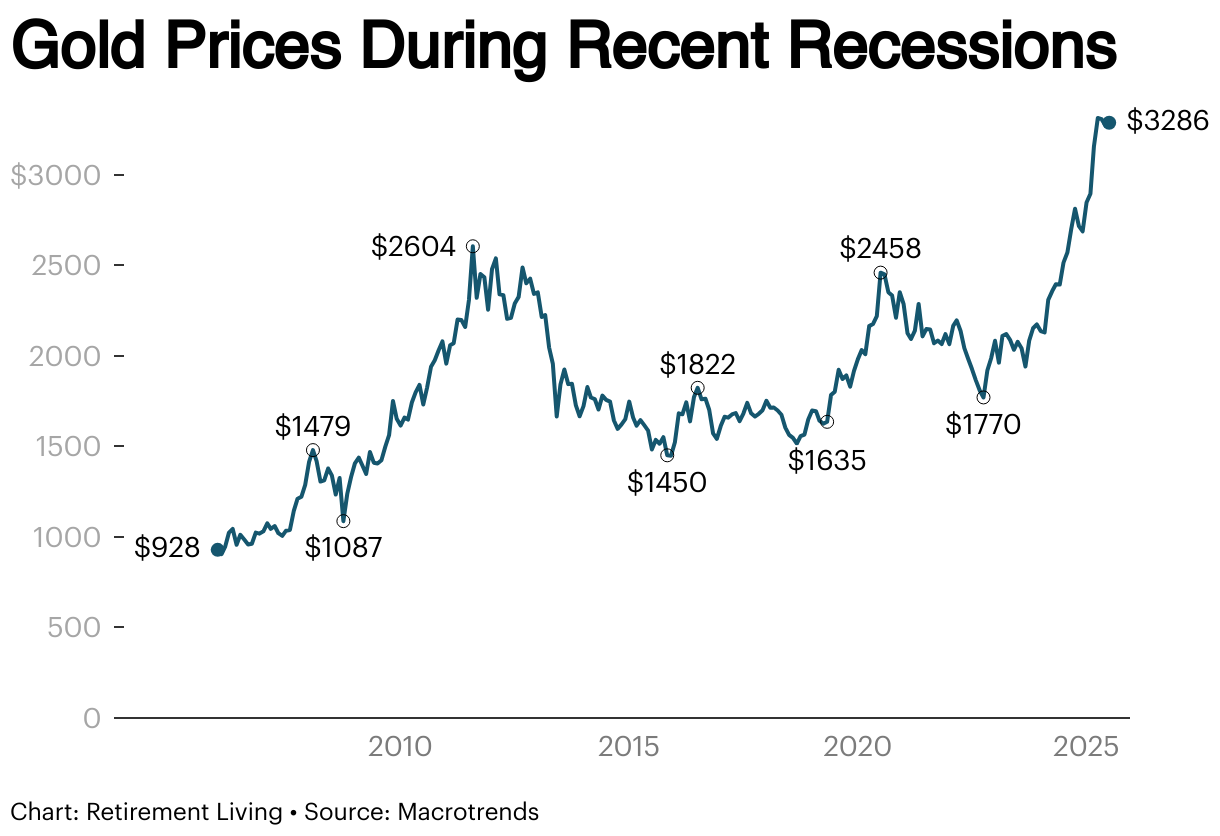
Gold prices often rise during periods of economic and political stress. During the 2008 financial crisis, prices increased 2.6% in 2008 and 12.8% in 2009 as markets recovered. In 2020, the COVID-19 shock pushed prices from $1,517 to $1,712 per ounce as investors sought stability.
Central banks expanded gold reserves in recent years to reduce reliance on the U.S. dollar and protect against financial shocks. In 2024, they purchased over 1,045 metric tons for the third consecutive year. This buying was driven by global inflation, high interest rates, and rising geopolitical tensions. These factors increased gold’s appeal as a reliable reserve asset.
By the first half of 2025, gold prices rose 26% as the dollar weakened, interest rates stayed high, and global tensions increased. As of mid-August 2025, prices range between $3,340 and $3,370 per ounce, up from an average of $2,860 in the first quarter.
That is a 38% increase over the same period last year. Central banks bought 244 tonnes in the first quarter and 166 tonnes in the second, keeping purchases well above historical averages.
Gold Prices vs. the U.S. Dollar
Gold prices often move opposite the U.S. dollar. When the dollar weakens, the market price of gold becomes cheaper in other currencies, lifting global demand. A stronger dollar makes gold more expensive abroad, often pushing prices down.
Interest rates shape this trend. Trade policies and tariff changes can also influence gold demand and pricing globally. Lower rates weaken the dollar and often raise gold demand.
Since the 1970s, the USD Index (DXY) has swung sharply during crises and policy shifts. Periods of dollar weakness, such as the 1970s inflation era and recent post-pandemic years, often align with major gold price spikes.

Is Now a Good Time to Buy Gold?
Gold prices have climbed sharply in 2025. That leaves you wondering whether it still makes sense to invest in gold now or wait.
Whether now is a good time to buy gold depends on timing, cost, and your long-term goals. The gold market often rises when inflation is high or the dollar weakens. It can also lose value if interest rates climb or the economy strengthens.
When buying gold, keep these points in mind:
- Avoid rushing in right after a large price jump. Adding gold gradually spreads out the risk of price swings.
- Decide whether to buy physical gold, such as gold bars or coins, or financial products like ETFs or IRAs. Each comes with different costs and gold storage needs.
- Gold pays no interest or dividends. The value of gold depends entirely on price changes over time.
- Physical gold requires storage and insurance. Paper gold products avoid storage issues but carry management fees.
- Gold works best as part of a balanced retirement plan. Relying on it alone increases risk
If your goal is to protect savings from inflation or market shocks, hold gold as one part of a balanced retirement plan. How much to buy, and when, depends on your income needs, comfort with risk, and investment timeline.
Gold IRA Accounts: Best Options for Retirement Savers
If you want to hold gold as part of your retirement plan, one option is a gold IRA. A Gold IRA is a type of self-directed individual retirement account that lets you own physical gold such as gold coins or bars instead of traditional assets such as stocks or bonds. The account follows the same tax rules as a regular IRA but adds the benefit of diversifying into tangible assets.
Unlike traditional IRAs that hold stocks or bonds, a Gold IRA can help protect savings from inflation, currency changes, and market downturns. Historical price data shows that gold often keeps its value during times when other assets lose ground, making it useful for long-term stability.
If you decide to open a Gold IRA, start by reviewing the best gold IRA companies. Focus on providers with transparent fees, reliable customer support, and secure storage options. Some of the top choices include:
- American Hartford Gold: Specializes in gold and silver IRAs with no buyback fees and same-day account setup. Qualified accounts can receive up to $15,000 in free silver and benefit from multiple IRS-approved storage options.
- Patriot Gold Group: Known for its no-fee-for-life IRA when balance minimums are met. Offers 24-hour account setup and a dealer-direct model to reduce costs on gold, silver, platinum, and palladium purchases.
- Goldco: Helps roll over existing retirement accounts into self-directed Gold IRAs with IRS-approved metals. Stands out for strong customer support, transparent costs, and flexible storage partnerships.
- Birch Gold Group: Provides gold, silver, platinum, and palladium IRAs with a focus on investor education. Offers multiple storage choices and ongoing guidance for long-term portfolio diversification.
Help us improve our gold investment resources! If you’ve recently opened a Gold IRA or requested a quote from a dealer, email us at [email protected]. Your personal details will remain completely confidential.