
Retirement Living takes an unbiased approach to our reviews. We may earn money when you click a partner link. Learn More
Shaftless Home Elevators: Cost, Installation & Capabilities
The average shaftless elevator costs about $34,500 with installation, making them more affordable than both traction and hydraulic elevators.


Updated:
At a glance:
- Shaftless lift parts and installation cost between $9,000 – $60,000 on average, depending on the type of elevator, floor plan, and additional safety features.
- Shaftless elevator types include through-the-floor elevators, pneumatic vacuum elevators (PVE), and vertical platform lifts (VPL).
- Shaftless elevators help save floor space because they operate without a hoistway or a separate machine room.
Shaftless elevators are more space-saving and affordable than other residential elevator options. But they come with their own pros and cons that you should be aware of. From shaftless home elevator costs to the installation process, our team of elevator experts researched all the essentials. That way, seniors can make home lift investment decisions with peace of mind.
What is a Shaftless Elevator?
Shaftless elevators are a vertical mobility solution for seniors with limited space and finances. Unlike traditional elevators, shaftless elevators work without a shaftway or a separate machine room.
Instead, the elevator car uses guide rails installed along a cutout between two floors to move between them. The car can be powered either electrically, including battery backups for power outages, or by specialized air-pressure systems. As the elevator travels between floors, built-in safety sensors and interlocks keep seniors secure, automatically stopping if an obstruction is detected.
This compact design simplifies the new installation or retrofitting process, allowing seniors to achieve mobility with minimal remodeling.
Types of Shaftless Elevators for Homes
While stair lifts are sometimes cited as shaftless elevators, they technically fall into a separate category of home modification devices. In general, there are three distinct types of shaftless elevators seniors can choose from:
- Through-the-floor elevators are compact lifts that utilize a cutout in the floor to travel between levels. The electric-powered system safely seals the floor when not in use and efficiently powers the elevator car up and down.
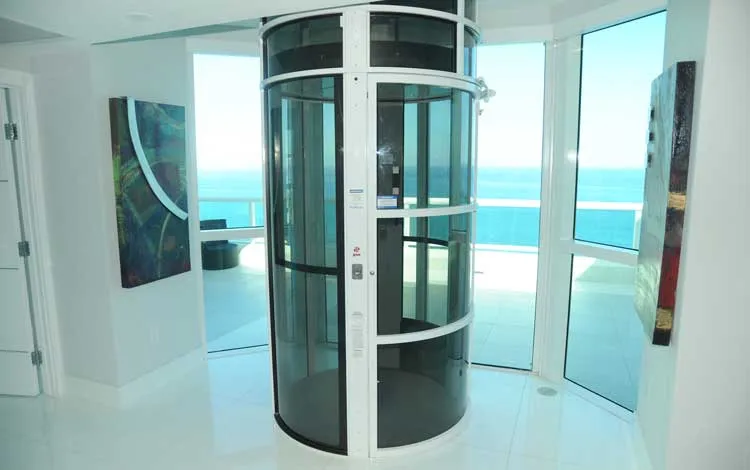
- Vacuum elevators, otherwise known as pneumatic elevators, use air pressure to lift and lower a cylindrical elevator car within a sealed tube. This means that the system requires no cables or counterweights. They take up less space because the system serves as both the hoistway and the car enclosure.
- Vertical platform lifts (VPLs), also known as wheelchair lifts, are open-style, shaftless elevators designed for stairway compatibility. They typically use a motor and drive mechanism to lift and lower a platform along a vertical tower adjacent to the stairs. Their limited travel distance makes them ideal for small-footprint installations, such as porch-to-entry access.
Each type of shaftless elevator has unique pros and cons, depending on your home layout and specific mobility needs. While all of them tend to be more affordable than traditional options, we still recommend getting quotes from manufacturers for specific pricing information.
Comparing Shaftless Elevator Capabilities to Other Residential Elevators
Before we dive deeper into general costs and specific brands, it’s important to understand how shaftless elevators compare to hydraulic or traction elevators. If you’re a senior looking to invest, here are some differences you should keep in mind:
- Space requirements: Shaftless elevators are ideal for seniors with limited space, as they operate without a hoistway or a separate machine room. Other elevator options often require both, resulting in expensive structural changes and increased long-term maintenance costs.
- Travel distance: Most shaftless elevators can travel 14-20 ft (about two floors), limiting their travel height compared to other options. Traction elevators, for example, can reach up to 300 ft.
- Ride speed: Shaftless elevators move at a gentle, steady pace of 20-30 ft/min, with no starts or stops. Hydraulic and traction elevators may travel faster, but they also require more complex machinery.
- Weight capacity: Many shaftless elevators can hold up to 500 lbs, which is ideal for one to two passengers or one wheelchair user. Traditional home elevators can move up to 1,000 lbs or more, but require stronger structural support.
- Safety features: Like traditional options, shaftless elevators include built-in safety sensors and an emergency stop mechanism to keep riders protected.
Shaftless elevators generally have the same capabilities as their traditional counterparts, but with limitations due to their smaller construction. This makes them ideal for homes that only have one extra floor.
Shaftless Home Elevator Cost: Equipment & Installation
The average cost of a shaftless home elevator, including the elevator car, installation equipment, and labor, ranges from $9,000 – $60,000. The price depends on the type of elevator, floor plan, added safety features, and even your state/region. Here’s what homeowners might expect to pay based on elevator type:
- Through-the-floor elevators: $15,000 – $30,000
- Vacuum elevators: $20,000 – $60,000
- Vertical platform lifts: $9,000 – $20,000
Shaftless Home Lift Installation Process
Shaftless home elevator installations are typically faster and less invasive than other elevator projects. Rather than needing major structural changes, most only require a small floor cutout and basic electrical connections. This process can take as little as a few days to a week, as technicians simply need to prepare the floor opening and reinforce the surrounding structure. Once the space is ready, the elevator car and guide rails are assembled, wired, and tested for safety and smooth operation.
Labor costs will account for a significant portion of the total price you pay, and they vary greatly by region. For example, if you’re in a well-populated area with a high concentration of seniors, you might pay only a few thousand. Seniors living in rural areas can expect to pay more—up to $10,000 for full installation services.
Overall, through-the-floor elevators fall on the lower end of expected labor costs. Vacuum or vertical platform lifts may cost more due to specialized components or electrical work.
The Best Shaftless Home Elevator Manufacturers
We’ve compared a few popular shaftless elevator brands, including their type and price ranges:
| Brand/Model | Elevator Type | Starting Price |
|---|---|---|
| Lifeway Mobility Wessex | Through-the-floor | $35,000 |
| Lifeway Mobility Savaria Telecab | Through-the-floor | $30,000 |
| Arrow Lift Shaftless | Through-the-floor | $30,000 |
| Mobility123 TrioAlta | Through-the-floor | $29,000 |
| Mobility123 Stiltz | Through-the-floor | $25,000 |
| Stannah Uplifts S2 / S3 | Through-the-floor | $20,000 |
| Arrow Lift Pneumatic Vacuum | Vacuum elevator | $35,000 |
| Pneumatic Vacuum Elevators PVE37 | Vacuum elevator | $35,000 |
| Savaria Multilift Vertical Platform Lift | Vertical Platform Lift (VPL) | $11,000 |
| Harmar Highlander II / VPL400-X | Vertical Platform Lift (VPL) | $7,000 |
The Bottom Line
Shaftless elevators are among the most affordable and least intrusive lift options for seniors, helping them move between at least two floors. Whether you need help navigating to your porch, basement, or upstairs bedroom, there’s a type of shaftless elevator that will work for your home. Just keep in mind that, while cheaper, these models will cost anywhere from $9,000 – $60,000+ to install.
Frequently Asked Questions
Shaftless home elevators cost between $9,000 and $60,000. VPLs are on the lower end of the price range, and vacuum elevators are typically the most expensive. Overall, seniors can expect to pay around $30,000 for many models.
Neither Medicare nor most private insurances cover the cost of a new shaftless home elevator. You may be able to get financial assistance if you can prove it’s a medical necessity. We recommend reaching out to your local Agency on Aging (AAA) for helpful information about insurance and non-profit assistance.
The installation process for shaftless lifts depends on the type, but typically involves cutting a hole in the floor(s), assembling the elevator car and guide rails, and providing a safe power source. Many are electrical, though vacuum elevators use an air pressure system.
The best elevator for your home depends on the available space, your mobility needs, and your budget. Through-the-floor elevators offer a compact, reliable solution for two-story homes, but require more remodeling than vertical platform lifts (VPLs). VPLs don’t require a hole in the floor, but are only practical for short vertical distances—like porch-to-entry access. Vacuum elevators use air pressure for a self-contained design and panoramic views, but usually cost more.
When deciding between shaftless vs. shafted elevators, shaftless options like through-the-floor lifts, VPLs, and vacuum elevators are best for short travel distances and limited space, while shafted elevators are better suited for larger homes or longer vertical travel.
Yes, shaftless elevators save space because they don’t require a hoistway or separate machine room to function. This saves homeowners significant time and money on required renovations.
Yes, shaftless elevators, and especially VPLs/wheelchair lifts, are a great option for wheelchair users. While they may not be as heavy-duty as traction elevators, they still have more than enough weight capacity to transport wheelchairs vertically.
Shaftless elevator maintenance ranges from $250 to $900 per year, depending on the type of elevator, usage level, and age. You can help prevent downtime or costly repairs by:
– Scheduling routine inspections for the drive system and cables every 12 months
– Checking for wear or unusual noises
– Regularly lubricating the moving components
– Keeping the area around the elevator free from debris.
Help us improve our resources! Email your recent shaftless elevator quote to [email protected]. And don’t worry, your personal details will remain confidential.