
Retirement Living takes an unbiased approach to our reviews. We may earn money when you click a partner link. Learn More
Are Walk-In Tubs Tax Deductible?
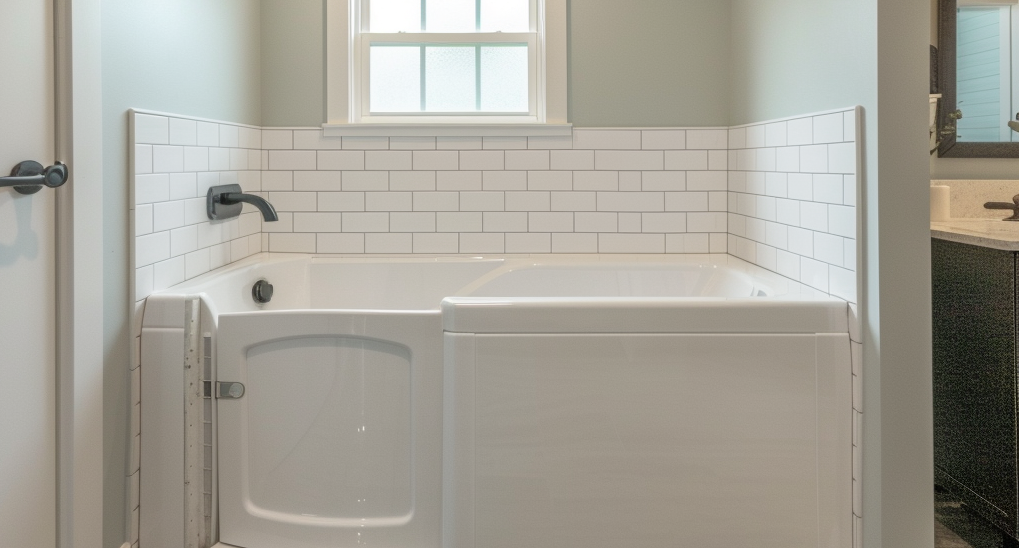
Walk-in tubs are usually tax-deductible when recommended by a doctor for medical reasons, as their high cost ($13,000 on average) often meets the IRS 7.5% adjusted gross income (AGI) threshold for medical expense deductions.


Updated:
AT A GLANCE:
- Bathroom upgrades for medical care, including walk-in bathtubs and showers, fall under IRS Publication 502’s list of deductible medical expenses. You can list them as an itemized medical expense on Schedule A (Form 1040).
- To qualify for a partial or full deduction, you’ll need to submit a doctor’s letter of medical necessity (LMN) and any related medical expense receipts.
- If your bathroom remodel isn’t eligible for a tax deduction, you can also get financial assistance through Medicaid, Medicare Advantage (Part C), Veterans Administration (VA) benefits, and various grants like the USDA Rural Repair & Rehabilitation grant.
For seniors with mobility issues looking to age in place, walk-in tubs and their safety features provide peace of mind by reducing fall risk. However, when installation costs are high and your healthcare plan won’t provide coverage, tax deductions can serve as a vital way to recoup expenses.
Come tax season, you can use guides like IRS Publication 502 to deduct some of the money you spent on your walk-in tub, lowering the amount of tax you owe or increasing your tax refund. Read on to learn more about how you can qualify for this option.
What Do IRS Medical Expense Tax Benefits Cover?
For U.S. seniors with limited mobility related to a disability or medical condition, the IRS allows itemized deductions for certain out-of-pocket medical equipment and home improvements. You’ll need to fill out and submit a Schedule A (Form 1040) with your taxes to receive the deduction.
Examples of deductible medical expenses include:
- Durable medical equipment (DME)
- Other medically necessary equipment (often includes walk-in tubs)
- Health insurance premiums
- Prescription drugs
- Blood sugar monitoring kits
- Glasses, hearing aids, and some dental expenses
- Communication aids
While walk-in tubs are not considered DME, they can meet the eligibility requirements with the right documentation. However, that doesn’t mean you’ll get a full reimbursement, since most walk-in tubs are considered capital expenses. That means you’re only allowed to deduct the part of the tub’s cost that goes beyond any increase in your home’s value.
Ultimately, if you’re unsure of how IRS tax deductions apply to your walk-in tub, we recommend reviewing eligibility information at IRS.gov.
Are Walk-In Tubs Under IRS Publication 502?
While deductions are approved on a case-by-case basis, both walk-in showers and tubs usually qualify as medically necessary capital expenses (home improvements). Your new tub will likely be eligible if:
- Its primary purpose is medical care for you or a senior spouse/dependent.
- You have an LMN from your doctor that states the tub is essential for addressing a disability or medical condition.
- The total medical expense exceeds 7.5% of your adjusted gross income (AGI).
Is My Walk-In Tub a Medical Necessity?
Walk-in tubs featuring hydrotherapy jets, grab bars, and entry doors have several health benefits, but to get an LMN from your doctor, you’ll need to have a medical explanation for why bathing in a traditional tub is unsafe. Examples include:
- Disabilities that cause limited mobility
- Conditions that increase fall risk
- Being a walker or wheelchair user
Often, seniors with arthritis, diabetes, osteoporosis, Parkinson’s disease, balance disorders, or chronic pain will qualify. However, it’s always best to ask your doctor before you invest.
How Much of The Cost of a Walk-In Tub Can I Deduct?
The amount you can deduct from the cost of a walk-in tub usually depends on two IRS rules: the 7.5% AGI threshold and whether the tub is considered a capital expense.
Understanding the 7.5% AGI Threshold
According to the IRS, your adjusted gross income (AGI) is your total (gross) income from all sources minus specific adjustments, such as contributions to a traditional IRA, student loan interest, etc. To qualify for a tax deduction, your walk-in tub must exceed 7.5% of your adjusted gross income (AGI) for the year. You can determine if this is the case by:
- Adding up all qualified medical expenses for the year, including walk-in tub costs.
- Calculating what 7.5% of your AGI is, as any expense above this “floor” amount is deductible.
- Subtract this floor from total medical expenses to find the amount you can deduct.
Luckily, walk-in tubs are high-cost medical improvements, so they often meet or exceed the AGI threshold. For example, if your new installation costs $13,000 and your AGI is $60,000, 7.5% would equal $4,500. Once you subtract that number from the tub’s cost ($13,000 – $4,500), you get a deductible of $8,500.
Understanding Capital Expense Rules
Most walk-in tubs are considered capital expenses because they often add value to your home. When this is the case, the amount you can deduct is limited, as only the portion of the cost that does not increase your home’s value qualifies.
To calculate your deduction, subtract the increase in home value (determined by an appraisal, if needed) from the total cost of the tub. The remaining amount is the portion treated as a medical expense.
For example, if your walk-in tub costs $13,000 but increases your home’s value by $5,000, only the difference of $8,000 is deductible.
Steps To Claiming a Walk-In Tub Tax Deduction
Working with a tax professional is a surefire way to get the best walk-in tub deduction, but you’re also allowed to submit the forms yourself. If you choose this route, here’s a step-by-step guide for senior homeowners and taxpayers:
- Gather documentation by collecting any receipts or invoices related to walk-in tub installation, including fixtures (handrails, grab bars, etc.), hydrotherapy features, and any necessary home-modification work you paid for. You’ll also want to contact your health care provider for an LMN.
- Itemize medical expenses on Schedule A (Form 1040) to specifically report medical expenses. Walk-in tubs are generally treated as capital medical expenses (home improvements).
- Apply the 7.5% AGI threshold to the cost of your walk-in tub installation to determine how much of the cost you can deduct.
- Calculate the increased home value to identify how much of the walk-in tub’s cost qualifies as a medical expense.
- Complete Schedule A and submit your tax return as usual. If the walk-in tub was capitalized, follow the instructions for medical home improvements.
- Keep thorough records, including the LMN, invoices, proof of payment, and warranty and insurance information—just in case you need to resubmit or face an IRS audit.
Other Ways To Get Financial Assistance For Your Walk-In Tub
If the AGI threshold or increase to your home’s value makes a tax deduction less viable, there are other ways to get financial assistance for walk-in tubs. Even if Original Medicare (Parts A and B) doesn’t cover the cost, other healthcare plans, grants, and local programs are all available to you.
- Medicare Advantage: Approvals can be rare, but if you have an LMN for the walk-in tub provided by your doctor, you may be able to cover or reimburse the cost.
- Medicaid programs: These joint state-federal plans often offer Home and Community-Based Services (HCBS) Waivers that cover the cost of walk-in tubs, but availability varies by state.
- Veterans benefits: Both health insurance and grant assistance are available to senior veterans through the Department of Veterans Affairs (VA). For example, you may be able to access Veteran Directed Care funds, SHA/SAH housing grants, HISA grants, and pension boosts through Aid & Attendance.
- State-based assistance: Medicaid programs are partially state-based, but other fully state-funded programs, like Nevada’s Assistive Technology Program, Indiana’s CHOICE, and Minnesota’s CADI waivers, all provide assistance for walk-in tubs.
- USDA Rural Repair & Rehabilitation grant: Low-income senior homeowners in rural areas may qualify for up to $7,500 toward a walk-in tub.
- Nonprofit support: Certain local organizations, like Habitat for Humanity’s Aging in Place and Rebuilding Together’s Safe at Home, can provide free or reduced-cost home modifications.
The Bottom Line: Medically-Necessary Walk-in Bathtubs Are Tax-Deductible Under IRS Publication 502
For seniors with a high fall risk who want to age in place, walk-in tubs serve as a vital way to maintain well-being. In turn, this means they’re usually tax-deductible under IRS Publication 502—as long as you can prove the installation is a medical necessity.
All you need to do is itemize your medical expenses on Schedule A and file it with your regular taxes, then enjoy either paying less or a higher tax return. Of course, if the tax deduction doesn’t work for you, you can also consider alternative financial assistance methods.
Not sure if you’re eligible? We always recommend reaching out to a tax professional to determine your next steps.
FAQs About Walk-In Tub Tax Deductions
Home improvements like walk-in tubs are tax-deductible when:
– Your doctor recommends it as a medical necessity
– The total cost exceeds 7.5% of your adjusted gross income (AGI)
– The increase in home value doesn’t exceed installation costs
You’ll need to gather a few documents before you file your taxes, including a written letter of medical necessity (LMN) from your doctor and receipts for the installation. You can then submit these documents in a Schedule A (Form 1040) as part of your income tax returns.
The average cost for a walk-in tub is $13,000, ranging between $2,300 for a basic soaker to $25,000 for advanced hydrotherapy features. Prices vary widely by brand, with options like Kohler and Safe Step being more expensive but also offering more safety features.
Walk-in tubs start at $2,300, which means the AGI threshold for the cheapest models is around $30,000. However, given that the average cost is $13,000, most seniors who make less than $100,000 per year should qualify for the deduction.
If the walk-in tub increases your home value, you can only deduct the portion of the expense that did not contribute to the increase. For example, if the installation $13,000 but increases your home’s value by $5,000, only the difference of $8,000 is deductible.
If the walk-in tub doesn’t qualify for a tax deduction, you can get financial assistance elsewhere. Medicaid, Veterans Benefits, state programs, and local nonprofits can all help, especially if the installation is deemed a medical necessity.
Help us improve our cost data! Email your latest walk-in tub quote to [email protected]. Rest assured, your personal details will remain completely confidential.