
Retirement Living takes an unbiased approach to our reviews. We may earn money when you click a partner link. Learn More
Does Medicaid Cover Wheelchair Lifts?
Most state Medicaid plans offer programs that either fully or partially cover wheelchair lifts, including home and community-based services (HCBS) waivers, Money Follows the Person (MFP) initiatives, and Veteran-Directed Care services.


Updated:
AT A GLANCE:
- Medicaid programs cover necessary medical expenses, like wheelchair lifts, but the level of Medicaid coverage will depend on your specific state and your ability to meet eligibility requirements.
- Home and community-based services (HCBS) waiver programs are one of the most reliable ways seniors with disabilities can get a free wheelchair lift, as they provide funding for aging in place rather than in nursing homes.
- Original Medicare and most private insurance companies don’t cover wheelchair lifts, but other healthcare plans that can help include long-term care insurance and Medicaid-supported Veterans Benefits.
Independent living can be a challenge for disabled seniors who can’t cover the cost of wheelchair lifts under Original Medicare (Part A and Part B). Unfortunately, being classified as home modifications, rather than durable medical equipment (DME), often prevents coverage. Medicare Advantage plans (Part C) aren’t a reliable solution either, further limiting access to financial assistance.
Luckily, for seniors who can’t afford out-of-pocket costs, Medicaid pays for these installations consistently. Further, most low-income seniors and their family members qualify for these state programs. So, if you’re struggling to navigate stairs with your wheelchair, read on to learn if Medicaid can help you address your mobility challenges at home.
Financial Assistance Varies By State
Regular Medicaid is a joint federal and state health insurance program, with many states setting their own funding levels and services. With that in mind, eligibility requirements for Medicaid waivers and the full cost of your new wheelchair lift vary from state to state. Your particular state might cover wheelchair lifts as:
- Assistive technology
- Home modifications
- Environmental accessibility adaptations (EAAs)
For example, Texas’s STAR managed care program offers Home and Community-Based Services (HCBS) waivers that cover wheelchair lifts as EAAs. Meanwhile, New York’s Medicaid program usually categorizes them as home modifications. These differences highlight the importance of researching your state’s specific insurance plans and programs, as they will impact the level of financial support.
To learn more, visit the Medicaid.gov website to find your state’s specific Medicaid home page.
Coverage Through Home and Community-Based Services (HCBS) Waivers
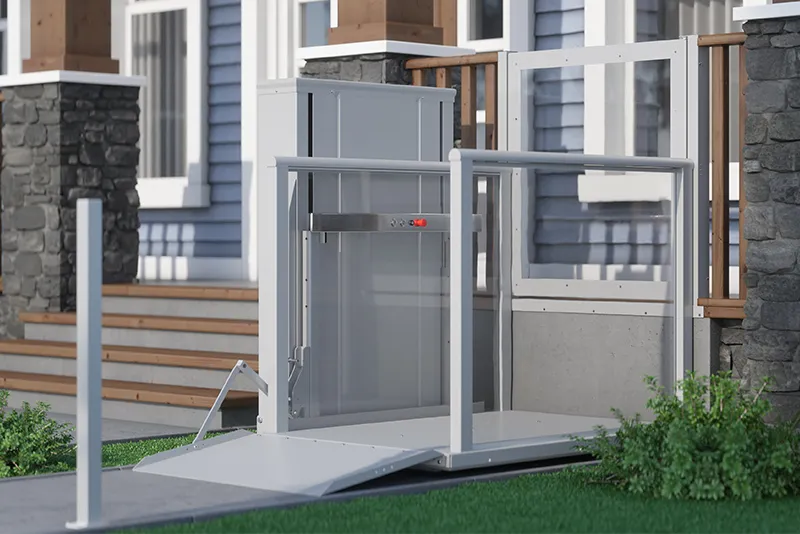
HCBS waivers are state-specific programs that help seniors avoid nursing homes or assisted living facilities by providing funds for aging in place. When eligible, they can help disabled seniors pay for wheelchair ramps, platform lifts, and other wheelchair-accessible stair lifts.
As mentioned, HCBS waiver programs are different in every state, meaning that the amount of funding you’ll receive can be unpredictable. However, most states will provide full or partial assistance if you can prove the wheelchair lift is a medical necessity for living safely at home. Fortunately, since wheelchairs typically help you manage an existing disability, getting a doctor’s letter of medical necessity (LMN) isn’t hard.
Medicaid Home Modification and Assistive Technology Programs
Whether falling under or working hand in hand with HCBS waivers, AT (Assistive Technology), and HM (Home Modification) programs also help seniors avoid or move out of nursing homes. If your wheelchair lift makes your home safer and more accessible for activities of daily living (ADLs), you’ll likely have access to financial assistance.
These programs are the go-to choice for seniors transitioning from hospitals or long-term care facilities back to their own homes. Just keep in mind that programs still vary by state.
Money Follows the Person (MFP)
MFP is a federally based Medicaid initiative that matches certain state HCBS expenditures, giving seniors who are aging in place more funds for essential mobility devices. Through this funding, MFP programs often cover wheelchair lifts as part of a broader package of accessibility upgrades; ramps, widened doorways, reinforced flooring, etc. All of these installations are covered because they reduce barriers that could lead to re-hospitalization or falls.
Veteran-Directed Care Programs (VDC)
If you’re a wheelchair-bound senior veteran trying to age in place, VDC programs like Veteran-Directed Home & Community-Based Services (VD-HCBS) can provide a consumer-directed monthly budget for medically-necessary mobility equipment. The best wheelchair lifts usually qualify, especially if your disability resulted from your service. However, programs are also only available in participating VA networks.
Do I Qualify For Medicaid Programs?
Medicaid is designed to help low-income and disabled Americans get affordable healthcare, so if you already have a wheelchair, you’ll likely qualify. Most seniors age 65 and older also qualify, but eligibility ultimately depends on your income, assets, and medical needs. In fact, every state sets different financial thresholds, so what’s considered “low income” in one state might not be in another.
Common eligibility requirements across states include:
- Being 65+ or meeting certain disability criteria.
- Limits on income and assets based on the state’s cost of living.
- LMNs and other documents that prove the lift is essential for aging in place.
- A functional needs assessment demonstrating that the lift supports activities of daily living (ADLs).
Don’t know if you qualify? Contact your state Medicaid office or local Area Agency on Aging (AAA) for information about local programs and required documents, as well as application assistance.
Wheelchair Lifts Vs. Traditional Stair Lifts: What Does Medicaid Cover?
While it’s possible to get Medicaid coverage for both wheelchair lifts and traditional stair lifts, wheelchair lifts are easier to access. That’s because most wheelchair-bound seniors already have a diagnosed disability they can leverage to qualify for Medicaid and get a doctor’s letter of medical necessity (LMN).
Additionally, while both are commonly categorized as home modifications, some wheelchair-accessible vertical platform lifts (VPLs) are considered durable medical equipment (DME). This opens up more financing options, especially through Medicare.
Ultimately, wheelchair lifts are easier to find financial assistance for, but they also cost more out of pocket. Classic stair lifts cost an average of $8,450, while wheelchair lifts cost $14,500. That means you’ll need to access more funding overall for wheelchair-accessible options.
Other Ways To Get Financial Assistance for Wheelchair Lifts
If you’re not eligible for Medicaid or prefer a health insurance plan that doesn’t cover wheelchair lifts, there are other ways to get funding. A few of the most popular options include:
- Long-Term Care Insurance: Coverage varies by policy and provider, but some policies cover wheelchair lifts under home modifications and equipment benefits.
- Area Agencies on Aging (AAA): A local nonprofit organization that provides access to used and discounted wheelchair lifts, as well as connects you to resources that help cover equipment and installation costs.
- Home Equity Loans or HELOCs: Loans borrowed against the available equity you have in your home generally have low interest rates, and can help pay for wheelchair lifts.
- Financing plans: Loans from your personal bank or wheelchair lift companies can provide fast, easy funds, but be mindful of high interest rates or lengthy loan terms.
- Tax Deductions: IRS Publication 502’s list of deductible medical expenses will often apply to wheelchair lifts.
Our Takeaway: Medicaid Can Cover Wheelchair Lifts for Eligible Seniors
If you’re a low-income, wheelchair-bound senior, Medicaid is one of the best ways to get financial assistance for wheelchair lift installation. While the specific Medicaid program available to you varies by state, most will cover medically necessary wheelchair lifts that help you age in place rather than in a nursing home.
If you want to make your staircase more accessible without spending thousands, we recommend browsing your state’s Medicaid website for available waivers and initiatives.
FAQs about Medicaid-Covered Wheelchair Lifts
Yes, there are ways seniors can cover the cost of a wheelchair lift through Medicaid. Several funding programs, including HCBS waivers, provide financial assistance for home modifications that help seniors age in place.
Original Medicare typically won’t cover wheelchair lifts because they are considered home modifications rather than durable medical equipment (DME). Some Medicare Advantage plans will make exceptions if the installation is deemed medically necessary and prescribed by a doctor.
Medicaid usually categorizes wheelchair lifts as either assistive technology, home modifications, or environmental accessibility adaptations (EAAs), impacting the programs they qualify for. Some types of wheelchair lift, like VPLs, may be classified as DME, but this isn’t always the case.
Most low-income, senior (65+), and disabled individuals will qualify for Medicaid. However, because eligibility requirements vary by state, we recommend contacting your local Medicaid office for more information.
Yes, there are other methods for covering the cost of a new wheelchair lift. Some of the most common include long-term care insurance and local nonprofits.
Wheelchair lifts generally range from $4,000 for a simple vehicle lift attachment to over $25,000 for a fully enclosed vertical lift. The average cost is around $14,500.
Help us improve our cost data! Email your latest wheelchair lift quote to [email protected]. Rest assured, your personal details will remain completely confidential.