
Retirement Living takes an unbiased approach to our reviews. We may earn money when you click a partner link. Learn More
Best Behind-the-Ear Hearing Aids of 2026
Our research highlights the best over-the-counter and prescription BTE hearing aids for every budget and lifestyle.


Updated:
We reviewed over 30 hearing aid brands and identified the best behind-the-ear (BTE) hearing aid providers based on features, personal research, and expert consultations. After evaluations, we determined that Jabra Enhance, Signia, Phonak, MDHearing, and more were among the best BTE hearing aid companies.

Jabra Enhance offers online tools that begin with a virtual consultation. This helps you find the right hearing aid for your needs. After receiving them, the company provides support as needed. Jabra Enhance offers a great choice for those seeking affordable hearing aids. You don’t need to visit an office to get them.
- Trained audiology care team support
- 100-day free trial
- 3-year warranty
Signia Assistant AI and TeleCare support keep your hearing aids performing well everywhere. The company offers hearing aids for active people. They have a discreet design and elegant styles, among other features.
- Great Mobile Apps
- Hearing aids for mild to profound hearing loss
- Large selection of models to choose from
Phonak is an award-winning leader in hearing aid technology. The company offers 12 hearing devices plus accessories to provide the right fit. Phonak produces crisp, natural sound that adjusts to your environment.
- Broad Product Line
- Has an extended wear option
- Models for all types of hearing loss
4.6
MDHearing is a Midwestern hearing aid company that creates affordable hearing solutions. There are four models to choose from in two different styles. All models are smartphone-compatible and feature advanced feedback cancellation technology.
- Great Value Hearing Aid
- Smart and rechargeable options
- Free lifetime support

4.6
Lexie Hearing aids are affordable and offer easy access to customer service. The company sells directly to consumers. This allows for lower costs. You can also choose Lexie Hearing subscription payment plans.
- Great Technology
- 45-day free trial
- Affordable subscription available
4.4
Oticon is a tech leader. Its high-quality products are pricey but seen as top-notch.
- Innovative Products
- Various styles of hearing aids
- Mobile application
Starkey is a U.S. manufacturer. They blend advanced sound processing with health and wellness tracking features. Its current lineup features different styles for customization. It also works well with easy-to-use apps.
- Great variety available
- Health and wellness tracking available
- Large, well-known hearing aid manufacturer
How We Chose the Best Behind-the-Ear Hearing Aids
We reviewed 32 well-known hearing aid brands, consulted with audiologists, and personally tested a range of models to identify the best hearing aid companies. From there, we identified those that offered behind-the-ear (BTE) styles and considered support and features to find the top BTE providers among them.
Behind-the-Ear Hearing Aids Reviews
Learn more about our top behind-the-ear hearing aid providers.
Jabra Enhance Hearing Aids Review
Trained audiology care team support
|
Jabra Enhance offers over-the-counter and prescription-grade hearing solutions. Its OTC hearing aids are designed for those with mild-to-moderate hearing loss, while their prescription-grade aids are best for those with mild-to-profound hearing loss. Jabra Enhance offers three hearing aid models, which we discuss below.
- Jabra Enhance Select: Over-the-counter (OTC) model, made for mild-to-moderate hearing loss. It’s available as a receiver-in-canal (RIC) style hearing aid and comes with three technology levels, from basic to advanced. With the Enhance Select, you receive professional fitting and care through telehealth support. Jabra’s Enhance Select costs between $1,195 and $1,995, with financing available.
- Jabra Enhance Pro: Prescription-grade models, available in multiple styles including BTE, RIE, and Custom. The Enhance Pro is designed for mild-to-profound hearing loss and features premium technology. You receive professional, in-store fitting and care. Prices start at $1,699.
- Jabra Enhance Max: Prescription-grade model, supporting severe-to-profound loss with premium hearing technology. The Enhance Max is designed as a super-powered BTE, with prices starting at $1,699. When you buy one, you receive professional, in-store fitting and care.
For more information, read our full Jabra Enhance review.
Signia Hearing Aids Review
Great Mobile Apps
|
Signia’s Motion Charge&Go IX BTE family offers three models, which come in over ten colors. Signia uses unique technology (Signia Integrated Xperience) that enhances speech in noisy environments, allowing you to stay engaged in conversations, regardless of your level of hearing loss.
The IX comes in three models, and a hearing care professional can help you find which one works best for you:
- Motion Charge&Go M
- Motion Charge&Go P
- Motion Charge&Go SP
Signia BTE devices have the longest battery life of any rechargeable Super Power hearing aid, offering all-day power. It also offers RealTime Conversation Enhancement and an easy-to-use app that provides all the tools you need to customize your hearing experience.
Signia doesn’t list pricing on its website, but customer reports and various suppliers place average costs between $2,600 and $7,600 per pair, depending on technology level, model, and provider.
For more information, read our full Signia review.
Phonak Hearing Aids Review
Broad Product Line
|
Phonak offers five behind-the-ear hearing aids, designed with state-of-the-art technology to provide an excellent hearing experience. Below, we briefly discuss the five BTE hearing aids Phonak provides.
- Naída Lumity: Phonak’s most powerful hearing device, designed for mild-to-severe hearing loss. Powered by real-time AI to increase speech understanding. Features Bluetooth and a personalized listening experience with the myPhonak app.
- Sky Lumity: Designed for children, prioritizing speech understanding in all noise environments. It offers Bluetooth connectivity and compatibility with Roger microphones. Sky Lumity can support children with hearing loss at all levels, from mild to profound, and features a tamper-proof design and LED indicators.
- Naída Paradise: Offers enhanced speech, dynamic noise cancellation, motion sensor hearing, universal connectivity, and more. Enjoy tap control and customizable programs via the myPhonak app.
- Naída Link M: Designed for severe-to-profound hearing loss. The bimodal hearing aid can pair with an advanced Bionics sound processor if your hearing loss progresses and you end up needing a cochlear implant. It’s rechargeable, dust- and water-resistant, and connects to smartphones, TVs, and more.
- Sky Marvel and Sky Link Marvel: Designed for children, providing a comfortable hearing solution that they can wear all day. The series offers tamperproof earhooks and battery doors, rechargeable battery options, Bluetooth connectivity, durability, and personalized, mix-and-match colors.
While Phonak doesn’t list pricing for its BTE hearing aids on its website, customer reviews and provider websites list the average cost at $2,000 to $7,000+ per pair, depending on model, technology level, and provider.
For more information, read our full Phonak review.
MDHearing Review
Great Value Hearing Aid
|
MDHearing provides FDA-registered over-the-counter BTE hearing aids, designed by their dedicated US-based team of audiologists and licensed hearing specialists, who are available to help you throughout the process. MDHearing provides three BTE hearing aids, which we list below.
- VOLT MAX 2: This smart, rechargeable hearing aid automatically adapts to your environment and can be customized to your unique hearing. It comes with advanced noise reduction, feedback cancellation, Bluetooth connectivity, a portable charging case, a free telehealth setup appointment, and a 1 year warranty. Prices start at $597 per pair.
- VOLT 4: This premium rechargeable BTE model is MDHearing’s sleekest design. It offers background noise reduction, feedback cancellation, easy sound adjustments, a portable charging case, silicone tips for all-day comfort, a free telehealth setup appointment, and a 1 year warranty. Prices start at $397 per pair.
- AIR 3: Designed to be discreet, lightweight, and easy to wear. It delivers dependable sound quality and offers simple controls on the device, allowing you to easily adjust the volume and switch between four different sound settings. Prices start at $297 per pair; it comes with a 1-year warranty.
Every MDHearing device comes with a 60-day risk-free trial, allowing you to find the best solution for your needs and to take the time to get comfortable using it.
For more information, read our full MDHearing review.
Lexie Hearing Review
Great Technology
|
Lexie manufactures two behind-the-ear hearing aids, both FDA-cleared and available over the counter, with free lifetime customer support. All Lexie hearing aids are designed by hearing experts and audiologists to ensure you receive the best hearing experience possible.
- Lexie B1: Offers clear, quality sound powered by Bose. You can self-tune the device via the mobile app, enjoy personalized settings, and get access to on-demand customer support. It offers Bluetooth connectivity for phone calls. The Lexie B1 is designed for adults with perceived mild-to-moderate hearing loss. Prices start at $649.
- Lexie B2 Plus: Offers advanced personalization with an in-app hearing test, allowing you to create a unique hearing profile. The B2 Plus provides up to 18 hours of performance per charge and comes with a compact charging case. It comes with four environment programs, but you can create up to 10 of your own. It’s splash and dust-resistant, and prices start at $999.
Lexie offers a free 45-day risk-free trial, a 1-year warranty, and free lifetime support. Plus, with easy-to-use controls, you can personalize your hearing experience for almost any situation.
For more information, read our full Lexie review.
Oticon Review
Innovative Products
|
Oticon offers a wide range of hearing aids built with modern technology and designed to blend in with your skin and hair color, maximizing discretion. Oticon has over 20 BTE-style hearing aids available. Each comes with Bluetooth, allowing you to effortlessly connect with your phone, computer, and TV. Plus, with the Oticon Companion app, you can personalize your hearing aids to create the best listening experience for you.
Below are a few of Oticon BTE hearing aids.
- Oticon Siya BTE: Compact design with double push button for easy volume and program control. It features Bluetooth, a built-in telecoil, and is available as a thin tube or hook solution.
- Oticon Intent miniBTE R: Discreet and rechargeable, built with telecoil and double push-button control. Features 360° sound, sensors that adapt to listening environments, Bluetooth, and in-app control.
- OticonPlay PX miniBTE T: World’s first pediatric hearing aid with an on-board Deep Neural Network (DNN). Uses disposable batteries and features Bluetooth streaming, a single push-button, an LED light, and a telecoil. Plus, it’s compatible with the new Android protocol for Audio Streaming for Hearing Aids (ASHA).
While prices aren’t available on Oticon’s website, sources indicate that their hearing aids typically cost between $3,000 and $8,000+ per pair.
For more information, read our full Oticon review.
Starkey Hearing Aids Review
Great variety available
|
Starkey BTE hearing aids are sleek, modern, and smart, offering longer battery life, more durability, and more features. Starkey’s BTE hearing aids are part of the G Series AI.
The G Series AI BTE hearing aid features directionality that identifies your listening environment and automatically adjusts settings to ensure the best hearing experience. It also features telecoil technology, which allows you to connect to and stream audio from public systems, such as theaters, churches, and gyms.
Starkey doesn’t list prices online, but sources estimate the average cost of Starkey hearing aids to be between $1,500 and $6,000 per pair.
For more information, read our full Starkey review.
Choosing the Best Behind-the-Ear Hearing Aid
When looking for the best hearing aids, you want to ensure they are powerful enough to treat your hearing loss while still providing a comfortable, proper fit. Behind-the-ear (BTE) hearing aids are one of the most common types of hearing aids available, and finding the one that works best for you depends on various factors.
Consider these factors when choosing BTE hearing aids:
1. Open-fit vs. traditional BTE hearing aids
An open-fit BTE hearing aid uses thin tubes and open domes, which leave the ear canal open. It’s designed for listeners with mild-to-moderate high-frequency hearing loss, allowing low-frequency sounds to enter naturally while amplifying high frequencies.
Traditional BTE hearing aids are the largest type of hearing device and use custom earmolds, which seal the ear canal. Traditional BTE hearing aids provide stronger sound amplification, making them suitable for those with severe-to-profound hearing loss.
Open-fit BTE hearing aids are often referred to as mini-BTEs, but they are sometimes replaced with receiver-in-canal (RIC) hearing aids.
Keep your hearing loss level in mind when choosing between open-fit and traditional BTE hearing aids. Open-fit is best for mild-to-moderate hearing loss and high-frequency amplification, while traditional is best for severe-to-profound loss and for preventing feedback, like whistling.
2. Features and technology preferences
Behind-the-ear hearing aids often include advanced features and the latest technology. Some of the most common features include:
- Rechargeable batteries
- Bluetooth connectivity
- Directional microphones
- Advanced noise cancellation
Some users may not want all the extra features, preferring a straightforward hearing solution. Others may value the latest and most advanced technology. Consider what features you prioritize and look for providers that can meet your hearing needs.
3. Lifestyle
One’s lifestyle can affect the type of BTE hearing aid that works best for you. Those who lead an active lifestyle and spend much of their time in loud or noisy environments should consider a BTE device with a higher level of technology (such as Premium or Advanced) to ensure better performance in complex, loud situations.
However, individuals who lead a quieter lifestyle can opt for simpler, more affordable models without sacrificing sound quality.
If you’re considering a couple of different behind-the-ear hearing aids and are unsure which to choose, see if the manufacturer offers a trial period. Many OTC hearing aid providers offer trial periods and money-back guarantees, allowing you to test different hearing aids and find the ones that work best for you. If you’re looking into prescription hearing aids, then talk with your audiologist about your needs and preferences.
Compare BTE Hearing Aid Providers
Here’s a quick side-by-side comparison of our top BTE hearing aid providers.
| Brand | Price Range | OTC or Prescription | Types Available |
|---|---|---|---|
| Jabra Enhance | $1,195 – $1,995 | OTC | RIC, BTE |
| Signia | *$2,600 – $7,600 | Prescription | CIC, RIC, ITC, BTE, ITE |
| Phonak | *$2,000 – $7,000+ | Prescription | CIC, RIC, BTE, ITE |
| MDHearing | $297 – $699 | OTC | BTE, ITE |
| Lexie | $299 – $999 | OTC | RIC, BTE, ITE |
| Oticon | *$3,000 – $8,000+ | Prescription | ITC, ITE, BTE, CIC, IIC |
| Starkey | *$1,500 – $6,000 | Prescription | ITC, ITE, CIC, IIC, BTE, RIC |
Behind-the-Ear Hearing Aid Features to Consider
Behind-the-ear hearing aids are among the most powerful and versatile hearing solutions on the market because of their larger size. The most advanced models often include features such as AI-driven sound processing, hands-free Bluetooth streaming, long-lasting rechargeable batteries, and more.
Below are key features you should consider when shopping for BTE hearing aids:
- Bluetooth Connectivity: Bluetooth-enabled hearing aids allow you to stream audio directly from your smartphone, TV, tablet, and more.
- Directional Microphones: These microphones improve hearing in noisy environments by focusing on sound in front of you.
- Customizable Programs: Advanced BTE models allow you to customize your hearing aid settings for different environments, and the devices will remember them and automatically switch between modes as needed.
- Rechargeable Batteries: Easily recharge your hearing aids at night without manually replacing small batteries, saving money over time.
- Advanced Noise Reduction: Advanced models can automatically reduce background noise, allowing you to focus on the conversation.
- Own Voice Processing (OVP): Hearing aids can sometimes make your own voice sound unnatural or loud. OVP technology reduces this effect, enhancing comfort.
- Tinnitus Masking: Built-in sound generators create soothing noise (such as white noise or nature sounds) to mask the buzzing and ringing of tinnitus, making it less intrusive.
- Built-in Telecoils: Sometimes called T-Coils, these tools enhance hearing on compatible telephones and in public venues with induction loop systems, such as theaters and churches.
- App Control: Allows users to adjust volume, switch programs, toggle Bluetooth, and more via a phone app.
- Easy-to-Use Controls: Because the main body is larger and easily accessible, buttons and switches are larger, making them ideal for those with limited dexterity.
- Sensor Technology: Some providers may incorporate 4D sensor technology, which tracks movement and environmental changes to make needed adjustments.
- Ease of Maintenance: BTE devices are less prone to moisture damage and earwax buildup compared to smaller in-ear models, making them easier to maintain.
In addition to key features, it’s important to consider the pros and cons of hearing aids. For instance, behind-the-ear hearing aids are powerful, supporting mild to profound hearing loss, are feature-rich, and durable, but they are more prone to wind noise and physical interference than smaller, in-the-ear hearing aids.
Hearing Aid Types: BTE vs. RIC
Behind-the-ear (BTE) and receiver-in-canal (RIC) hearing aids are very similar to each other in design. The biggest difference is their size and how they deliver sound to your ear.
BTE hearing aids sit behind the ear and connect to an earpiece that rests inside the ear canal via a thin tube. The speaker and other electronic components are located within the hard case. Similarly, RIC hearing aids sit behind the ear, but they are smaller. Additionally, the speaker is located at the end of a thin electrical wire connected to the case. This speaker (receiver) is enclosed inside a flexible earmold and goes into your ear canal.
Due to their size, behind-the-ear hearing aids can house a strong amplifier and a large battery. Plus, they can amplify both high and low frequencies, making them ideal for those with severe or profound hearing loss. However, RIC hearing aids, while still powerful, are better suited for those with moderate-to-severe hearing loss.
| Type | Size | Speaker Location | Best for | Advantage |
|---|---|---|---|---|
| Behind-the-Ear (BTE) | Bigger & thicker | In the case | Severe-to-profound hearing loss | Durability |
| Receiver-in-Canal (RIC) | Smaller & slimmer | In the ear canal | Moderate-to-severe hearing loss | Natural sound quality |
BTE hearing aids are durable, easy to handle, and offer powerful amplification. RIC hearing aids offer a more discreet appearance, a natural sound quality, and an open-fit design that allows for airflow and comfort.
Where to Buy Behind-the-Ear Hearing Aids
You can buy hearing aids from a licensed healthcare provider with a prescription, or over-the-counter (OTC) from professional audiology clinics, online, or in person at retail stores such as Amazon, Costco, and specialized retailers.
Behind-the-ear hearing aids can be prescribed or bought over-the-counter, giving you plenty of options to choose from. However, you should consider your level of hearing loss before purchasing. For adults with self-perceived mild-to-moderate hearing loss, OTC behind-the-ear hearing aids can be a great solution. For adults with more significant loss, however, it’s best to schedule a hearing test so you can get a prescription.
This is because OTC hearing aids are designed to be self-fitted and often have limited listening programs or functions. While self-fitting is convenient and sufficient for many, it won’t work for those with greater hearing loss and unique needs. Buying a BTE hearing aid with a prescription ensures better hearing, a more comfortable fit, ongoing support, and improved hearing health.
Frequently Asked Questions (FAQs) about Behind-the-Ear Hearing Aids
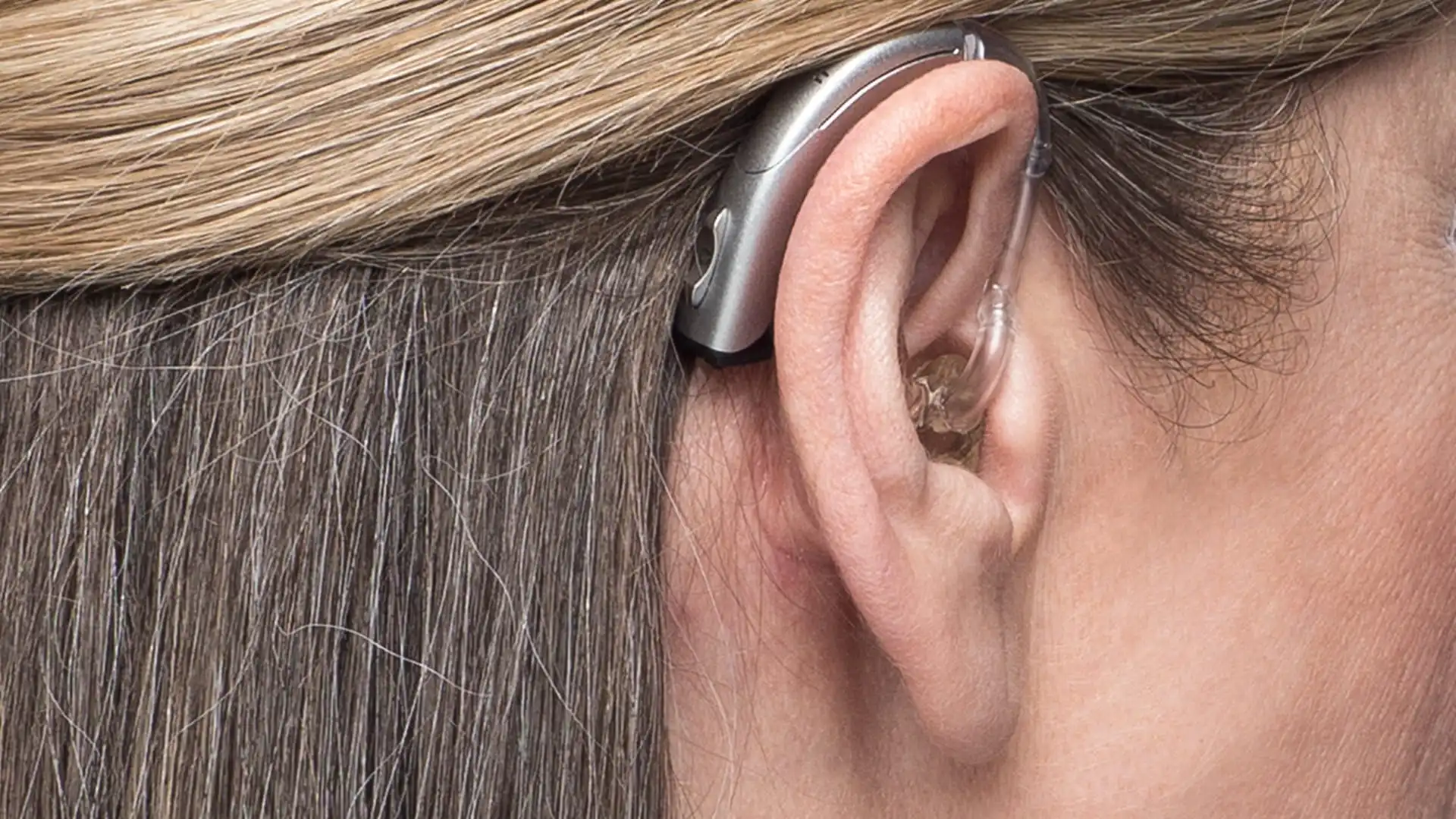
Behind-the-ear hearing aids offer many advantages, such as powerful hearing support, durability, and more features; however, they do have some disadvantages, including being very visible, prone to wind noise, and often getting in the way of glasses or other facial wear.
Yes, you can wear glasses with BTE hearing. However, it may take some time to get used to it, as having both glass and BTE hearing aids can be distracting at first. Follow these tips to successfully wear BTE hearing aids with your glasses: 1) Put glasses on before fitting the hearing aids, 2) practice removing your glasses in a way that doesn’t disturb the devices, and 3) choose glasses with thinner frames and ask your audiologist about getting BTE devices that are less obtrusive.
Yes, many modern BTE hearing aids are rechargeable. These batteries typically offer a full day of power (15-24+ hours) after an overnight charge, increasing convenience and saving money over time.
Yes, due to their larger size, BTE hearing aids are generally visible to others, even the more discreet, sleeker models. If you don’t want others to know you’re wearing hearing aids, consider smaller styles like in-the-ear (ITE) or invisible hearing aids like completely-in-canal and invisible-in-canal.
The effectiveness of invisible hearing aids depends on your level of hearing loss. Due to their smaller size, invisible hearing aids are most suitable for those with mild-to-moderate hearing loss. As such, if you have significant hearing loss (severe to profound), then invisible hearing aids may not be as effective for you.
Concluding Thoughts on Behind-the-Ear Hearing Aids
Behind-the-ear hearing aids provide powerful hearing solutions for those with mild-to-profound hearing loss. They are reliable, durable, easy to maintain, feature-rich, and have a superior battery life. Plus, with modern technology, many BTE hearing aid providers can offer sleeker, more discreet designs, making them a popular choice.
No matter your hearing needs, budget, or preferences, there’s a hearing solution for you.