
Retirement Living takes an unbiased approach to our reviews. We may earn money when you click a partner link. Learn More
How Does a Wheelchair Lift Work?
Both vertical platform lifts (VPLs) and inclined platform lifts (IPLs) for wheelchair users operate using either hydraulic drive systems—which move the platform through fluid pressure—or screw drive systems that raise and lower the platform using a rotating, threaded shaft.


Updated:
At a glance:
- How a wheelchair accessible stair lift works depends on the type of wheelchair lift, with both VPLs and IPLs using either hydraulic drive systems or screw drive systems.
- Screw drive systems are the most common and affordable mechanism for moving residential wheelchair lifts, raising and lowering the platform with a rotating threaded shaft.
- Hydraulic drive systems power wheelchair lifts using fluid pressure in a hydraulic cylinder and are often used in industrial or commercial applications for their high power and weight capacity.
Wheelchair platform lifts are an excellent mobility solution for seniors who use wheelchairs and their caregivers, providing an ADA-compliant solution for those who want to age in place. However, they’re also a major investment, leading many to wonder how exactly they work. After all, you might be wondering which mechanical and safety features are worth investing in?
To answer that, our team evaluated how different types of wheelchair lifts work, so you can tackle the investment and installation process with peace of mind.
What is a Wheelchair Lift?
Wheelchair lifts refer to a broad category of wheelchair accessible power chair lifts that give seniors easy access to different floors, even with limited mobility. The most common types—inclined platform lifts (IPLs) and vertical platform lifts (VPLs)—come in a variety of different shapes, sizes, and drive types.
Generally speaking, wheelchair lifts can be both temporary and permanent installations. Installation depends on the type. ILPs are anchored to either your stairway or added support posts. VPLs usually need to be installed in a new, dedicated home elevator shaft. Both use intricate mechanisms to then lift and lower the wheelchair platform.
Understanding Different Types of Wheelchair Lifts
How a wheelchair lift works largely depends on its type. Below, we’ve outlined the most common types, so you know what to expect:
Inclined Platform Lifts (IPLs)
Inclined platform lifts (IPLs) are mobility devices that travel directly along your staircase, allowing you to move up and down the stairs without transferring out of your chair. They’re installed on both straight and curved staircases, though curved railings often require more customization.
Key features of an IPL include:
- Custom track: Mounted along your staircase or supported by built-in posts, the track follows the exact slope and curve of the stairs.
- Platform options: May include standard or folding platforms, depending on the additional safety features you choose. The platform may also offer entry and exit points from multiple sides or small, built-in ramps.
- Simple installation: Compared to other wheelchair lift types, IPLs are often more cost-effective. That’s because they adapt to your existing staircase, rather than requiring extensive construction.
Vertical Platform Lifts (VPLs)
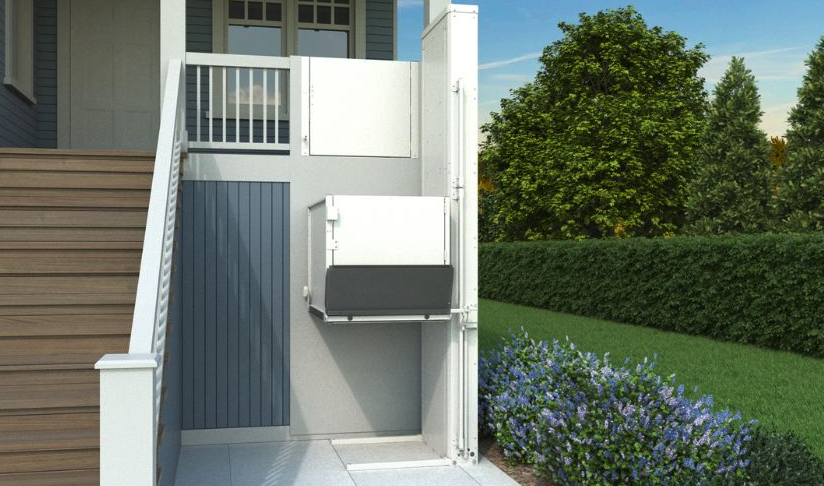
Vertical platform lifts (VPLs) essentially function as in-home elevators, moving straight up and down the stairwell or another dedicated space, with the weight capacity and safety features needed for wheelchair users. Unlike IPLs, these lifts do not attach to your stairs. Instead, VPLs require a dedicated shaft, a concrete pad, and possibly more.
Common aspects of a VPL include:
- Lift shaft or enclosure: VPLs need a support structure or shaft, and in many cases, a concrete pad for stability. The ideal construction depends on the home structure and whether the VPL is for indoor or outdoor use.
- Smooth vertical travel: VPLs safely carry seniors up and down without following the angle of your stairs, making it useful for porches, decks, or areas without ground-level stair access.
- More complex installation: Due to more complex structural requirements, VPLs usually cost more to install—especially for multi-level homes.
Wheelchair Van Lifts
These lifts, also known as vehicle lifts, are common in public transportation—but did you know that you can bring that comfort to your own home? These wheelchair-accessible platform lifts can be installed in vans, SUVs, or other larger vehicles, offering safe operation for both drivers and passengers. Typically, the installation is powered by the vehicle’s own battery, making it reliable whether mounted inside or under it.
Hydraulic Drive vs. Screw Drive Mechanical Systems
When discussing how wheelchair lifts work, it’s important to understand that both IPLs and VPLs can use either hydraulic drive or screw drive mechanical systems. These systems are responsible for the motion of the platform and have unique pros and cons.
Screw Drive Systems
Screw drive systems are the most common and budget-friendly mechanism used in residential settings; both IPLs and VPLs. They work by turning a threaded shaft to raise or lower the lift—a process that requires fewer components when compared to hydraulic processes. However, they may not support the same heavy loads that hydraulic systems can bear.
- Pros: Affordable, compact design, low maintenance needs.
- Cons: Slower operation, lower weight capacity.
Hydraulic Drive Systems
Hydraulic drive systems are less common overall, but often preferred for industrial or commercial applications. They utilize pressurized hydraulic fluid (usually oil) to lift and lower the wheelchair platform. This provides a smooth, quiet ride with a heavier weight capacity, but also typically involves higher installation costs and regular hydraulic pump maintenance.
- Pros: High weight capacity, smooth operation, reliable for frequent use
- Cons: More expensive, may require extra space, and more maintenance over time.
How Does Wheelchair Lift Installation Work?
Wheelchair lift installation, ideally done by a professional installer, starts with an examination of your staircase, entryway, deck, or vehicle. Wheelchair lift companies can help you determine which type of lift is right for your home.
- IPL installation: The installer first mounts a custom track to the stair treads or added support posts, then attaches the wheelchair platform. It’s a simple process that only takes a day or two.
- VPL installation: Generally taking at least a few days, if not weeks, VPLs require a dedicated space for the shaft or enclosure. The construction process includes creating a stable base, such as a concrete pad, and then building out a support structure. Afterward, the system can be connected to your home’s electrical system.
- Vehicle lift installation: Involves mounting the lift either inside your van or underneath it. The system is then connected to the vehicle’s power source and tested for smooth operation.
Regardless of the type of wheelchair lift you choose, the installer should test the lift, review its safety features, and show you how to operate it before they leave.
The Bottom Line
Looking for the best wheelchair lift? From screw drive IPLs to hydraulic VPLs, wheelchair lifts come in a variety of shapes, sizes, and costs. If you’re a senior with mobility issues, it’s important to understand the pros and cons of how different types of wheelchair lifts work. Consider your mobility needs, home layout, and budget when deciding which solution is right for you.
Frequently Asked Questions
Most permanent wheelchair lifts last between 5 and 15 years, depending on the type of installation and regular maintenance. Routine inspections, cleaning, battery checks, and careful power outage recovery will help keep your lift in good condition longer. Screw drive IPLs are generally the most reliable, while hydraulic VPLs will likely require the most maintenance.
The average cost of a wheelchair lift depends on the type, with IPLs typically costing $23,000 ($12,000 – $35,000) after installation, and VPLs costing well over $30,000 in some cases.
Installation for wheelchair lifts typically adds between $10,000 and $20,000 to the base cost, depending on the type. Curved models and in-home elevator designs are especially costly.
Yes, IPLs can be installed on both curved and straight staircases, indoors and outdoors. Always research your ideal model’s compatibility before investing.
Not necessarily. The best wheelchair lift for your home depends on your circumstances. However, if you have an accessible staircase, IPLs are generally less expensive and more reliable over time for residential users.
Both new and used wheelchair lifts have pros and cons. Used models often fit nicely on straight staircases, while this is less so the case for curved staircases.
Help us improve our cost data! Email your latest wheelchair lift quote to [email protected]. Rest assured, your personal details will remain completely confidential.