
Retirement Living takes an unbiased approach to our reviews. We may earn money when you click a partner link. Learn More
Best OTC Hearing Aid Companies
We worked with audiologists and real users to highlight the best over-the-counter hearing aids that are simple, reliable, and budget-friendly.


Updated:
|
Expert Reviewed
Retirement Living evaluated the offerings of 15 over-the-counter hearing aid providers, performed long-term testing on the hearing instruments, and consulted with professional audiologists to identify the best options for buying hearing aids over the counter.
4.7
Eargo hearing aids treat mild to moderate hearing loss. Consumers can buy breathable, rechargeable hearing aids online. No hearing test or prescription is needed. Eargo provides unlimited phone support from licensed hearing professionals.
- Innovative Products
- Expedited process
- 2 hearing aid models available

4.5
ELEHEAR offers affordable OTC hearing aids available for purchase online. The three offerings are rechargeable with app-based sound customization and AI noise reduction. ELEHEAR provides remote support and a risk-free trial period.
- Great Battery Life
- Rechargeable, app-controlled models
- AI noise reduction
4.7
Audicus offers affordable RIC hearing aids. Customers receive free lifetime audiology support, fully customized hearing aids, and a 100-day risk-free trial.
- Fully customized hearing aids starting at $62/mo
- Lifetime audiology support
- 45 Day Risk-Free Trial

Jabra Enhance offers online tools that begin with a virtual consultation. This helps you find the right hearing aid for your needs. After receiving them, the company provides support as needed. Jabra Enhance offers a great choice for those seeking affordable hearing aids. You don’t need to visit an office to get them.
- Trained audiology care team support
- 100-day free trial
- 3-year warranty

4.6
Lexie Hearing aids are affordable and offer easy access to customer service. The company sells directly to consumers. This allows for lower costs. You can also choose Lexie Hearing subscription payment plans.
- Great Technology
- 45-day free trial
- Affordable subscription available
4.6
MDHearing is a Midwestern hearing aid company that creates affordable hearing solutions. There are four models to choose from in two different styles. All models are smartphone-compatible and feature advanced feedback cancellation technology.
- Great Value Hearing Aid
- Smart and rechargeable options
- Free lifetime support
4.4
With prices starting at $98, Audien Hearing devices are a great option for seniors on a budget. Audien offers three models, two ITE hearing aids, and one advanced BTE hearing aid. Try out the trade-in program to get the newest hearing aid technology at a lower price.
- Great Affordable Option
- Wireless charging
- Easy setup process
4.7
Upload your hearing test to Embrace Hearing. You’ll receive custom hearing aids with two-way Bluetooth. Embrace Hearing’s online Hearing Aid Comparer lets you compare prices, warranties, and more for around 30 hearing aid models.
- Great Service and Value
- Custom programmed by Embrace Audiologists
- Free online hearing test

Sony
4.4
Sony hearing aids come with Bluetooth audio streaming (iOS only) and rechargeable batteries. Use the mobile app to program your aids, based on the results of its 10-minute hearing test.
- Great for Customizations
- In-app adjustments
- Impressive sound quality
HP Hearing Pro
4.4
HP’s HearingPro aid offers an in-depth and immersive hearing experience. The EAR ID feature adjusts automatically for your personal hearing configurations allowing for a smooth and precise adjustment experience.
- Great Trial Period
- Best-in-class sound fidelity
- 60-day trial
Our Experience Testing OTC Hearing Aids
The Retirement Living review team conducts long-term testing of hearing aids to create the most comprehensive buying resources possible. As part of the process, a member of our reviews team, who has been diagnosed with mild hearing loss and is a long-time wearer of hearing aids, tests hearing instruments for two weeks, evaluating fit, technology, features, and ease of use.
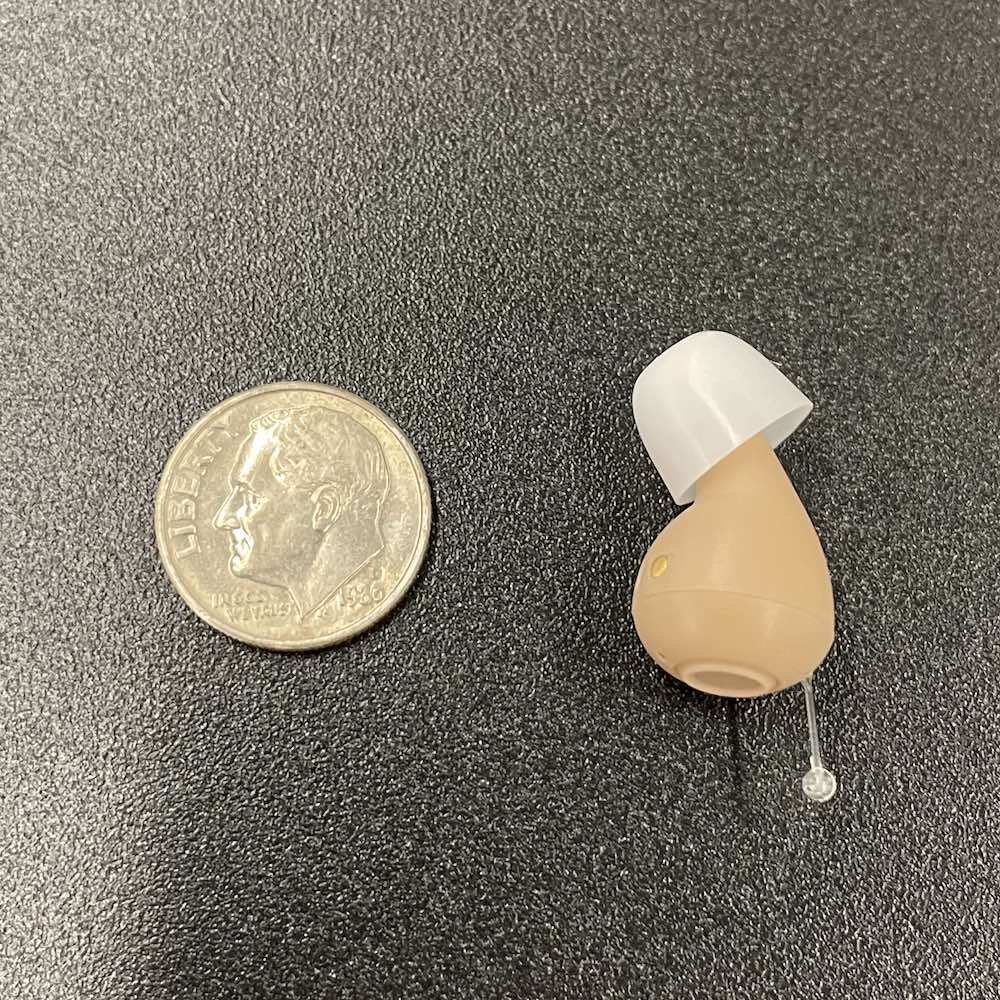
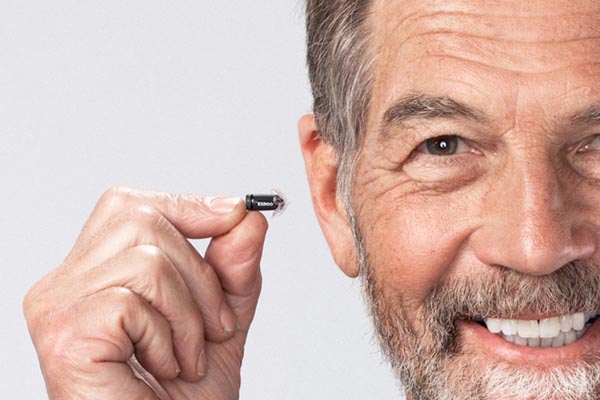
During our tests, Audien hearing aids stood out for being the most discreet. While many companies use this buzzword in their marketing, Audien’s claim is true—the Atom Pro is the size of a dime and barely noticeable. (See picture no. 1 below.)
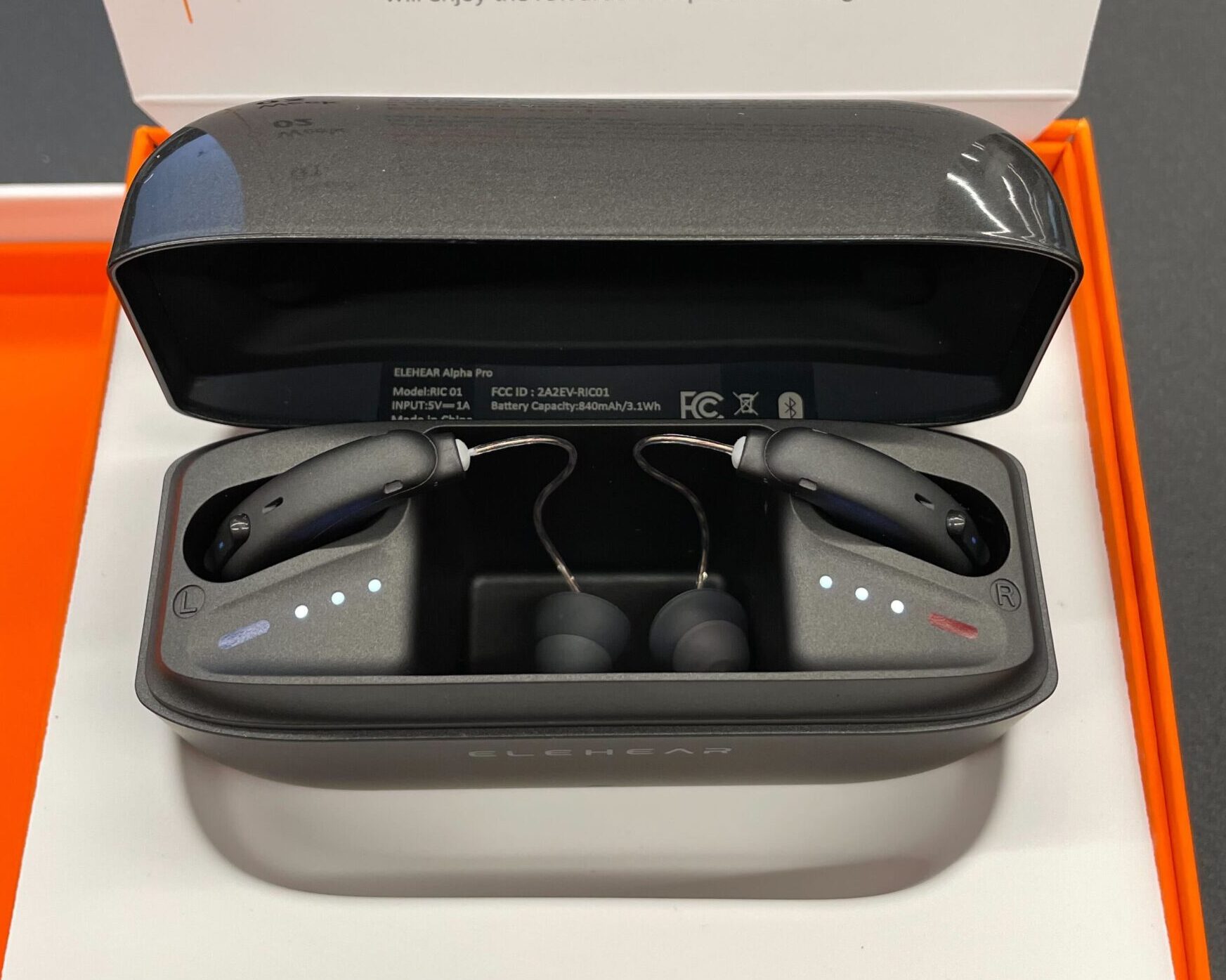
If battery life is important to you, ELEHEAR has the best battery of all the products we tested. After 14 hours of full use, the hearing aids still showed 60% remaining battery. And the charging case? Its charge lasted the whole two weeks of our test, despite using it to charge our hearing aids daily. (The charging case is pictured above.)
Here are a few key takeaways from our time testing OTC hearing aids:
- The features and technology available with OTC hearing aids vary widely by brand. Audien hearing aids simply magnify sounds, but they’re the most affordable option on our list. Eargo’s 7 model automatically adjusts the hearing aids’ sound profile to your surroundings for clearer hearing in any setting.
- Decide whether programming and aftercare support are important to you. You don’t have to visit an audiologist or hearing center to buy OTC hearing aids, which certainly adds to their convenience. But if you think you might benefit from professional product recommendations or personalized setup and programming help, MDHearing, Jabra Enhance, or Lexie all offer one-on-one and remote programming support with the purchase of your OTC device.
- Taking an online hearing test could help you diagnose whether hearing loss is present, choose an OTC hearing device, and program it according to your needs. When comparing online hearing tests, look for a comprehensive assessment that tests speech clarity, speech-in-noise testing, and frequency testing. We rate MDHearing and HearUSA as the best online hearing tests, based on our experience.
The Best OTC Hearing Aid Companies: Reviewed
Eargo Review
Innovative Products
|
Eargo sells affordable and attractive in-canal hearing aids without a prescription. Customers receive lifetime phone support from licensed hearing professionals. You can also try before you buy—order a free, non-working sample to test the fit delivered to your home.
All Eargo hearing aids come with a manufacturer’s warranty and a 45-day return period. After you purchase an Eargo device, you’ll work with a personal hearing professional to help you program the device, and you’ll have lifetime customer support.
- Cost per pair: $1,650 – $2,950
- Type: CIC
- Battery type/life: Rechargeable; Up to 16 hours
- Technology: Bluetooth, noise reduction, feedback cancellation, smart adjustments
- Adjustment: Via the app, tapping on the ear, remote programming support
- Warranty and trial period: 1 year (Eargo 5 and Eargo 6); 2 years (Eargo 7); 45-day trial
- Financing: As low as $47 per month
Eargo devices are small and comfortable, yet pack enough advanced technology to allow for a natural hearing experience with noise reduction, feedback cancellation, and smart adjustments. The newest Eargo 7 model allows you to automatically adjust the hearing aids’ sound profile to your surroundings.
To learn more, read our comprehensive Eargo hearing aids review and watch our YouTube video to learn about our experience wearing the devices for two weeks.
ELEHEAR Review
Great Battery Life
|
ELEHEAR offers two over-the-counter models, Beyond and Beyond Pro, created for adults experiencing mild to moderate hearing loss.
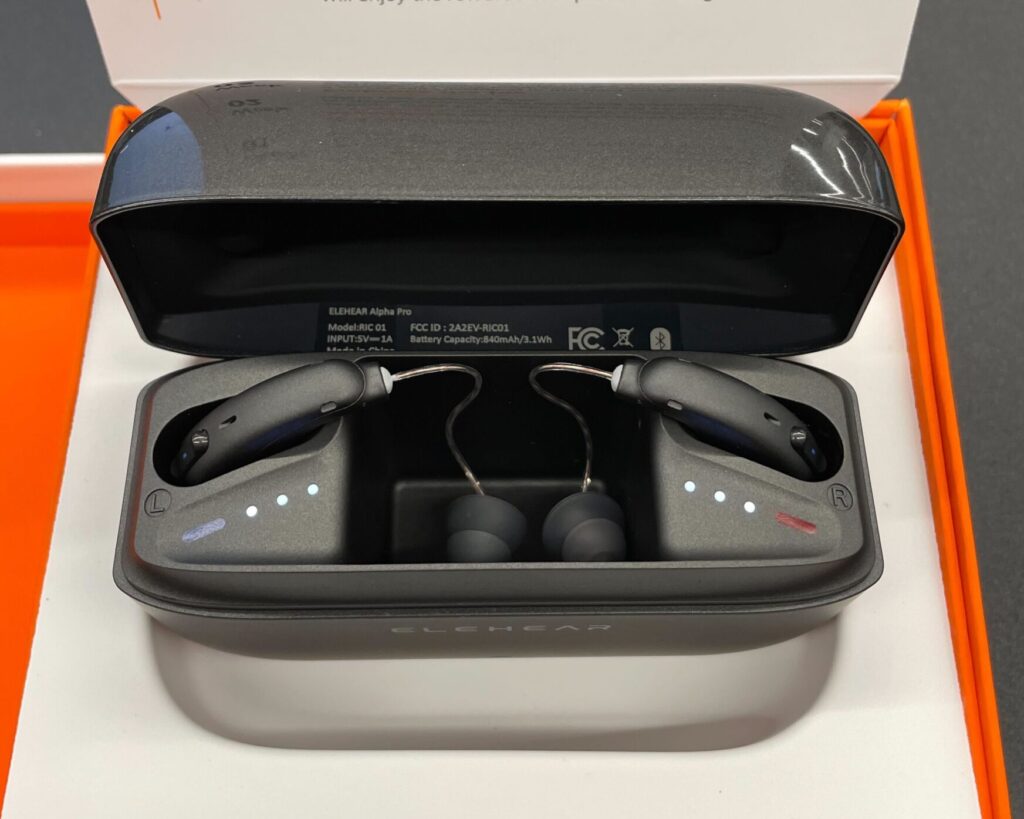
The Beyond focuses on improving speech clarity. It uses AI-driven background noise management and feedback suppression. With amplification levels up to 37 dB, it is designed for daily listening, including conversations, TV viewing, and small social gatherings.
The Beyond Pro builds on those features. It adds advanced sound processing and Bluetooth connectivity for streaming calls and media. Through the companion app, users can adjust volume, select listening programs, and refine sound settings for their environment.
- Cost per pair: $399 – $499
- Type: BTE
- Battery type: Rechargeable
- Technology: Wireless charging, Bluetooth, noise/feedback cancellation, 4 environmental settings
- Adjustment: In the app, tapping on the ear
- Warranty and trial period: 45-day trial period; 1-year warranty
- Financing: Yes, via Klarna
ELEHEAR states the devices provide up to 20 hours of use on a single charge. In our extended everyday testing, battery life varied by usage and sound settings, but it went beyond typical daily wear needs.
Learn more about our experience using ELEHEAR OTC hearing aids in our full ELEHEAR review or watch our YouTube review.
Audicus Review
Fully customized hearing aids starting at $62/mo
|
Audicus sells four over-the-counter hearing aids online, or you can visit one of its clinics in New York City, Chicago, Illinois, and Denver, Colorado. The RIC and CIC devices treat mild to severe hearing loss. Audicus has a unique rental program called the Audicus Plus Plan that lets members upgrade to newer models after renewing their contracts.
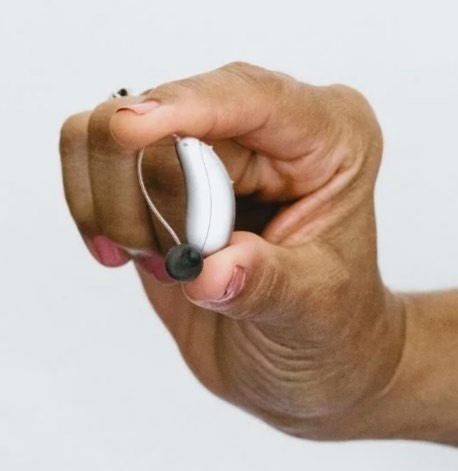
Take a hearing test online, and an audiologist will customize your hearing aids depending on your needs. (Audicus hearing aids don’t require fitting.) Remote setup, programming, and adjustments are available. Or you can adjust settings in the mobile app or via the buttons on the device.
- Cost per pair: $1,398 – $1,798
- Type: CIC, RIC
- Battery type: Rechargeable battery
- Technology: Bluetooth, digital noise reduction, partner mic
- Adjustment: Via the app, tapping on the ear, remote programming support
- Warranty and trial period: 2- or 3-year warranty; 45-day risk-free trial
- Financing: $100 per month
Audicus provides a 45-day trial period. Costs start at $1,398, which is a more affordable option than some competitors, but additional features like rechargeable batteries, care kits, remote controls for adjustments, and three-year warranty plans cost extra (between $36 and $198 each).
Read our full Audicus hearing aids review to learn more.
Jabra Enhance Hearing Aids Review
Trained audiology care team support
|
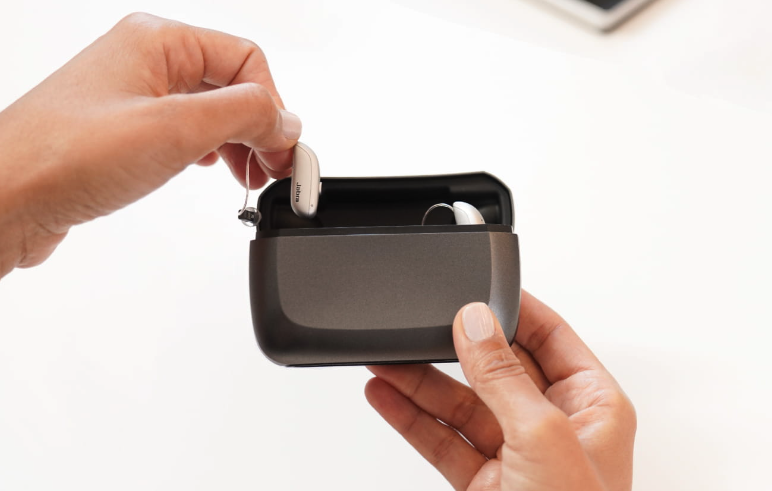
Jabra Enhance offers low-cost behind-the-ear (BTE) hearing aids backed by GN, a global leader in the industry with 150 years of hearing expertise. Each device comes in several colors to match your complexion or hair color, and they are suitable for those with mild to severe hearing loss.
- Cost per pair: $1,195 – $1,995
- Type: RIC, ITE
- Battery type/life: Rechargeable up to 24 hours or battery
- Technology: Bluetooth, noise reduction, ongoing support
- Adjustment: Via the app, tapping on the ear, remote programming support
- Warranty and trial period: 1- or 3-year warranty, including loss and damage protection; 100-day trial
- Financing: As low as $39 per month
Choose a battery-powered (Enhance Select 50) or rechargeable hearing aid (the Enhance Select 300 debuted in December 2023). The rechargeable charging case will power 30 hours of sound per three-hour charge. Jabra Enhance offers a 100-day risk-free trial, the longest in the OTC industry, and a warranty between one and three years, depending on the support package you choose. We consider this to be Jabra’s stand-out feature.
Premium members get full access to Jabra Enhance’s trained audiology care team, who are there to offer comprehensive remote support—not every hearing aid company has an audiology care team on staff for consultations. The aids come with several processing channels and advanced noise-reducing technology. Adjust manually or through the app (the audiology care team will help you).
Learn about our experience taking Jabra Enhance’s online hearing test in our comprehensive Jabra Enhance review.
Lexie Hearing Review
Great Technology
|
Lexie’s self-fitting OTC hearing aids provide cutting-edge technology at low prices. But customers can also choose a unique monthly subscription payment plan that makes accessing hearing aids, parts, and maintenance more affordable. You can buy Lexie devices online and in stores where healthcare devices are sold.
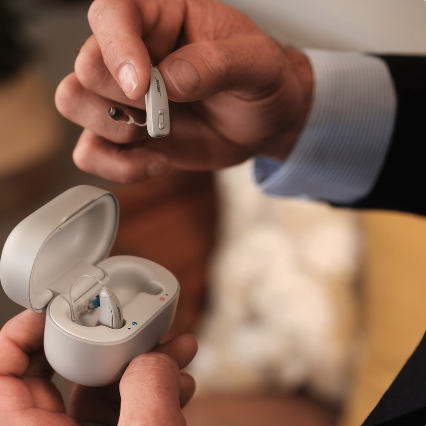
All Lexie hearing aids come with noise and feedback reduction to decrease background sounds and cut down on whistling. The Lexie B2 lets you stream phone calls on iPhones, but not Androids.
- Cost per pair: $799 – $999
- Type: RIC, BTE
- Battery type: Rechargeable battery
- Technology: Bluetooth, telecoil, noise reduction
- Adjustment: Via the app, remote programming support
- Warranty and trial period: 1-year warranty; 45-day free trial
- Financing: As low as $39 per month
Within Lexie Hearing’s mobile app, you can adjust your hearing aids, monitor battery power, and store your preferred settings for easier adjustments. This is a great feature for those comfortable with technology, but if you prefer to adjust your aids manually, we recommend considering Audien. The Lexie Luman is also a good choice for those who prefer a simpler option.
Read our comprehensive Lexie Hearing review and watch our YouTube video to learn more about our experience wearing the devices for two weeks.
MDHearing Review
Great Value Hearing Aid
|
MDHearing’s high-quality, medical-grade hearing aid models come with 24/7 customer service and licensed audiologists on staff who can answer any questions.
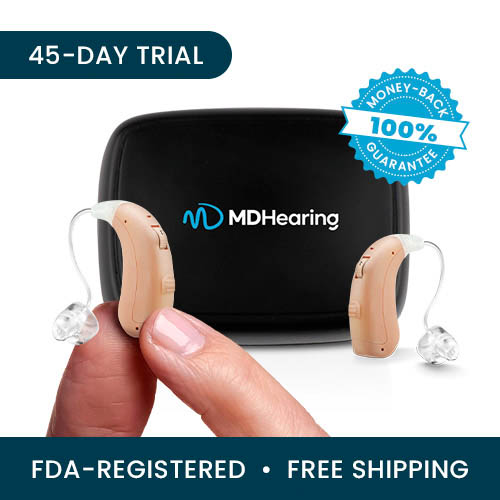
Its most affordable model, the AIR, has advanced noise reduction, rechargeable batteries, feedback cancellation, and telecoil technology. You can get dual-directional microphones (which help filter out unwanted noise), intelligent noise reduction (for greater speech clarity), and Bluetooth capability at a slightly higher price point. Like all OTC options, these devices won’t work for severe hearing loss, but the products are FDA-registered and designed by doctors and audiologists.
- Cost per pair: $297 – $699
- Type: RIC, BTE
- Battery type/life: Rechargeable; Up to 20 hours
- Technology: Environmental settings, directional microphones, noise reduction, water resistance
- Adjustment: Tapping a button, turning a dial, 1:1 programming support (VIP care only)
- Warranty and trial period: 1-year warranty; 45-day free trial
- Financing: As low as $24.75 per month
MDHearing offers four devices ranging from about $800 to $1,900 for two hearing aids when not on sale. The company runs frequent sales, and single-device pricing is also available. It also offers 12-month 0% financing, a 45-day trial period, and a money-back guarantee. MDHearing manufactures the devices in the U.S. and sells directly to consumers to keep costs down.
For details, read our full MDHearing review.
Audien Hearing Review
Great Affordable Option
|
Audien Hearing offers affordable over-the-counter hearing aids and hearing amplifiers. The Audien Atom series (in-the-canal) and the Audien BTE (behind-the-ear) are medical-grade hearing aids registered with the FDA. The EV1 and EV3 are not medical-grade hearing aids but rather PSAPs (personal sound amplification products), otherwise known as hearing amplifiers.
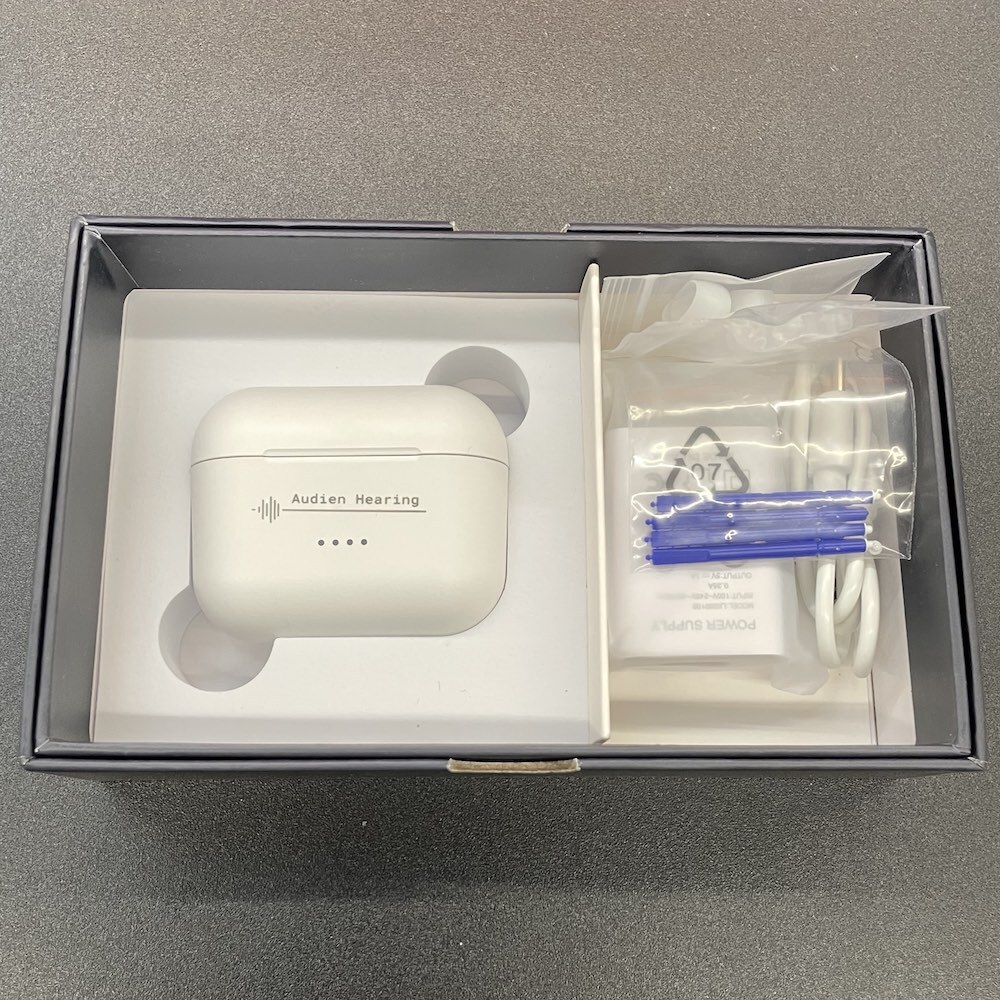
Aside from its affordable pricing structure, Audien devices stand out to us during our test because of how easy they are to set up and program. To program your Audien hearing device, simply charge it, find the correct-sized earbud, and set the device volume to the appropriate level. The rechargeable devices last up to 24 hours.
- Cost per pair: $99 – $489
- Type: ITC
- Battery type/life: Rechargeable; Up to 24 hours
- Technology: Wireless charging, noise/feedback cancellation, directional sound technology
- Adjustment: Tapping on the ear, twisting the dial with a screwdriver (included)
- Warranty and trial period: 45-day trial period; No warranty
- Financing: None
While Audien’s devices are inexpensive, the company does not offer a warranty for its products. Instead, you have a 45-day trial period to decide if their hearing devices are right for you. Once you buy a hearing aid or amplifier, it is shipped directly to your door within three to five business days.
Learn more about our experience testing an Audien hearing device in our full Audien Hearing review.
Embrace Hearing Review
Great Service and Value
|
Embrace Hearing offers fully customized hearing aids in three models. Each model offers a range of features so that you can choose the one that best fits both your needs and budget. They also offer 24/7 online help with great customer service.
- Cost per pair: $899 – $1,399
- Type: CIC, RIC
- Battery type: Size 10 battery
- Technology: Live speech focus, Bluetooth
- Adjustment: Smartphone app or handheld remote
- Warranty and trial period: 3-year warranty; 45-day trial
- Financing: As low as $63 a month
With an in-depth customization experience, Embrace Hearing provides a range of enhanced features at value prices. They also offer financing for 24 or 36 months, or through CareCredit for 12 or 24 months.
To learn more or start your 45-day trial, read our full Embrace Hearing review.
Sony Review
Great for Customizations
|
Sony offers two OTC hearing aids, both in discreet designs that offer precise sound clarity. Additionally, their app allows you to customize your hearing experience. Once installed, you’ll take its 10-minute hearing test, and then it will program the hearing aids based on the results.
- Cost per pair: $999 – $1299.99
- Type: ITE, ITC
- Battery type/life: Rechargeable up to 26 hours or size 10 battery
- Technology: Bluetooth, noise reduction, focused microphones
- Adjustment: In-app
- Warranty and trial period: 1-year warranty
- Financing: As low as $84.99 a month
With only two options, you can focus on which key features are important to you and your budget. Two of the biggest distinctions in the Sony hearing aids are whether you prefer a replaceable or rechargeable battery and if you want Bluetooth-enabled audio streaming.
HP Hearing Pro Review
Great Trial Period
|
HP’s HearingPro aid delivers best-in-class sound fidelity, providing an in-depth, immersive hearing experience. Additionally, their EAR ID automatically adapts to your personal hearing preferences, providing a smooth, precise adjustment experience. Currently, HP only offers one model of hearing aid, but its comprehensive features for a relatively low cost make it a standout.
- Cost per pair: $499
- Type: ITE
- Battery type: Rechargeable
- Technology: Ear ID, Active Noise Cancellation, Bluetooth,
- Adjustment: In-app
- Warranty and trial period: 2-year warranty, 60-day risk-free trial
- Financing: None
HP’s HearingPro offers high-tech features at an affordable price, with a focus on ensuring conversations are heard clearly. According to their customer service line, HP does not offer financing for the HearingPro, but the product is sold through Best Buy, which may offer financing.
Additional Hearing Aid Companies
Costco carries several hearing aid brands in select warehouse locations, often at lower prices due to its bulk purchasing model. Learn more in our Costco hearing aids review.
Yes Hearing sells prescription hearing aids from major brands like Oticon, Phonak, and ReSound at prices that are often lower than traditional retailers. The company provides in-home delivery and fitting support through licensed hearing specialists. Read our Yes Hearing review to learn more.
Our Research Methodology
Our review team personally tested hearing aids to create the most well-rounded review of hearing aid brands. A Retirement Living review team member, who has been diagnosed with mild hearing loss and is a long-time wearer of hearing aids, wore hearing aids from several brands for two weeks each. With 105 hours (and counting) of research logged, we considered the effectiveness of each device in combating hearing loss.
We also consulted with four audiologists to determine the most important factors for consumers to consider when buying OTC hearing aids. Based on their professional feedback, we evaluated each brand for fit, price, return policies, technology, and support available.
Lastly, we scored the following 11 data points to give you a well-rounded review of each provider:
- Status with the FDA, company experience, and other credentials
- Ease of use
- Features and technology, such as Bluetooth connectivity and rechargeable batteries
- Costs, both upfront and ongoing
- The range of hearing loss that the devices support
- Return policies, trial periods, and warranty options
- Customer service and device support availability
- Types of hearing aids available
- Online buying experience for OTC devices
- Quality of the online hearing tests available
- Look and design of the device
Because buying OTC hearing aids is often an online endeavor with less professional support, Retirement Living also evaluated the quality of the online hearing tests available from top OTC hearing aid brands. The results of our analysis can be found in the Our Experience Taking Online Hearing Tests section.
Our methodology uncovered the best OTC hearing aid providers that we would recommend to a friend or family member. Companies that obscured their prices, lacked customer support, and/or had limited options to buy or try hearing aids were eliminated from our list.
Retirement Living writers and editors evaluate hearing aid reviews annually, and we frequently contact brands and retailers to update information on changes to their devices, costs, features, and support services.
OTC Hearing Aids vs. Prescription Hearing Aids
Nearly 38.2 million Americans have hearing loss in both ears, but only about 29.2% of adults aged 71 years and older use hearing aids. A major obstacle for many is cost and accessibility; however, recent FDA policies have helped address these.
The Over-the-Counter Hearing Aid Act of 2017 made it possible for adults to buy OTC hearing aids without visiting a doctor. In August 2022, the FDA officially created a new category of over-the-counter hearing aids, allowing certain devices to be sold directly to consumers online and in stores, with no prescription, medical exam, or in-person fitting required. These OTC hearing aids are intended for adults 18 and older with perceived mild to moderate hearing loss.
Both OTC and prescription hearing aids are regulated by the FDA as medical devices. The main difference is how they’re purchased and fitted. You can buy OTC hearing aids directly from manufacturers or retailers, while prescription hearing aids require a hearing test and must be fitted and dispensed by a licensed hearing professional.
Prescription hearing aids generally cost more because they include professional services such as custom fittings, programming, and follow-up care. OTC hearing aids are typically more affordable, though the level of customer support varies by brand. Some companies, like Eargo and Jabra Enhance, offer remote support from hearing professionals, while others, such as Yes Hearing, provide in-home delivery and personalized aftercare with every purchase.
Self-Fitting or Preset Over-The-Counter Hearing Aids
Over-the-counter hearing aids fall into two categories: self-fitting and preset. Knowing the difference helps you choose what matches your hearing needs and comfort with technology.
Self-Fitting OTC Hearing Aids
This type allows you to customize the sound to your specific hearing profile. These devices typically connect to a smartphone app and guide you through a hearing check or sound calibration process. You can adjust volume, fine-tune frequencies, switch listening programs, and personalize settings based on your environment. This option works well for adults who want more control and are comfortable using apps.
Preset OTC Hearing Aids
These devices come with pre-programmed sound profiles designed for mild to moderate hearing loss. Instead of completing a hearing test in an app, you select a listening mode or volume level enhancement for your hearing. Preset models are generally easier to set up and may appeal to users who prefer fewer adjustments and less technology.
The best choice depends on how much customization you want. If you prefer a more tailored listening experience, self-fitting devices offer flexibility. If you want something simple and ready to use out of the box, a preset model may be enough.
What to Consider Before Buying OTC Hearing Aids
When looking for a hearing aid, it’s important to choose a product that treats your type/level of hearing loss, budget, and lifestyle.
From The Expert
“Devices that minimize the need for adjustments or maintenance will likely serve older patients who are less tech-savvy. Research shows the most common adjustment used is volume change. The best hearing aids are really dependent on the patient’s lifestyle and needs. That’s why there are so many options, because each patient is different—a one-size-fits-all approach doesn’t apply to hearing aids.”

Ruth Reisman, AuD, MBA, CCC-A
Audiologist
1. Battery Type
Hearing aids offer either replaceable or rechargeable batteries. While maneuvering small batteries to change them can be a hassle, you may prefer this option if you don’t want to remember to charge your hearing aids.
2. Type of Hearing Loss
OTC hearing aids are best for those with mild to moderate hearing loss. If you have more severe hearing loss, we recommend browsing our list of prescription hearing aids, which include brands like Signia, Starkey, and Widex.
If your hearing loss is mild to moderate, there will be a wider array of OTC options available to you. In this case, it can be helpful to focus on specific features for the type of hearing loss you have. For example, if you struggle to hear certain tones in background noise, then you may consider an aid that offers noise reduction or cancellation features.
For more profound hearing loss, audiologist Ruth Reisman suggests looking for devices that specifically state they are for those with moderate to severe hearing loss—usually prescription devices. Implantable bone-conduction devices or cochlear implants may also work, depending on the type of hearing loss.
3. Technology and Features
As you research hearing aid technology, you’ll notice the devices are much smaller now compared to decades past. The OTC Atom Pro 2.0 we tested was the size of a dime and barely noticeable in our ears. Even some behind-the-ear models are discreet enough, such as ELEHEAR.
In addition, rechargeable hearing aids are common and eliminate the need to change batteries, making them a good choice if you don’t see well or have trouble handling small parts.
- Artificial Intelligence (AI) trains hearing aids to distinguish between sounds, amplifying or de-emphasizing them. The technology is able to differentiate through cluttered noise in most environments.
- Feedback suppression, telecoils, and preprogrammed settings are ideal for hearing better in crowded or large spaces and for adjusting as needed.
- To stream sounds, OTC hearing aids use Bluetooth wireless technology to connectto smartphones, tablets, and other devices.
- Directional microphones are used to filter background noise. They can change settings based on your surroundings.
4. Warranty Length and Coverage
If a hearing aid company doesn’t offer a warranty, it may be a red flag. Look for warranties of at least one year. If you lead a more active or adventurous lifestyle, it is often worth checking whether an extended warranty can be purchased.
In addition to the warranty length, check what it covers. Typically, OTC hearing aid warranties cover manufacturer defects, but some also include loss, damage, or wear and tear in their standard warranties. Jabra Enhance is a good example, with a three-year manufacturer’s warranty and three years of coverage for loss and damage.
Other brands, like MDHearing and Lexie, offer shorter warranties with the option to purchase additional coverage.
5. Trial Periods and Return Policies
Because OTC hearing aids are often bought without professional guidance, it’s important to prioritize brands that offer some kind of risk-free period so you don’t get stuck with a device that is uncomfortable or does not help your hearing.
From The Expert
“Allow between two and four weeks to allow your body to adjust to the sound quality and determine whether the hearing aids are comfortable. Select patients may need more time and should consider devices with longer trial periods.”
Ruth Reisman, AuD, MBA, CCC-A
Audiologist
All the brands featured on our list allow you to return your devices, but the return window ranges from one to two months. MDHearing, Lexie, and several others offer a 45-day trial window, while Jabra offers a 100-day trial period, the longest of all brands featured on this list.
Read any fine print, such as if the aid needs to be returned in original packaging, and be mindful that many companies will still charge you for shipping on your return.
Pros and Cons of OTC Hearing Aids
Pros:
- Most are regulated by the FDA
- More affordable than prescription hearing aids
- No hearing exam or prescription required for purchase
- Can be purchased directly by the consumer at nationwide retailers
- Most are easy to program and use
Cons:
- Not suitable for severe or profound hearing loss
- Limited customization and technology features
- Limited in-person care and support
- Doesn’t identify loss requiring medical or surgical attention
How Much Do OTC Hearing Aids Cost?
Based on our conversations with manufacturers and providers, prices for a pair of OTC hearing aids in 2024 range from about $100 to $3,000. The average cost of OTC hearing aids is about $1,700. Experts expect the FDA’s August 2022 ruling to lower the cost of OTC hearing aids even further as companies compete to increase access to affordable devices.
OTC hearing aid prices are lower because they lack fewer advanced features than prescription models. This doesn’t necessarily mean you’re getting a less effective aid, but rather less one-on-one support and custom programming for your specific type of hearing loss.
Many of the OTC brands we feature on this list offer remote support for adjusting, programming, and repairing hearing aids.
Where to Buy OTC Hearing Aids
You can buy OTC hearing aids online directly from the companies that sell them. Manufacturers with FDA-registered devices can also partner with nationwide retailers to sell over-the-counter hearing aids, like Best Buy, Walmart, Costco, CVS, and Walgreens.
- Best Buy sells OTC hearing aids and amplifiers from several top brands, such as Sony, Lexie Hearing, Jabra, and Eargo. Prices range from $14.99 (for amplifiers) to $2,599 for more advanced types of hearing aids.
- Walmart has several retail locations that sell hearing aids. Its website offers many hearing aids from brands like Lexie and Audien. Lexie’s top-rated B2 self-fitting BTE hearing aid is priced at $999.99.
- Costco operates in-store hearing aid centers nationwide. Schedule a hearing test and shop for hearing aids from the top brand, Jabra. Prices range from $1,499 to $1,599, and remote aftercare is available.
- CVS carries hearing aids and accessories from several brands in-store. Walgreens provides hearing aids and accessories, many of which are FSA-eligible.
The prices listed are as of December 2023 and are likely to change.
FDA Regulation of OTC Hearing Aids
The FDA outlines several OTC hearing aid regulations to ensure their safety for adults with mild to moderate hearing loss. These regulations include:
- Labeling guidelines on the packaging, such as warnings against the use of hearing aids for those younger than 18, when to seek help from a hearing health professional, manufacturer information, whether you bought a new or used device, and what you’ll need to use the aids (e.g., a phone app or remote control)
- How much they magnify sounds
- How far can they be safely inserted into the ear
- FDA registration status
While OTC hearing aids must be registered with the FDA, registration does not mean the FDA has tested the product or deemed it safe. FDA registration only applies to the manufacturer’s facility that makes the devices.
Actual OTC devices that have been tested and approved by the FDA will typically have a 510(k) FDA approval or clearance label.
Frequently Asked Questions About OTC Hearing Aids
Yes, for many adults with mild to moderate hearing loss. OTC hearing aids cost less than prescription devices and offer features like noise reduction and app controls. However, people with severe or complex hearing loss may need professionally fitted devices.
There isn’t a single “best” OTC hearing aid for everyone. The right choice depends on your level of hearing loss, budget, comfort with technology, and preferred features like Bluetooth streaming or app customization. Some models stand out for sound quality, others for affordability or ease of use — so the #1 option is the one that fits your specific hearing needs and lifestyle.
That said, in our testing and scoring system, Eargo, Elehear, and Lexie stood out as the best over-the-counter hearing aids.
Medicare does not cover hearing aids, but Medicaid may be able to help seniors in certain states. Currently, 28 states offer some type of coverage for those over age 21: Alaska, California, Connecticut, Florida, Hawaii, Illinois, Indiana, Iowa, Kansas, Michigan, Minnesota, Missouri, Montana, Nebraska, Nevada, New Hampshire, New Jersey, New Mexico, New York, North Dakota, Ohio, Oregon, Rhode Island, South Dakota, Texas, Vermont, Wisconsin, and Wyoming.
Contact your state agency to find out if you’re eligible. Also, most states’ Department of Health and Human Services offices offer financial assistance programs to help cover the cost of hearing aids.
Yes. FDA-regulated OTC hearing aids are generally eligible expenses under HSA and FSA plans. Check with your plan administrator to confirm coverage details.
Most types of hearing aids are available in OTC versions. This means that whether you prefer a more discreet model, such as an in-the-canal (ITC), or prefer the comfortable fit of a behind-the-ear (BTE), you should be able to find a type that suits you. To learn more about each type of aid, check out our more in-depth article on hearing aid types.
Concluding Thoughts on OTC Hearing Aids
Bottom Line: If you’re experiencing mild to moderate hearing loss, over-the-counter hearing aids give you a more affordable path to better hearing.
OTC devices have expanded access, lowered costs, and made it easier to start addressing hearing loss without waiting for appointments or prescriptions. The right choice depends on your level of hearing difficulty, comfort with technology, and budget. While some people benefit from prescription devices and professional fittings, or even the simplicity of hearing amplifiers, many adults find that today’s best OTC models deliver clear sound, modern features, and meaningful improvement at a fraction of the cost.
Local Hearing Aid Companies Near Me
- Atlanta, GA
- Austin, TX
- Boston, MA
- Charlotte, NC
- Chicago, IL
- Cleveland, OH
- Dallas, TX
- Denver, CO
- Detroit, MI
- Fayetteville, AR
- Fort Worth, TX
- Houston, TX
- Las Vegas, NV
- Los Angeles, CA
- Memphis, TN
- Miami, FL
- Minneapolis, MN
- New York, NY
- Orlando, FL
- Philadelphia, PA
- Phoenix, AZ
- Portland, OR
- Raleigh, NC
- San Diego, CA
- San Francisco, CA
- San Jose, CA
- Seattle, WA
- St. Louis, MO
- Tampa, FL
- Tulsa, OK
- Washington DC